Butterfly Valve vs Ball Valve: A Practical Guide for Industrial Buyers
Content Menu
● Article Angle and SEO Intent
● Butterfly Valve vs Ball Valve: Quick Comparison
>> 4. Cost
>> 5. Throttling and Flow Control
● How to Choose the Right Valve
● Industry Applications and Real-World Selection
● Expert View From Manufacturing
● CTA
● FAQ
>> 1. Which valve seals better, butterfly valve or ball valve?
>> 2. Which valve is better for large pipes?
>> 3. Which valve causes less pressure drop?
>> 4. Can a butterfly valve be used for flow control?
>> 5. Are ball valves suitable for oil and gas service?
Choosing between a butterfly valve and a ball valve is not just a technical decision; it affects pressure loss, sealing performance, footprint, maintenance, and long-term operating cost. In oil and gas, desalination, offshore drilling, and other demanding industries, the right valve can improve reliability and reduce downtime.
Article Angle and SEO Intent
This article is designed for engineers, procurement teams, and OEM buyers who want a clear, field-oriented comparison of butterfly valve vs ball valve. It naturally targets high-intent keywords such as butterfly valve, ball valve, butterfly valve vs ball valve, industrial valve selection, quarter-turn valve, tight shut-off, pressure drop, and oil and gas valve applications.
Butterfly Valve vs Ball Valve: Quick Comparison
This table reflects the most common industrial selection logic used by valve engineers and buyers.
What Is a Butterfly Valve?
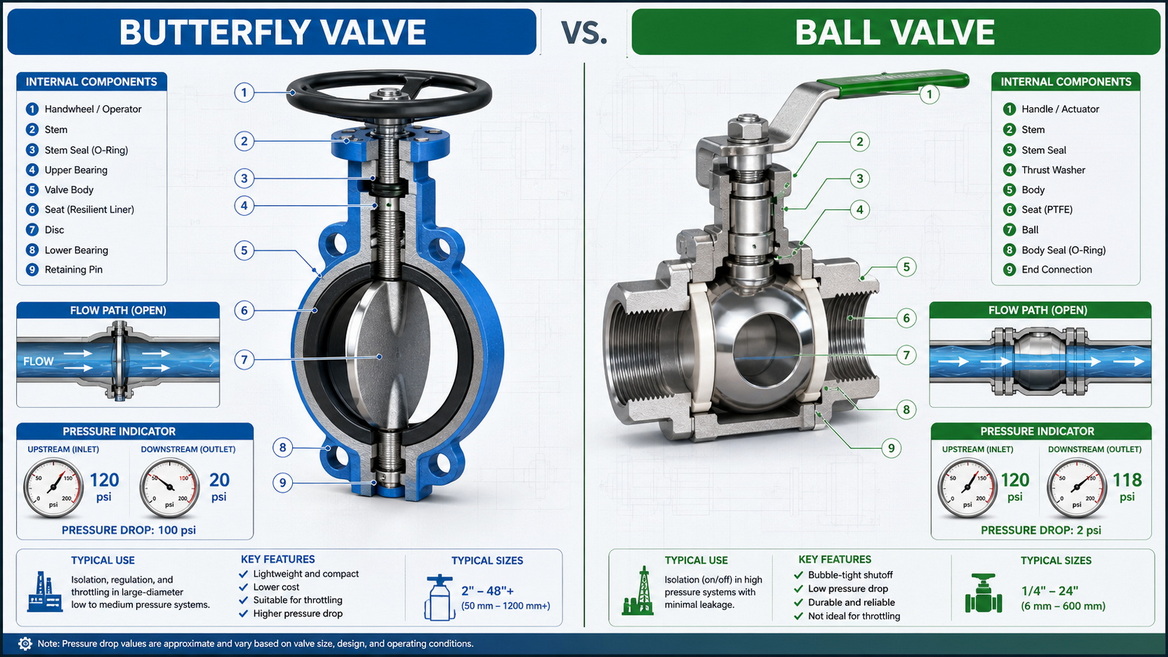
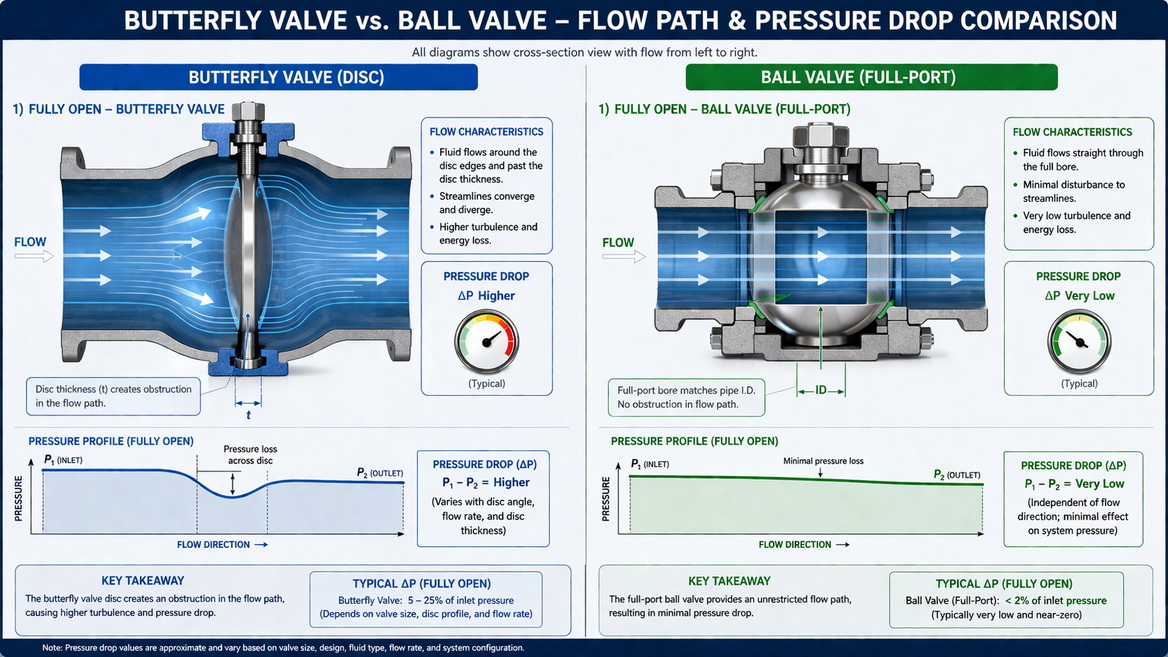
A butterfly valve uses a rotating disc to start, stop, or regulate flow. When the disc turns parallel to the pipe, the valve is open; when it turns perpendicular, the valve is closed. Because the disc stays in the flow even when open, butterfly valves usually create more pressure drop than ball valves.
Butterfly valves are often chosen for large-diameter pipelines, especially when compact installation space and lower initial cost matter. They are widely used in water systems, general industrial services, HVAC, marine utilities, and some process applications.
What Is a Ball Valve?
A ball valve uses a spherical ball with a bore through the center. When the bore aligns with the pipeline, flow passes through; when the ball rotates 90 degrees, flow is blocked. This design gives ball valves fast operation and strong shut-off performance.
Ball valves are especially valued where tight sealing, low leakage, and dependable isolation are critical. In oil and gas facilities, petrochemical systems, fuel gas lines, and offshore applications, ball valves are commonly preferred because they handle pressure well and close reliably.
Key Differences That Matter
The most important difference is not just the shape of the internal closure element. It is how that shape affects real-world performance.
1. Sealing Performance
Ball valves generally provide superior shut-off performance, especially when the process demands very low leakage. In many applications, the upstream pressure helps push the ball against the seat, improving sealing integrity. Butterfly valves can seal well too, but their sealing performance is usually more sensitive to pressure, seat material, and operating conditions.
2. Pressure Drop
A butterfly valve leaves the disc inside the flow path even when fully open, which creates resistance and a measurable pressure drop. A full-port ball valve offers a more unobstructed flow path, so pressure loss is typically lower.
3. Size and Weight
Butterfly valves are usually the better choice for large diameters because they are lighter and more compact. Ball valves become heavier and more costly as size increases, especially in large-bore industrial systems. For many utility lines, that weight difference directly affects installation cost and support structure design.
4. Cost
At larger sizes, butterfly valves often deliver better cost efficiency. Ball valves may cost more upfront, but that cost can be justified when the application needs higher sealing confidence, higher pressure capability, or more dependable isolation.
5. Throttling and Flow Control
Butterfly valves can be used for flow regulation in many non-critical cases, although they are often selected primarily for shut-off service. Standard ball valves are better for on/off isolation, while V-port ball valves can provide improved control in modulating service.
How to Choose the Right Valve
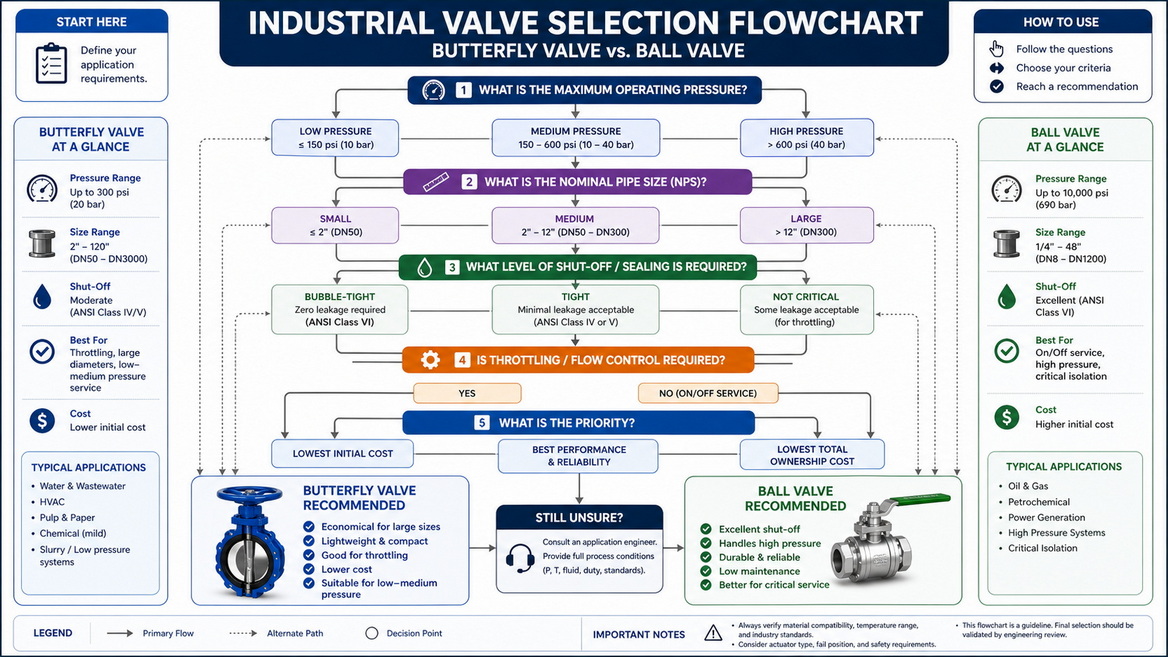
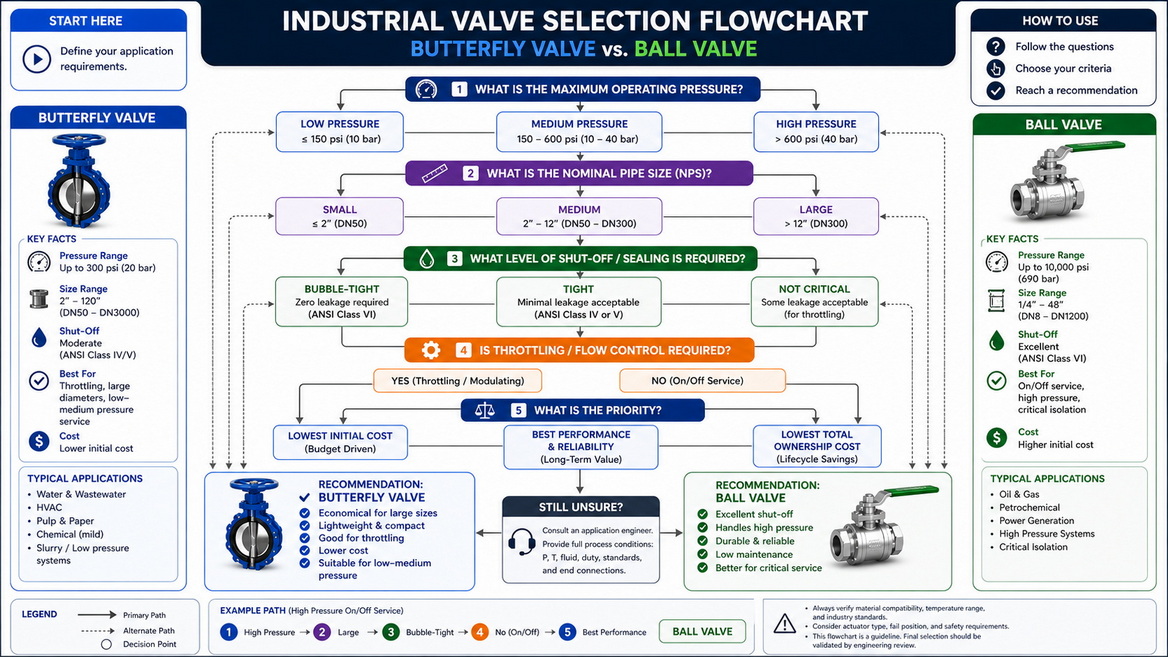
Use the following decision logic when selecting between a butterfly valve and a ball valve.
1. Choose a butterfly valve if the line is large-diameter and the project is budget-sensitive.
2. Choose a butterfly valve if installation space is limited and weight reduction matters.
3. Choose a ball valve if the application requires tight shut-off or critical isolation.
4. Choose a ball valve if the system carries high-pressure gas, oil, or hazardous media.
5. Choose a ball valve if leakage risk is unacceptable and reliability is the top priority.
6. Consider a V-port ball valve if your project needs better throttling performance than a standard ball valve.
Industry Applications and Real-World Selection
In oil and gas, ball valves are widely used for shut-off and isolation because they perform well under pressure and offer strong sealing reliability. That is one reason ball valves are common in upstream, midstream, and downstream systems, including fuel gas and offshore service.
Butterfly valves are often preferred in larger utility lines, cooling water systems, ship systems, and other services where compact size and low cost are more important than extreme sealing performance. In seawater desalination and marine infrastructure, their lighter weight and smaller installation envelope can be practical advantages.
Expert View From Manufacturing
From a valve manufacturing perspective, selection should never be based on size alone. Material grade, seat design, pressure class, fire safety requirement, corrosion resistance, and actuator compatibility all affect performance in service. A well-designed ball valve with proper material control, anti-static structure, and fire-safe design can be the right choice for demanding energy-sector projects.
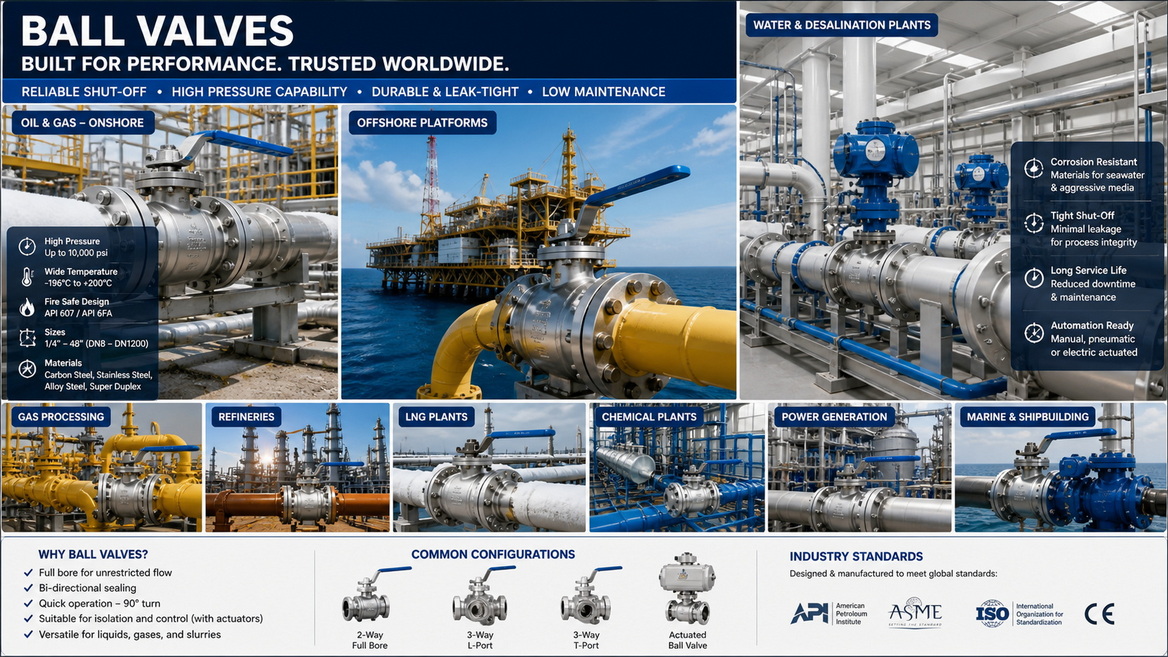
At Wenzhou Leader Flow Control Equipment Co., Ltd., the focus is on designing and manufacturing high-quality ball valves for OEM and ODM customers, especially for oil and gas, offshore drilling, and seawater-related applications. That background matters because industrial buyers often need more than a catalog choice; they need a custom-engineered solution that matches process conditions.
Latest Selection Insight
One trend in industrial procurement is that buyers now evaluate total cost of ownership rather than purchase price alone. That means seal life, maintenance interval, pressure stability, and failure risk are often more important than the initial valve price. In practice, a lower-cost butterfly valve can be the smarter choice for utility service, while a higher-spec ball valve may reduce lifecycle risk in critical isolation duty.
Another important trend is the growing emphasis on safety standards such as fire-safe performance in oil and gas service. This is particularly relevant for ball valves used in hydrocarbon systems where fire exposure and leakage control are major concerns.
Maintenance and Lifecycle
Butterfly valves usually have a simpler structure and can be easier to install in compact systems. However, their disc and seat are constantly exposed to the flowing media, which can increase wear in harsh conditions. Ball valves are often more robust in isolation service, though large or high-spec models may require more careful procurement and cost planning.
For long service life, buyers should match valve type to process duty, media, temperature, and pressure. No valve type is universally better; the correct choice depends on operating reality.
Final Recommendation
If your project prioritizes large diameter, compact installation, and lower cost, a butterfly valve is often the practical choice. If your project prioritizes tight shut-off, lower leakage risk, and high-pressure reliability, a ball valve is usually the better answer.
For OEM and ODM buyers in oil and gas, offshore drilling, and seawater applications, the safest strategy is to select the valve based on pressure class, sealing requirement, and media behavior—not just on price or nominal size.
CTA
Need a custom valve solution for your project? Contact Wenzhou Leader Flow Control Equipment Co., Ltd. for OEM and ODM support on floating ball valves and trunnion ball valves, with engineering guidance for demanding industrial applications.
FAQ
1. Which valve seals better, butterfly valve or ball valve?
A ball valve usually provides tighter shut-off and lower leakage risk than a butterfly valve, especially in high-pressure service.
2. Which valve is better for large pipes?
Butterfly valves are generally better for large pipe diameters because they are lighter, more compact, and often more economical at scale.
3. Which valve causes less pressure drop?
A full-port ball valve usually causes less pressure drop because the bore aligns with the pipe when fully open.
4. Can a butterfly valve be used for flow control?
Yes, butterfly valves can be used for flow regulation in many applications, although they are more commonly selected for shut-off service.
5. Are ball valves suitable for oil and gas service?
Yes, ball valves are widely used in oil and gas because they provide strong sealing, fast operation, and reliable isolation in demanding environments.
References
- Tameson. "Ball Valve Applications." https://tameson.com/pages/ball-valve-application
- Wenzhou Leader Flow Control Equipment Co., Ltd. Official website. https://www.wzldballvalve.com
- Gemini Valve. "Ball Valves vs. Butterfly Valves." https://www.geminivalve.com/ball-vs-butterfly-valve/
- Dombor. "Floating Ball Valve vs Trunnion Ball Valve." https://www.dombor.com/floating-ball-valve-vs-trunnion-ball-valve/
- Google Search Central. "SEO Starter Guide." https://developers.google.com/search/docs/fundamentals/seo-starter-guide?hl=zh-cn
- OneRo Valve. "API 607 Fire Safety Standards." https://www.onerovalve.com/blog/comparison/api-607-vs-api-6fa/
Hot Tags: ball valve, Manufacturers, Customized, Custom, Suppliers, Buy, Cheap, Quality, Advanced, Durable, in Stock, Free Sample, Made in China, Price, Quotation