Ball Valve Connection Types: How To Choose The Right Ends for Floating And Trunnion Ball Valves in Oil And Gas
Content Menu
● What This Guide Covers (Expert Perspective)
● Ball Valve Connection Types: The Essentials
● Threaded Ball Valve Connections (NPT, BSP)
● Welded Connections: Socket Weld and Butt Weld
>> Socket weld ball valve connections
>> Butt weld ball valve connections
● Flanged Ball Valve Connections (RF, RTJ, etc.)
● Union, Compression, and Clamp Connections
>> Union / true union ball valves
● Floating vs Trunnion Ball Valves: Connection Implications
● How to Choose the Right Ball Valve Connection Type (Step‑by‑Step)
● Industry Case Insight: Oil & Gas and Desalination Projects
● OEM / ODM Perspective: What Buyers Often Overlook
● User Feedback Trends: What End Users Care About Most
● Practical Checklist Before Finalizing Your Spec
● Call to Action: Work With a Specialist Manufacturer
● Frequently Asked Questions (FAQ)
>> 1. Which ball valve connection type is best for high‑pressure gas pipelines?
>> 2. When should I use threaded ball valve connections?
>> 3. Are flanged ball valve connections always better than welded?
>> 4. How does floating vs trunnion design affect the choice of connection type?
>> 5. Can I mix different flange standards in one plant?
Ball valve connection types determine how reliably your system seals, how fast you can install or service a line, and ultimately how safe and profitable your operation is. As a ball valve manufacturer serving oil and gas, desalination, and offshore platforms, I see connection choices misunderstood more often than pressure class or materials.
What This Guide Covers (Expert Perspective)
In this guide, I will walk through the main ball valve connection types, where each works best, and how to choose between them for demanding applications like upstream and midstream pipelines, offshore skids, and desalination plants. I will also explain how connection choice interacts with floating and trunnion ball valve designs, and share practical selection tips from real OEM and EPC projects. The goal is to go significantly deeper than generic buyer guides and give you a framework you can apply on your next project.
For context, our factory (Wenzhou Leader Flow Control Equipment Co., Ltd.) designs and manufactures floating ball valves and trunnion-mounted ball valves for OEM and ODM customers worldwide, mainly to API, ASME, and ISO standards for severe-service industries. That experience shapes the recommendations and trade‑offs discussed below.
Core Keyword Focus
Primary keyword target: ball valve connection types
Supporting long‑tail targets: floating ball valve connection options, trunnion ball valve end connections, flanged vs welded ball valve ends, threaded ball valves for low‑pressure systems
Ball Valve Connection Types: The Essentials
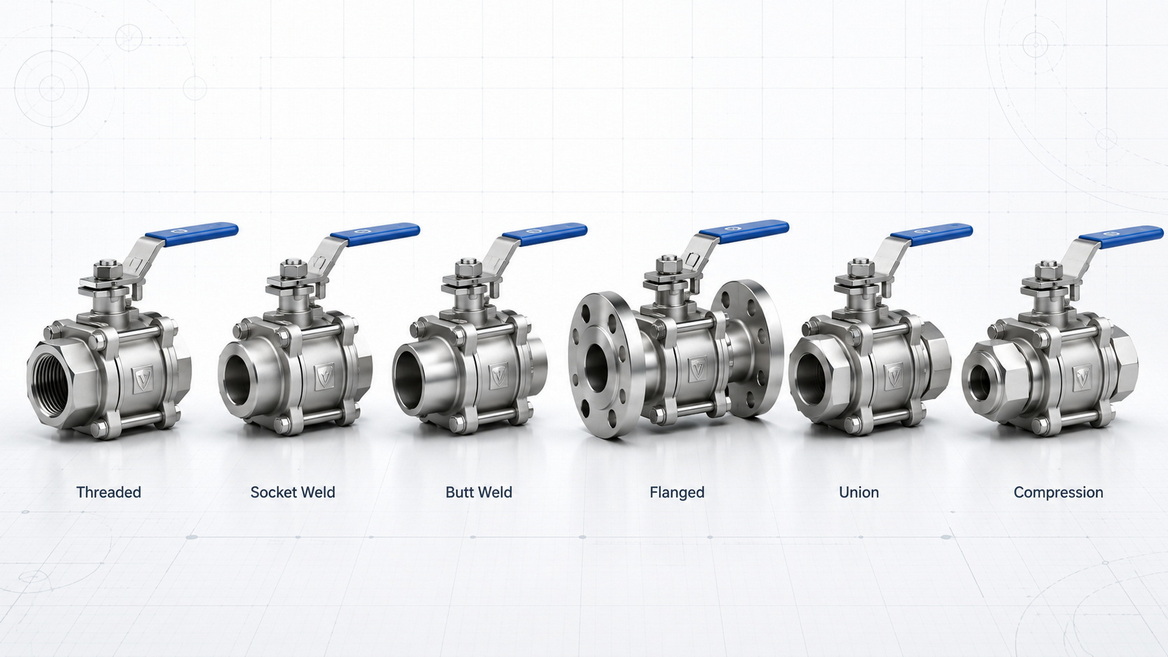
Ball valve "connection type" refers to how the valve body physically joins to the piping—threaded, welded, flanged, union, clamp, or compression. The connection impacts leak risk, installation time, maintenance method, and compliance with regional standards.
At a minimum, engineers and buyers should evaluate:
- Operating pressure and temperature range
- Medium type (gas, crude, produced water, seawater, chemicals)
- Accessibility for maintenance or future tie‑ins
- Regional and corporate standards (ASME, API, DIN, ISO, client specs)
- Required level of fire safety and fugitive emission control
If you treat connection type as a late‑stage detail, you often end up redesigning spool pieces, supports, or even the valve specification itself.
Threaded Ball Valve Connections (NPT, BSP)
Threaded ball valve connection types (usually NPT or BSP) remain popular in small‑bore, low‑to‑medium pressure systems because they are compact and inexpensive. They are widely used on utility lines, low‑pressure gas, and general industrial service.
Key characteristics:
- Advantages: Lower initial cost, no welding required, easy to install on small diameters, suitable for many utility and auxiliary lines.
- Limitations: Thread sealants can degrade, more leak paths, not ideal for cyclic high‑pressure gas or severe vibration.
- Typical standards: NPT (ASME B1.20.1) and BSP (ISO 7/1) threads, often combined with floating ball valve designs in brass or stainless steel.
From an expert standpoint, I only recommend threaded ends in critical oil and gas service when pressures are modest and vibration is fully controlled by supports and layout.
Welded Connections: Socket Weld and Butt Weld
Socket weld ball valve connections
Socket weld ball valve connection types use a recess (socket) where the pipe inserts and is fillet‑welded around the circumference. This design is common for small‑bore high‑pressure applications where leak tightness is more important than ease of future removal.
- Advantages: High structural integrity, good for small high‑pressure lines and where alignment is critical.
- Limitations: Difficult to inspect and clean, not hygienic, removal requires cutting and re‑welding.
Butt weld ball valve connections
Butt weld connections align the pipe and valve ends with matching bevels, then weld them together for a full‑penetration joint. Butt weld ball valves are standard on pipelines, wellhead flowlines, and many high‑pressure production headers.
- Advantages: Highest integrity, minimal turbulence, excellent for high‑pressure, high‑temperature, or buried services, especially with trunnion ball valves.
- Limitations: Permanent, requires qualified welding procedures and NDT, more planning for maintenance and replacement.
In critical pipeline projects, our trunnion ball valves are specified almost exclusively with butt weld ends for long‑term reliability and lower fugitive emissions.
Flanged Ball Valve Connections (RF, RTJ, etc.)
Flanged ball valve connection types remain the workhorse in refineries, petrochemical plants, and desalination facilities because they balance sealing performance with maintainability. Flanges also make it easier to align heavy trunnion ball valves with pipe spools in the field.
Common flange faces and standards:
- Raised face (RF) flanges for general service in ASME B16.5 and EN 1092‑1.
- Ring type joint (RTJ) flanges for high‑pressure, high‑temperature, and critical hydrocarbon service.
- Flat face and special sanitary patterns for certain water and hygienic lines.
When a customer wants both strong sealing and easy future replacement, flanged RF or RTJ ends on floating or trunnion ball valves are often the most pragmatic choice.
Union, Compression, and Clamp Connections
Union / true union ball valves
Union and true union ball valves allow you to unscrew end caps while the valve body stays in place. These are common in PVC/CPVC and some stainless applications in water treatment, industrial utilities, and non‑hazardous chemicals.
- Advantages: Very easy maintenance and replacement, minimal tools needed.
- Limitations: Typically limited to low or medium pressures and non‑critical services.
Compression and clamp ends
Compression ball valve connections are used in small‑diameter tubing systems, such as instrument air, sampling lines, and analyzer shelters. Clamp or sanitary connections are used where fast cleaning and minimal dead space are more important than maximum pressure.
In our OEM projects, we mainly see these in skids where process ball valves (flanged or welded) feed into instrument manifolds and hygienic or sampling circuits downstream.
Floating vs Trunnion Ball Valves: Connection Implications
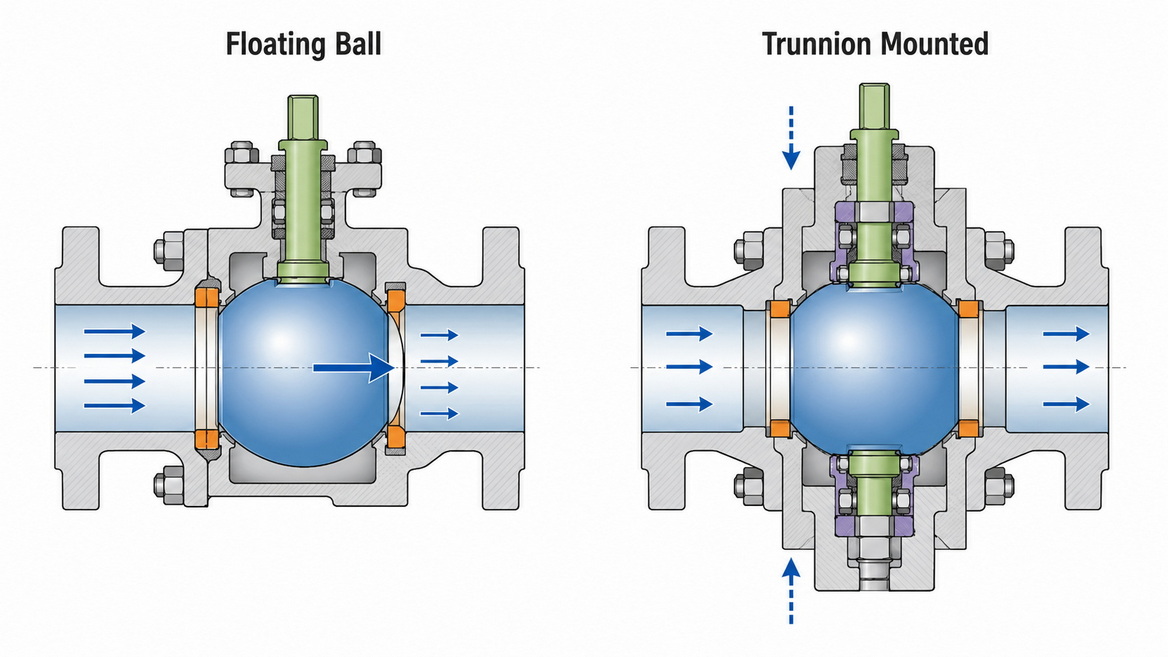
Floating ball valves use line pressure to push the ball against the downstream seat, making them efficient and relatively simple for low‑to‑medium pressure applications. Trunnion ball valves support the ball with upper and lower trunnions, which stabilizes it under high differential pressures and reduces operating torque.
Connection choices by design:
- Floating ball valves
- Common with threaded and flanged ends in smaller sizes.
- Often used up to medium pressures (e. g., Class 300) in utilities and light process service.
- Trunnion ball valves
- Frequently supplied with butt weld and flanged ends in medium to large sizes.
- Preferred in high‑pressure gas pipelines, crude oil lines, and offshore riser manifolds.
In high‑pressure gas with high cycling, I generally steer customers toward trunnion ball valves with butt weld or RTJ flanged connections, even if this increases upfront fabrication cost. The long‑term reduction in leakage and maintenance usually offsets the higher CAPEX.
How to Choose the Right Ball Valve Connection Type (Step‑by‑Step)
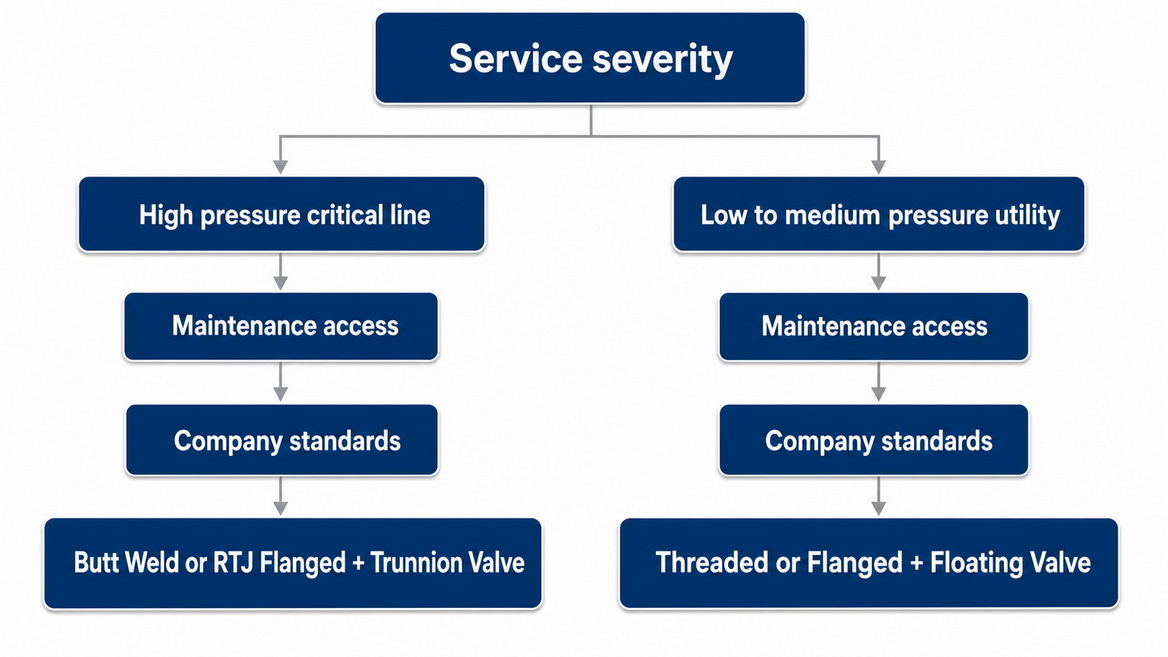
From a project engineer's or maintenance manager's perspective, selection can be simplified to a short workflow:
1. Define service severity
- High pressure, sour service, high temperature, or safety‑critical? Favor butt weld or RTJ flanged connections with trunnion valves.
2. Assess maintenance strategy
- If lines must be opened regularly or spools frequently replaced, flanged ends usually win over welded ends.
3. Check company and regional standards
- Many operators mandate weld ends on buried pipelines and RTJ flanges for hydrocarbon service above specific pressure classes.
4. Review line size and layout
- Small‑bore, non‑critical utility: threaded or socket weld can be acceptable.
- Large bore or high vibration: choose flanged or butt weld.
5. Confirm compatibility with installed base
- Matching existing flange drilling (ASME vs DIN) and end types reduces inventory complexity and simplifies spares.
6. Verify lifecycle cost
- A slightly higher‑priced welded or flanged trunnion valve can cost much less over 20 years than a cheaper threaded solution that leaks or fails early.
This pragmatic procedure has helped many of our OEM and EPC clients avoid late‑stage redesigns and unexpected site rework.
Industry Case Insight: Oil & Gas and Desalination Projects
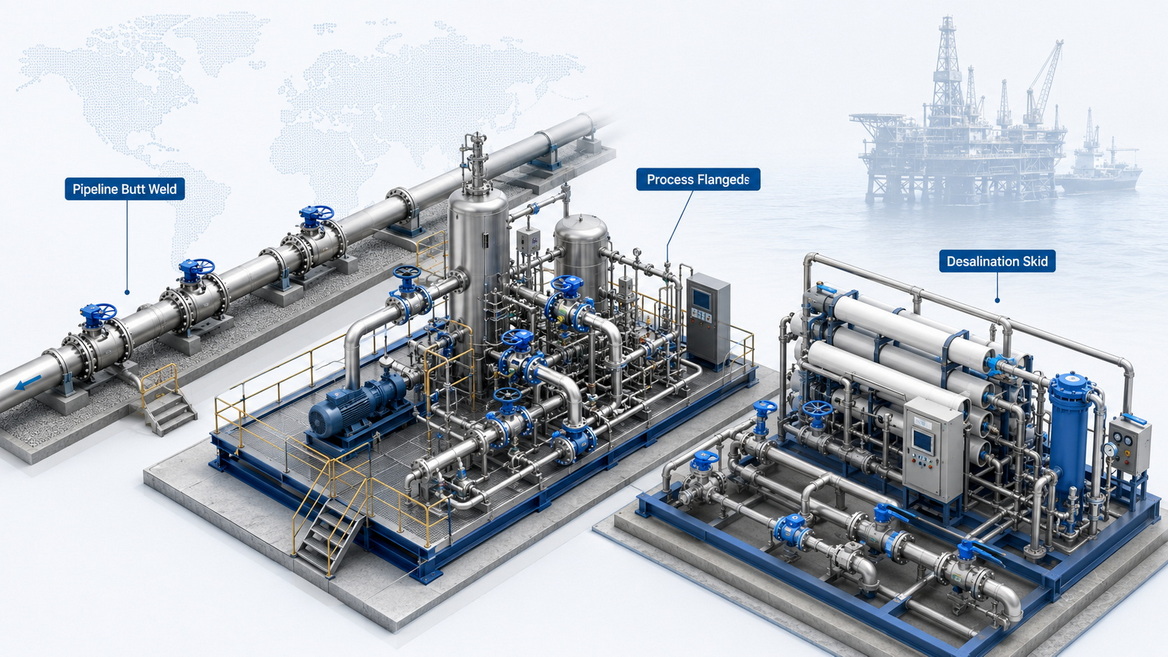
In one offshore gas project, the operator initially specified flanged floating ball valves for certain high‑pressure riser lines to reduce cost. After early torque and seat wear issues during FAT and commissioning, the spec was revised to trunnion ball valves with RTJ flanges to handle the sustained high differential pressure and cycling.
On a large Middle East desalination plant, welded trunnion ball valves were used on main seawater intake and high‑pressure brine lines, while flanged floating ball valves with epoxy‑coated carbon steel were selected for lower‑pressure distribution headers. That combination balanced corrosion resistance, cost, and maintainability across thousands of valves.
These are typical patterns we see: trunnion, butt weld/RTJ where failure is unacceptable; floating, flanged/threaded for ancillary and lower‑risk services.
OEM / ODM Perspective: What Buyers Often Overlook
As an OEM/ODM ball valve manufacturer, we frequently see RFQs that specify pressure class and material in detail but leave "end connection: TBD" or mix incompatible standards (for example, ASME B16.5 flanges with DIN piping). This usually leads to delays, engineering clarifications, and sometimes costly rework.
Common oversights:
- Not aligning valve end types with welding procedures qualified by the contractor
- Ignoring coating and PWHT impacts when choosing welded vs flanged connections
- Underestimating torque and actuation implications for high‑pressure trunnion valves
- Forgetting to coordinate NDE requirements (RT, UT, MPI) for welded ends
Bringing the valve supplier in early, with access to P&IDs and line class data, allows us to recommend optimal combinations of floating or trunnion design, connection type, and actuation method for each service.
User Feedback Trends: What End Users Care About Most
From the feedback we receive from international customers and maintenance teams, three themes keep coming up:
- Leak tightness over time: Users prefer welded or RTJ flanged ends for high‑pressure gas after experiencing leaks at threaded joints.
- Ease of shutdown and replacement: In multi‑product terminals and refineries, maintenance personnel often push for flanged ends where access allows.
- Standardization and inventory: Buyers want to reduce the variety of end connections in their plants to simplify spares and training.
For many, the ideal is a standardized set of flanged and welded trunnion ball valves for critical lines, with floating, threaded, and union valves used sparingly in non‑critical services.
Practical Checklist Before Finalizing Your Spec
Before releasing your valve data sheets or purchase orders, run through this quick checklist:
- Have you matched connection type (threaded, flanged, welded) to service severity and maintenance philosophy?
- Are flange standards, facing types, and pressure classes consistent with local piping specs?
- For welded ends, are welding procedures and NDE requirements clearly defined?
- Have you confirmed that the actuation package (manual, gear, electric, pneumatic) is sized for the chosen design (floating vs trunnion) and connection type?
- Do the selected ball valve connection types support your plant standardization and spares strategy?
Completing this checklist with your valve vendor or OEM partner reduces change orders and accelerates commissioning.
Call to Action: Work With a Specialist Manufacturer
If you are planning a new oil & gas, desalination, or offshore project—or updating line class standards—it is worth partnering with a ball valve specialist who understands how connection types, design (floating vs trunnion), and materials interact in the real world.
As a manufacturer of floating ball valves and trunnion-mounted ball valves for demanding global applications, we can support you with:
- Application‑specific advice on ball valve connection types for each line class
- OEM/ODM customization to your specifications and branding
- Comprehensive testing (hydrostatic, seat leakage, fire‑safe, fugitive emissions) aligned to your standards
You can share your project data sheets or P&IDs, and we will propose optimized valve and connection selections that balance performance, safety, and total lifecycle cost.
Frequently Asked Questions (FAQ)
1. Which ball valve connection type is best for high‑pressure gas pipelines?
For high‑pressure gas pipelines, butt weld or RTJ flanged connections combined with trunnion-mounted ball valves are generally preferred due to their superior structural integrity and sealing performance.
2. When should I use threaded ball valve connections?
Threaded ball valve connections are suitable for small‑bore, low‑to‑medium pressure services such as utilities, non‑critical gas, and general industrial fluids, provided vibration and thermal cycling are controlled.
3. Are flanged ball valve connections always better than welded?
Flanged connections are better for maintainability and ease of replacement, while welded connections are better for maximum leak tightness and are typically chosen for buried or very high‑pressure lines. The "better" option depends on your service and maintenance strategy.
4. How does floating vs trunnion design affect the choice of connection type?
Floating ball valves are common with threaded and flanged ends in smaller sizes and moderate pressures, whereas trunnion ball valves are more often paired with butt weld or RTJ flanged ends in high‑pressure and large‑bore services.
5. Can I mix different flange standards in one plant?
Mixing ASME and DIN/EN flange standards in the same plant usually complicates spares, gaskets, and installation; most operators standardize on one system per facility or region to simplify engineering and inventory management.
References
1. Tameson. "Ball Valve Connection Types." [https://tameson.com/pages/ball-valve-connection-types](https://tameson.com/pages/ball-valve-connection-types)
2. Assured Automation. "Types of Valve End Connections." [https://assuredautomation.com/actuated-valve-training/types-of-valve-end-connections.php](https://assuredautomation.com/actuated-valve-training/types-of-valve-end-connections.php)
3. Strahman Group. "Common End Connections for Ball Valves." PDF.
4. Dombor. "Floating Ball Valve vs. Trunnion: What's Their Difference." [https://www.dombor.com/floating-ball-valve-vs-trunnion-ball-valve/](https://www.dombor.com/floating-ball-valve-vs-trunnion-ball-valve/)
5. Onero Valve. "Floating vs. Trunnion Mounted Ball Valves: Key Differences." [https://www.onerovalve.com/blog/floating-vs-trunnion-ball-valve/](https://www.onerovalve.com/blog/floating-vs-trunnion-ball-valve/)
6. Uscortec. "Trunnion Vs Floating Ball Valve." [https://uscortec.com/trunnion-vs-floating/](https://uscortec.com/trunnion-vs-floating/) [uscortec](https://uscortec.com/trunnion-vs-floating/)
7. Warren Valve. "Oil & Gas Pipeline Valve Solutions." [https://www.warrenvalve.com/oil-and-gas/](https://www.warrenvalve.com/oil-and-gas/)
8. RKSfluid. "Trunnion Mounted Ball Valve." [https://www.chinavalvesmanufacturer.com/cn/products/Trunnion-Mounted-Ball-Valve.html](https://www.chinavalvesmanufacturer.com/cn/products/Trunnion-Mounted-Ball-Valve.html)
Hot Tags: Ball Valve , Manufacturers, Customized, Custom, Suppliers, Buy, Cheap, Quality, Advanced, Durable, in Stock, Free Sample, Made in China, Price, Quotation