Ball Valve Full Port Vs Reduced Port: How To Choose The Right Design For Your Pipeline
Content Menu
● What Is a Full Port Ball Valve?
● What Is a Reduced Port Ball Valve?
● Full Port vs Reduced Port: Key Technical Differences
>> Flow, Pressure Drop, and Energy Use
>> Typical Use Cases in Oil & Gas and Water
● How Port Type Interacts With Floating vs Trunnion Ball Valves
● Market Context: Why Port Selection Matters in 2024–2030
● Expert Decision Framework: When to Choose Full Port vs Reduced Port
>> Step 1 – Check Flow and Pressure Requirements
>> Step 2 – Evaluate Medium and Service Severity
>> Step 3 – Consider Space, Weight, and Automation
● OEM/ODM Perspective: How a Specialized Ball Valve Factory Adds Value
● Practical CTA for Engineering and Procurement Teams
● FAQs: Full Port vs Reduced Port Ball Valves
Ball valve full port vs reduced port is ultimately a question of flow performance vs cost and footprint, and for OEM/ODM buyers in oil & gas and water treatment, making the wrong choice can quietly erode system efficiency and lifecycle ROI.
What Is a Full Port Ball Valve?
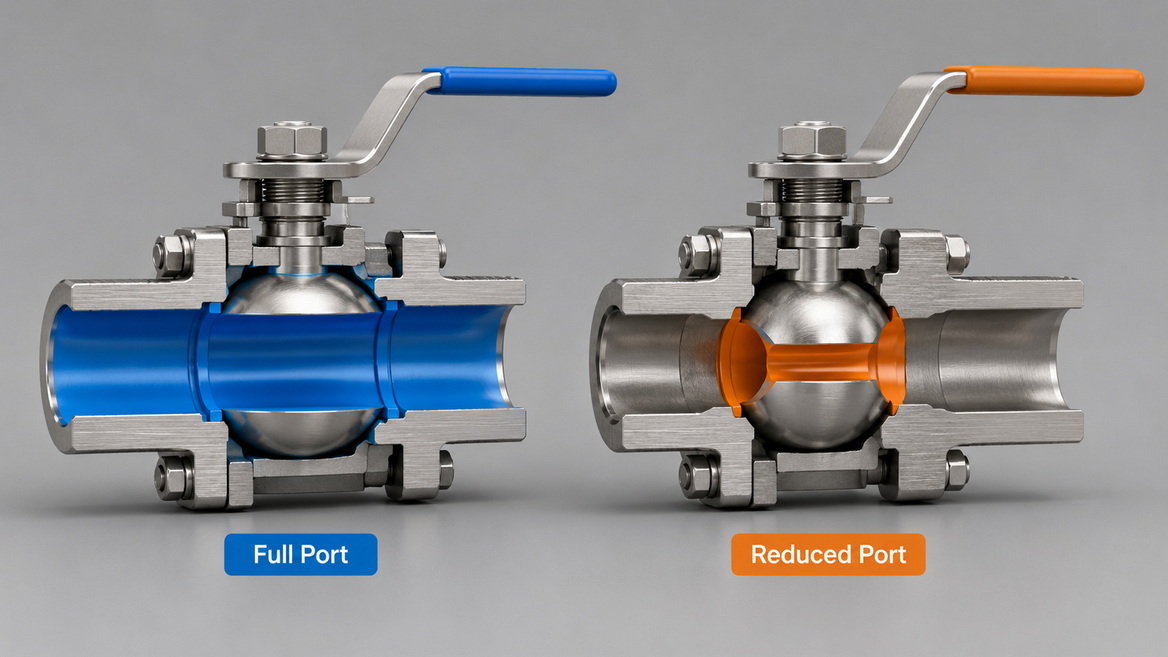
A full port ball valve (also called full bore) uses a ball with a bore equal to the pipeline inner diameter, so media passes through with minimal turbulence and pressure loss. In practice, this means the valve does not become a bottleneck in the line, which is critical in high‑flow systems such as crude oil transfer, gas trunk lines, and desalination plants.
Because the bore matches the pipe, flow velocity stays relatively stable, which helps reduce erosive wear on internal components and downstream equipment. Full port designs are common in floating and trunnion ball valves used in mid‑ to large‑diameter lines where pigging, high‑integrity isolation, or strict process control is required.
What Is a Reduced Port Ball Valve?
A reduced port (standard port) ball valve uses a smaller bore than the pipeline ID, typically 25–50% smaller depending on size and design. This creates a Venturi‑like effect with higher velocity through the valve body, along with greater friction, energy loss, and pressure drop compared with full port.
The key advantages are lower weight, smaller face‑to‑face dimensions, and lower initial cost, which make reduced port ball valves attractive in compact skids, secondary lines, and non‑critical services. Many OEMs specify reduced port valves for general on/off duty where some pressure drop is acceptable and lifecycle operating cost is less critical than upfront CAPEX.
Full Port vs Reduced Port: Key Technical Differences
From an engineering and procurement perspective, you are balancing four main variables: flow efficiency, energy cost, footprint, and total cost of ownership.
Flow, Pressure Drop, and Energy Use
Full port:
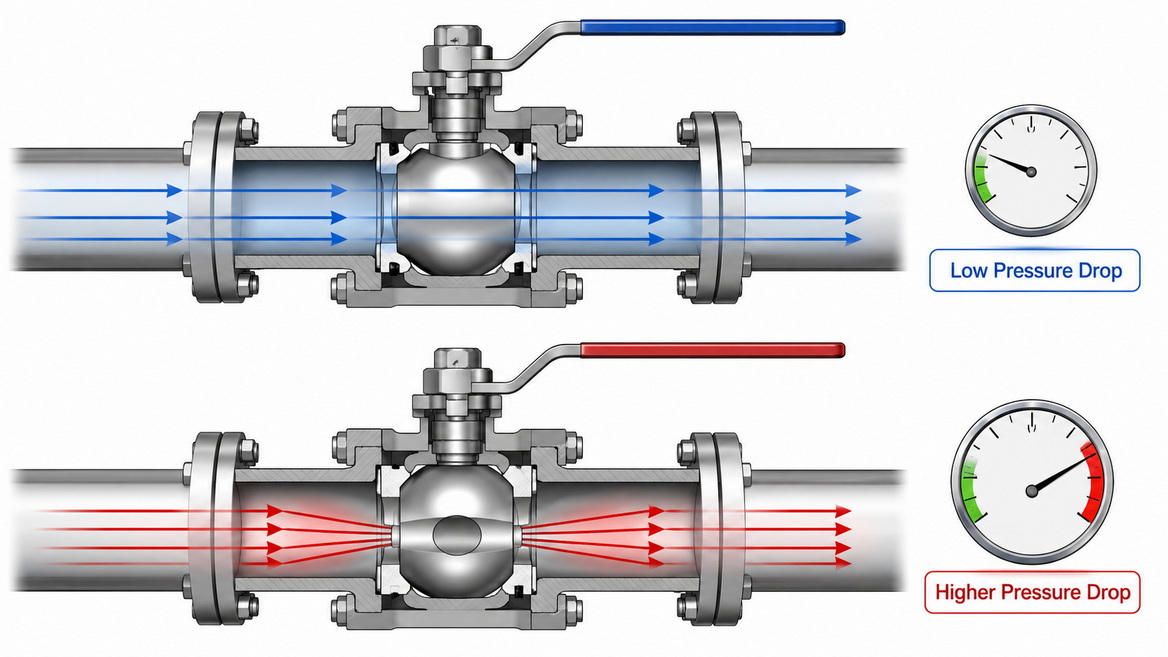
- Near‑zero additional pressure loss vs straight pipe.
- Lower pumping or compression power for the same throughput.
- Better for viscous, dirty, or multiphase fluids that are sensitive to high velocity.
Reduced port:
- Noticeably higher pressure drop at the same flow rate due to smaller bore.
- Higher velocity can accelerate erosion in abrasive services and increase noise.
- Better suited where flow is modest and energy cost impact is small.
Size, Weight, and Cost
Full port:
- Larger ball and body, higher material consumption, and typically heavier actuators.
- Higher unit price but cost‑effective where energy savings or pigging justify the premium.
Reduced port:
- More compact envelope with 30–40% space savings in some sizes.
- Lower initial price and easier integration in tight manifolds and modular skids.
Typical Use Cases in Oil & Gas and Water
Full port:
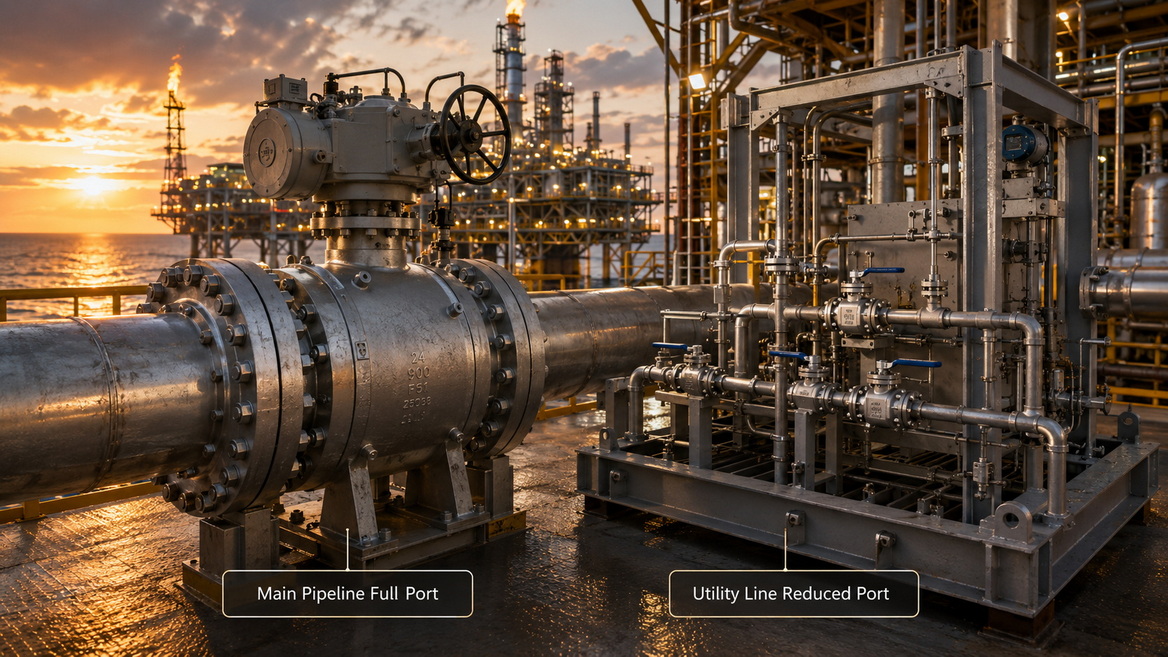
- Piggable transmission lines.
- High‑capacity pump discharge lines.
- Critical isolation on offshore platforms and LNG facilities.
Reduced port:
- Utility lines (cooling water, instrument air).
- Bypass, drain, and vent services.
- Compact process skids where space and cost are under pressure.
How Port Type Interacts With Floating vs Trunnion Ball Valves
For buyers of floating ball valves and trunnion ball valves, port selection is closely tied to pressure range, line size, and automation strategy.
Floating ball valves:
- The ball is not mechanically anchored; it "floats" and uses line pressure to press against the downstream seat.
- Common in low‑ to medium‑pressure service and smaller sizes where higher operating torque is acceptable.
- Often specified as full port in smaller line sizes to keep pressure drop minimal and maintain tight shut‑off.
Trunnion ball valves:
- The ball is supported by trunnions at the top and bottom, reducing seat load and required torque.
- Preferred for high‑pressure, large‑diameter pipelines and automated systems in oil and gas.
- Available in both full and reduced port, with reduced port often chosen where pigging is not needed but high pressure and automation are.
From an OEM/ODM perspective, integrating the right port type + ball design (floating or trunnion) ensures that actuator sizing, sealing performance, and lifecycle cost are optimized for the target market segment.
Market Context: Why Port Selection Matters in 2024–2030
The global ball valve market is projected to grow from around 12.86 billion USD in 2023 to about 19.15 billion USD by 2030, at a CAGR of roughly 5.84%. This growth is driven by long‑cycle investments in oil and gas, power generation, water treatment, and chemical processing, where flow efficiency and reliability translate directly into operating margin.
In upstream and midstream oil and gas, pipeline operators are under constant pressure to reduce fugitive emissions and energy consumption per transported barrel, which makes correct port selection a line‑item in ESG‑driven engineering specs. In desalination and offshore water injection, rising energy costs make the lower pressure drop of full port designs particularly attractive despite higher initial CAPEX.
Expert Decision Framework: When to Choose Full Port vs Reduced Port
For engineering teams and procurement managers, a structured, three‑step approach keeps decisions consistent across projects.
Step 1 – Check Flow and Pressure Requirements
1. Define required flow rate and allowable pressure drop for each line.
2. If the line is a main process or transfer line with strict throughput targets, prioritize full port to avoid hidden capacity losses.
3. For bypass, drain, and non‑critical utilities, a reduced port can meet performance requirements at lower cost.
Step 2 – Evaluate Medium and Service Severity
High viscosity (heavy oil, slurries):
- Full port minimizes stagnation and erosion from accelerated velocity.
High solids or abrasive media:
- Full port often extends seat and body life by avoiding jetting through a narrow bore.
- Clean, non‑abrasive fluids:
- Reduced port is usually acceptable and cost‑effective.
Step 3 – Consider Space, Weight, and Automation
- If the skid or platform is space‑constrained, reduced port may simplify layout and support structure design.
- In large‑diameter, high‑pressure lines with automation, consider trunnion ball valves with the port style that balances actuator torque, footprint, and pigging requirements.
- For retrofits, check existing pump or compressor margins before switching from reduced to full port, or vice versa, to avoid unintended impacts on system curves.
OEM/ODM Perspective: How a Specialized Ball Valve Factory Adds Value
A dedicated ball valve manufacturer with experience in floating and trunnion ball valves for oil and gas, offshore platforms, and desalination can support EPCs, brand owners, and distributors in several ways.
Engineering support:
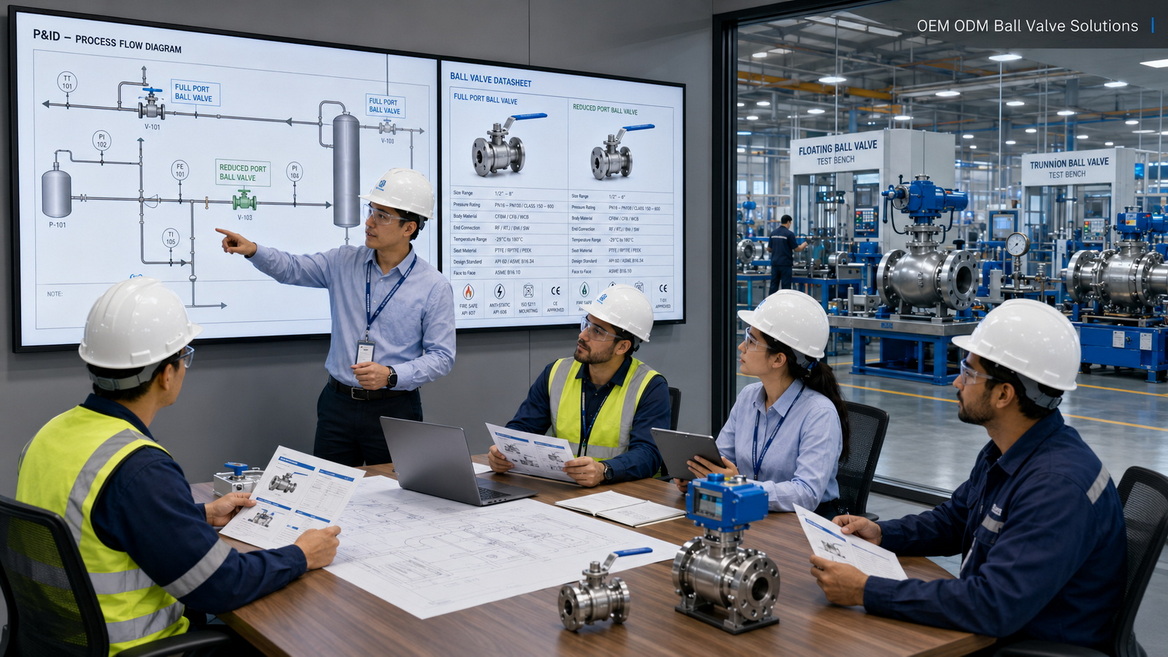
- Joint review of P&IDs and line lists to recommend full or reduced port for each service.
- Custom seat, coating, and material selection aligned with medium and design codes (API, ASME).
OEM/ODM collaboration:
- Branding, labeling, and documentation tailored to local markets.
- Co‑developed valve configurations (port type, bore, actuation) optimized for the buyer's typical projects and tenders.
Lifecycle alignment:
- Balancing CAPEX and OPEX across portfolios: full port for flagship, high‑spec lines and reduced port for cost‑sensitive, high‑volume ranges.
For B2B buyers, this means you do not need in‑house valve expertise for every decision—the manufacturer's application engineers help you standardize port selection across multiple projects and regions.
Practical CTA for Engineering and Procurement Teams
If you are currently specifying ball valves for oil and gas, desalination, or offshore projects and are unsure whether full port or reduced port is the right choice for each line, share your process conditions, line sizes, and design standards with a specialized ball valve factory's application team. They can help you engineer a portfolio‑level standard that optimizes port selection, reduces SKUs, and balances energy efficiency against footprint and cost across all your projects.
FAQs: Full Port vs Reduced Port Ball Valves
1. Does a full port ball valve always perform better than a reduced port?
No. Full port offers better flow and lower pressure drop, but reduced port is often the smarter choice in non‑critical lines where space and cost are more important than hydraulic performance.
2. Can I use reduced port ball valves in high‑pressure pipelines?
Yes, provided the valve design (often trunnion‑mounted) and materials are rated for the pressure and temperature; the limitation is more about flow and pigging than pressure rating.
3. Are full port ball valves always piggable?
Most full port trunnion designs in appropriate sizes are piggable, but you must confirm geometry, end connections, and internal features with the manufacturer and project standards.
4. How does port selection impact actuator sizing?
Full port valves tend to be larger and may require higher torque, particularly in floating designs; reduced port can lower torque requirements, especially when combined with trunnion mounting.
5. What documentation should I request when sourcing OEM/ODM ball valves?
Ask for datasheets specifying port type (full or reduced), Cv values, design code (API, ASME), pressure‑temperature ratings, seat and trim materials, and any pigging or automation limitations.
References
1. Onero Valve – "Ball Valve Full Port vs. Reduced Port: 4 Differences" – https://www.onerovalve.com/blog/comparison/ball-valve-full-port-vs-reduced-port/
2. Dervos Valve – "What Is the Difference Between Full Port Ball Valve and Reduced Port Ball Valve?" – https://www.dvsvalve.com/blog/what-is-the-difference-between-full-port-ball-valve-and-reduced-port-ball-valve-_b7
3. Tianyu Valves – "Full Port vs. Reduced Port Ball Valves: Flow Efficiency Comparison" – https://www.tianyuvalves.com/news/full-port-vs-reduced-port-ball-valves-flow-efficiency-comparison/
4. Pans Valve – "Floating Ball Valve vs Trunnion: Which to Choose?" – https://www.pansvalve.com/blog/ball-valve/floating-ball-valve-vs-trunnion-ball-valve/
5. OneRo Valve – "Floating vs. Trunnion Mounted Ball Valves: Key Differences" –https://www.onerovalve.com/blog/floating-vs-trunnion-ball-valve/
6. Global Industry Insights – "Ball Valves Market by Types… Global Forecast 2024–2030" – https://cn.gii.tw/report/ires1466556-ball-valves-market-by-types-floating-ball-valve.html
7. Wenzhou Leader Flow Control Equipment – Product and contact information for trunnion ball valves – http://www.wzld.cn/en/6-top_entry_ball_avlve.html
8. Dombor – "Floating Ball Valve Vs Trunnion: What's Their Difference" – https://www.dombor.com/floating-ball-valve-vs-trunnion-ball-valve/
Hot Tags: Ball Valve, Manufacturers, Customized, Custom, Suppliers, Buy, Cheap, Quality, Advanced, Durable, in Stock, Free Sample, Made in China, Price, Quotation