Ball Valve Handles Explained: Types, Selection, And Replacement Guide for Industrial Applications
Content Menu
● Introduction: Why Ball Valve Handles Matter in Real Plants
● What Is a Ball Valve Handle?
● Main Types of Ball Valve Handles
>> Overview Table: Handle Types, Pros, and Best Use Cases
>> Hand Wheels
● Expert Insight: Floating vs Trunnion Ball Valve Handles
● How to Replace a Ball Valve Handle (Step‑by‑Step)
>> Replacing a Push‑On Type Handle
>> Replacing a Screw‑On Type Handle
>> Additional Maintenance Considerations
● Choosing Handle Materials for Harsh Environments
● Safety, Compliance, and Best Practices from the Field
● OEM and ODM Considerations for Ball Valve Handles
● Common Field Problems with Ball Valve Handles (and How to Avoid Them)
● Call to Action: Specify the Right Ball Valve Handles for Your Next Project
● FAQs
>> 1. Can I change the handle on a ball valve without replacing the whole valve?
>> 2. Which way should a ball valve handle face when open or closed?
>> 3. Is a lever or hand wheel better for high‑pressure applications?
>> 4. Can I use a standard ball valve handle for throttling flow?
>> 5. What handle materials should I choose for offshore or marine environments?
Introduction: Why Ball Valve Handles Matter in Real Plants
After spending years walking through refineries, gas gathering stations, and desalination plants, I have learned that a "simple" ball valve handle is rarely simple in the field. A mis‑selected or damaged handle can mean unsafe operation, difficult shutdowns, or unnecessary downtime.
In this guide, I will walk through the main types of ball valve handles, how to select the right design for your application, and how to replace them safely, drawing on both industry standards and our own experience manufacturing floating and trunnion ball valves for demanding oil & gas and offshore environments. Whether you are an EPC engineer, maintenance planner, or OEM/ODM partner specifying valves for your own brand, this article is designed to give you practical, expert-level guidance you can apply immediately.
What Is a Ball Valve Handle?
A ball valve handle is the primary human–machine interface that allows operators to open and close the valve by rotating the stem connected to the internal ball. When the handle is aligned with the pipeline, the valve is generally fully open; when it is perpendicular, the valve is closed.
In industrial environments, the handle must do more than just turn the ball: it must provide clear position indication, enough torque to operate under pressure, compatibility with the process environment, and safe ergonomics for the operator. For critical applications in oil and gas, seawater desalination, and offshore platforms, handle design is directly linked to safety and compliance.
Main Types of Ball Valve Handles
Overview Table: Handle Types, Pros, and Best Use Cases
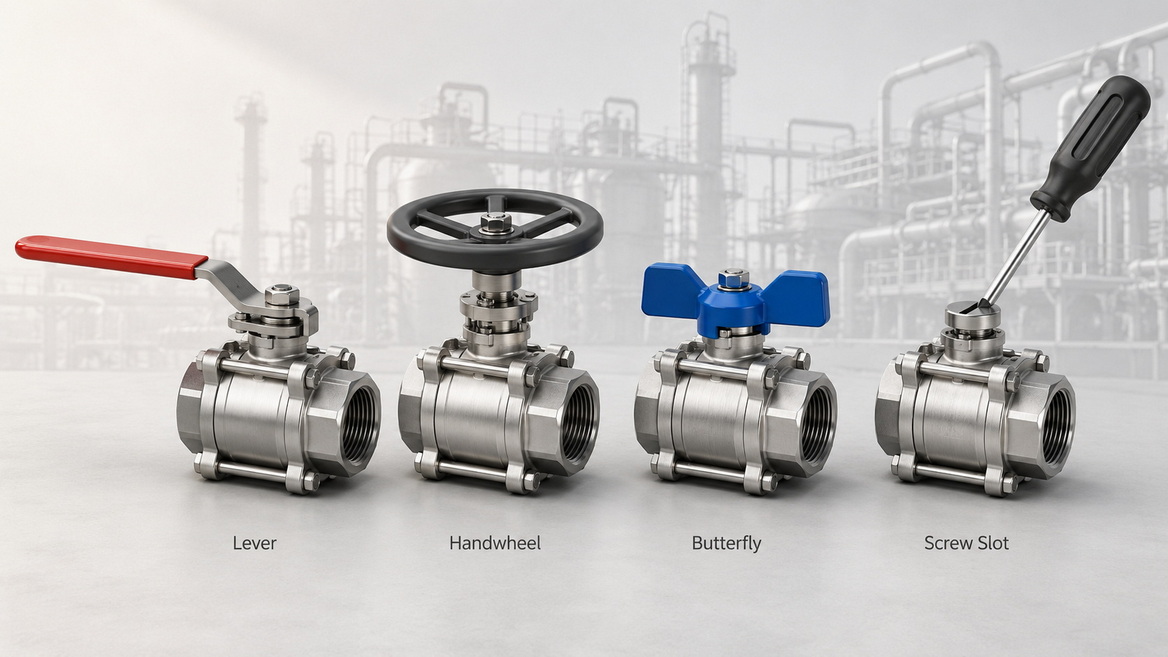
Lever Handles
Lever handles are by far the most common ball valve handle style in both residential and industrial service. They use a long arm connected to the valve stem, allowing a quick 90‑degree quarter turn to go from fully closed to fully open.
The orientation of the lever gives immediate visual feedback: aligned with the pipe is open; perpendicular is closed. This simplicity is why lever handles dominate on floating ball valves in process plants, tank farms, and utility lines. However, in cramped pipe racks or where accidental actuation is a concern, the swing radius and exposure of a long lever can become a drawback.
Hand Wheels
Hand wheels are circular handles that require multiple turns to open or close the ball valve. They offer more precise control and better ergonomics for high torque applications, especially on larger-diameter or higher-pressure valves where a lever would be difficult to operate safely.
Many hand wheel assemblies incorporate a scaled position indicator, giving operators a clear view of intermediate positions—useful in semi‑throttling situations or when monitoring from a distance. In practice, you often see hand wheels paired with trunnion‑mounted ball valves in midstream and downstream oil & gas applications, or as manual overrides on gear‑operated and actuated packages.
Butterfly (Wing) Handles
Butterfly handles—often called wing handles—are compact designs typically used on smaller valves. Their geometry allows for gradual, controlled closing, which helps to reduce water hammer, ignition risk, or mechanical shock, particularly in gas service.
In tight spaces, such as manifold blocks, skids, and OEM equipment housings, the short span of a butterfly handle avoids interference with nearby components. The trade-off is reduced leverage compared to long levers, so they are usually applied to small-bore valves where operating torque remains modest.
Screw Slot Handles
Screw slot "handles" replace a traditional grip with a recessed slot operated by a screwdriver. They are extremely compact and lightweight, which makes them suitable for confined spaces or enclosed assemblies where a protruding handle would be at risk of damage.
Because they lack an obvious position indicator and are inconvenient for frequent actuation, screw slot designs are best limited to infrequently operated isolation points or tamper-resistant installations. In OEM assemblies, they can be a neat solution when panel space is at a premium and operation is done only during commissioning or service.
Expert Insight: Floating vs Trunnion Ball Valve Handles
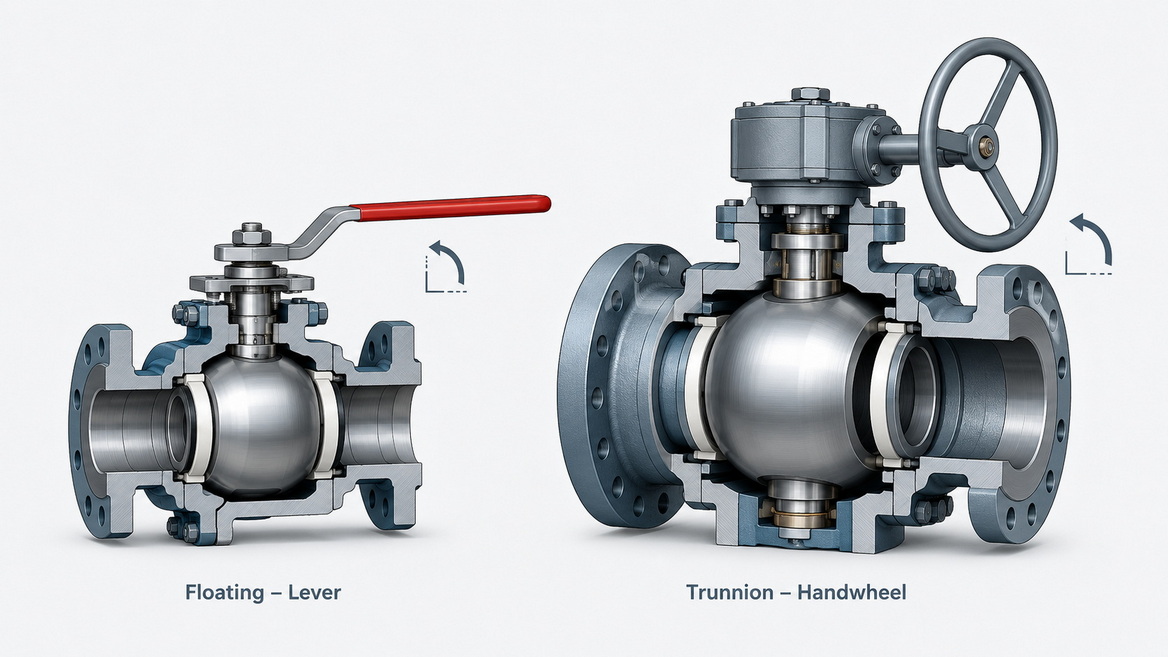
From a valve manufacturer's perspective, handle selection must also reflect the internal design of the valve—especially when comparing floating ball valves and trunnion‑mounted ball valves. Floating ball valves use line pressure to push the ball against the downstream seat, which generally keeps operating torque moderate and allows for simple lever handles on a wide range of sizes.
Trunnion ball valves support the ball at the top and bottom with trunnions, which stabilizes the ball under high pressure and large diameters but can increase system torque and justify gearboxes, hand wheels, or actuators rather than bare levers. In practice, we often provide long levers or gear‑operated hand wheels for trunnion valves used in oil and gas transmission lines, offshore platforms, and cryogenic service, where controlled operation and safety margins are critical.
How to Replace a Ball Valve Handle (Step‑by‑Step)
Ball valve handle replacement is a common maintenance task when handles crack, corrode, or become difficult to operate. Below is a practical step‑by‑step procedure based on the original guide plus field best practices.
Materials You Need
- Compatible replacement handle (matched to the valve model and stem design)
- Screwdriver or wrench for screw‑on or nut‑secured handles
- Basic PPE: gloves and safety glasses
Replacing a Push‑On Type Handle
1. Shut off the fluid supply
Close upstream isolation and ensure the line is depressurized before touching the handle.
2. Remove the old handle
Grip the existing handle firmly and pull it straight up until it pops off the valve stem.
3. Install the new handle
Align the new handle with the stem flats and press down firmly until it snaps into place.
Replacing a Screw‑On Type Handle
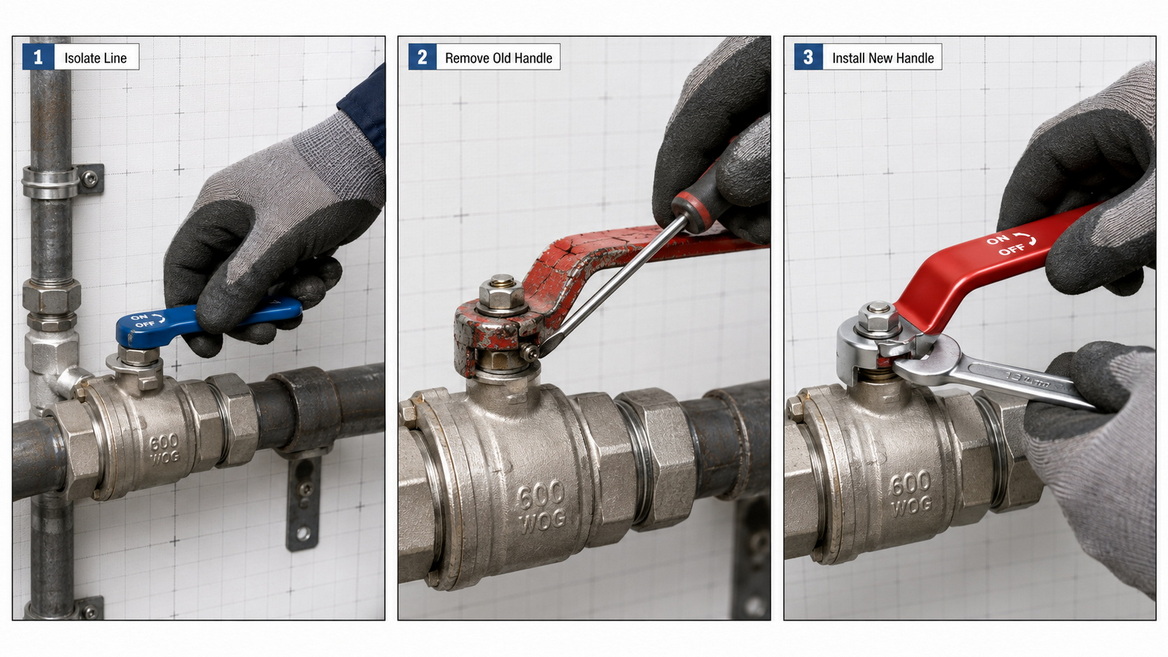
1. Shut off the fluid supply
As with push‑on types, fully isolate and depressurize the line first.
2. Remove the old handle
Use the specified screwdriver or wrench to remove the screw or nut securing the handle to the stem, then lift the handle off.
3. Install the new handle
Fit the new handle over the stem, align the position, and tighten the screw or nut to manufacturer torque recommendations.
Additional Maintenance Considerations
During handle replacement, it is good practice to check for other issues:
- Stem leaks: If you see leakage around the stem, the packing may require adjustment or replacement.
- Compatibility: Matching the handle to the exact valve series and stem interface prevents slippage or misalignment.
- Cost vs. risk: In low‑cost valves with severe corrosion or internal wear, replacing the entire valve can be more cost‑effective than only the handle.
Choosing Handle Materials for Harsh Environments
Handle material selection is frequently underestimated, especially in seawater, offshore, and corrosive chemical service. The right choice can extend operating life and reduce unplanned maintenance.
- Stainless steel: Excellent for outdoor and corrosive environments thanks to strong corrosion resistance; widely used on offshore platforms, marine, and chemical plants.
- Die‑cast zinc: A cost‑effective option for less aggressive environments; balances durability and price for general industrial use.
- Polyamide or other engineering plastics: Lightweight and corrosion‑resistant, suitable for many utility lines, but must be checked for UV resistance and temperature limits.
For floating and trunnion ball valves in oil & gas and desalination service, we often recommend stainless steel handles or hand wheels with robust coatings, combined with anti‑corrosion design features in the stem and fasteners. This is especially important in offshore atmospheres with salt spray and high humidity.
Safety, Compliance, and Best Practices from the Field
Industrial safety standards and internal plant procedures often dictate how ball valves and their handles should be selected, installed, and labeled. Best practices include:
- Ensuring the handle position clearly indicates open/closed state and aligns with P&IDs and operating procedures.
- Avoiding partial‑open operation of standard ball valves for continuous throttling, as non‑linear flow and potential cavitation can damage seats and internals.
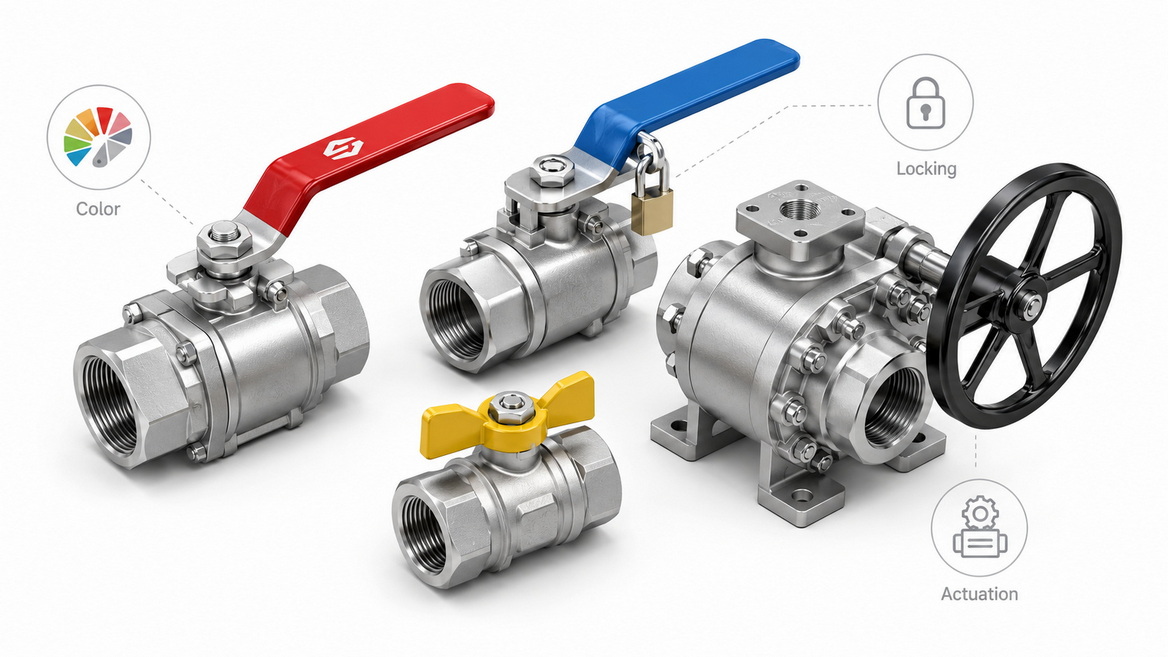
- Using locking devices, ISO‑mount pads, or actuator interfaces where unintentional operation could cause safety or environmental incidents.
For critical lines—such as high‑pressure gas or hydrocarbon transfer—plants often specify trunnion ball valves with gear‑operated hand wheels or actuators, plus clear mechanical stops and position feedback to the control system. This approach combines safe operation with verifiable status indication in control rooms.
OEM and ODM Considerations for Ball Valve Handles
If you are a valve brand, distributor, or system integrator sourcing valves on an OEM or ODM basis, handle design becomes part of your product differentiation and safety branding. As a dedicated ball valve manufacturer serving overseas brands, wholesalers, and producers with OEM/ODM services, we frequently customize:
- Handle color and shape to match customer branding and process coding.
- Locking devices, extensions, and ISO5211 top flanges for actuators.
- Material and coating combinations to suit specific markets (e. g., offshore, LNG, desalination).
Engaging early with your manufacturing partner to define handle torque requirements, ergonomics, and operating environment allows you to avoid later redesigns and field retrofits. This is particularly important for system OEMs delivering skid packages and modules into oil & gas upstream, midstream, downstream, and offshore platforms.
Common Field Problems with Ball Valve Handles (and How to Avoid Them)
Drawing from maintenance feedback and project walkdowns, several recurring handle issues show up across plants:
- Corroded or seized handles in marine and outdoor environments when low‑grade materials or inadequate coatings are used.
- Bent or broken levers due to over‑torquing or using the handle as a makeshift lever for other tasks.
- Incorrect orientation after maintenance, causing confusion about whether the valve is open or closed.
- Unsafe operation torque when system conditions change (e. g., higher differential pressure) but handles are not upgraded.
Mitigation strategies include specifying minimum material grades, adding handle guards, implementing clear position labeling, and periodically verifying operating torque against design assumptions during maintenance rounds.
Call to Action: Specify the Right Ball Valve Handles for Your Next Project
If you are designing or upgrading systems in oil & gas, desalination, or offshore platforms, choosing the right ball valve handle is a small decision with big operational consequences. For OEM and ODM customers, handle selection also shapes your brand's perceived quality and safety in front of end users.
To discuss handle options for floating and trunnion ball valves—including customized lever, hand wheel, or actuator‑ready configurations—contact our engineering team with your process data and project specifications. We can help you match handle type, material, and interface to your operating conditions and compliance requirements.
FAQs
1. Can I change the handle on a ball valve without replacing the whole valve?
Yes. If the valve body and internals are in good condition, you can usually replace only the handle, provided you select a handle compatible with the valve model and stem interface.
2. Which way should a ball valve handle face when open or closed?
In standard configurations, the handle should be in line with the pipeline when open and perpendicular when closed, providing a clear visual indication of valve position.
3. Is a lever or hand wheel better for high‑pressure applications?
For higher pressures, larger sizes, or frequent operation, a hand wheel with a gear operator often provides safer, more controlled torque than a bare lever, particularly on trunnion ball valves.
4. Can I use a standard ball valve handle for throttling flow?
Standard ball valves have non‑linear flow characteristics, and extended throttling can cause cavitation and erosion, so they are not ideal for continuous throttling; characterized ball valves or dedicated control valves are preferable.
5. What handle materials should I choose for offshore or marine environments?
Stainless steel handles (often with protective coatings) are typically recommended for offshore, marine, and corrosive environments due to their superior corrosion resistance and long‑term durability.
References
1. Tameson – "Types of Ball Valve Handles and Their Replacement" – original article content and basic handle definitions. https://tameson.com/pages/ball-valve-handle
2. Wenzhou Leader Flow Control Equipment Co., Ltd. – product range for floating and trunnion ball valves and industrial application focus. https://www.wzldballvalve.com/search.html
3. Swagelok Northwest (US) – "Tech Talk: Valve Selection Best Practices" – guidance on valve selection, flow requirements, and material considerations. https://nwus.swagelok.com/en/about-us/insights-blog/tech-talk-valve-selection-best-practices
4. Plant Engineering – "Best practices for selecting and maintaining industrial valves" – storage, maintenance, and standards compliance. https://www.plantengineering.com/best-practices-for-selecting-and-maintaining-industrial-valves/
5. ARPCO Valves – "Industrial Valve Installation and Maintenance: Best Practices for Longevity and Reliability" – installation, inspection, and maintenance steps. https://arpcovalves.com/blog/industrial-valve-installation-and-maintenance-best-practices-for-longevity-and-reliabilit/
6. Lumar – "The New 'E' in Google's E‑E‑A‑T: Why Experience Matters for SEO" – guidance on integrating experience, expertise, authority, and trust into technical content. https://www.lumar.io/blog/industry-news/the-new-e-in-eeat-why-experience-matters-in-website-content/
7. ROI Revolution – "Optimizing Your Site for Google E‑E‑A‑T" – best practices for citations, trust signals, and content audits. https://roirevolution.com/blog/google-e-e-a-t-how-to-optimize-your-site-to-align-with-the-search-quality-rater-guidelines/
8. Unleashed Software – "OEM vs ODM explained – what's best for manufacturers?" – overview of OEM/ODM manufacturing models. https://www.unleashedsoftware.com/blog/oem-vs-odm-explained-whats-best-for-manufacturers/
Hot Tags: Ball Valve, Manufacturers, Customized, Custom, Suppliers, Buy, Cheap, Quality, Advanced, Durable, in Stock, Free Sample, Made in China, Price, Quotation