Ball Valve Vs Check Valve: How To Choose The Right Valve For Oil & Gas, Desalination, And Offshore Projects
Content Menu
● Ball Valve vs Check Valve: Core Functional Difference
● Six Practical Differences You Need To Know
>> 1. Flow Direction and Control
>> 2. Operation: Manual / Automated vs Self‑Acting
>> 3. Shut‑off Performance and Leakage
>> 4. Pressure, Size, and Cost Considerations
>> 5. Installation, Orientation, and Piping Layout
>> 6. Maintenance, Reliability, and Lifecycle Cost
● Side‑By‑Side Comparison: Ball Valve vs Check Valve
● Floating vs Trunnion Ball Valves: Why It Matters When Comparing To Check Valves
● Application‑Level Comparison In Oil & Gas, Desalination, And Offshore
>> Oil & Gas (Upstream, Midstream, Downstream)
>> Desalination And Water Treatment
● Expert Checklist: How To Choose Between Ball Valve And Check Valve
● Where To Add Visuals For Better UX
● Strategic CTA For OEMs, Wholesalers, And EPCs
● FAQs: Ball Valve vs Check Valve
>> 1. Can a ball valve replace a check valve?
>> 2. Do I need both a ball valve and a check valve on the same line?
>> 3. Which valve is better for high‑pressure gas pipelines?
>> 4. Are ball check valves the same as ball valves?
>> 5. How does installation affect check valve performance?
For critical flow control in oil and gas, desalination, and offshore platforms, ball valves and check valves play very different roles—and choosing the wrong one can quietly destroy pumps, raise maintenance costs, or create safety risks. Drawing on our experience as a ball valve manufacturer serving global OEM and EPC clients, this guide explains their real-world differences and when each is the smarter choice for your project.
What Is A Ball Valve?
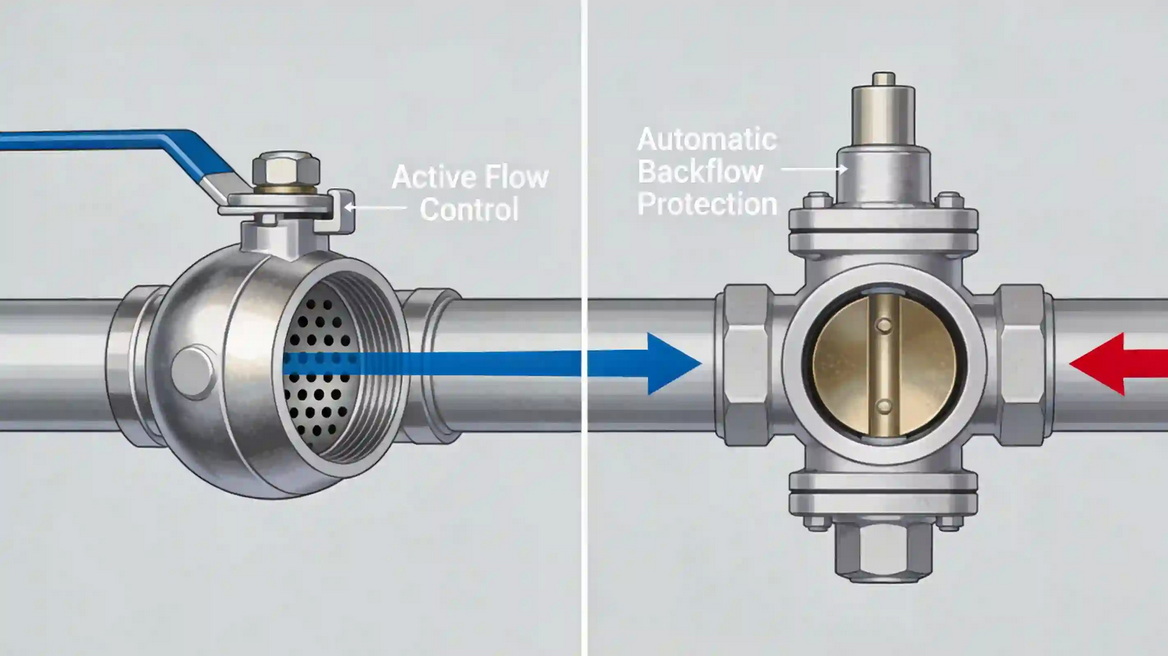
A ball valve is a quarter‑turn shut‑off valve that uses a drilled, rotating ball to start or stop flow. When the ball's bore aligns with the pipeline, the medium flows; when it is turned 90 degrees, the passage is fully blocked.
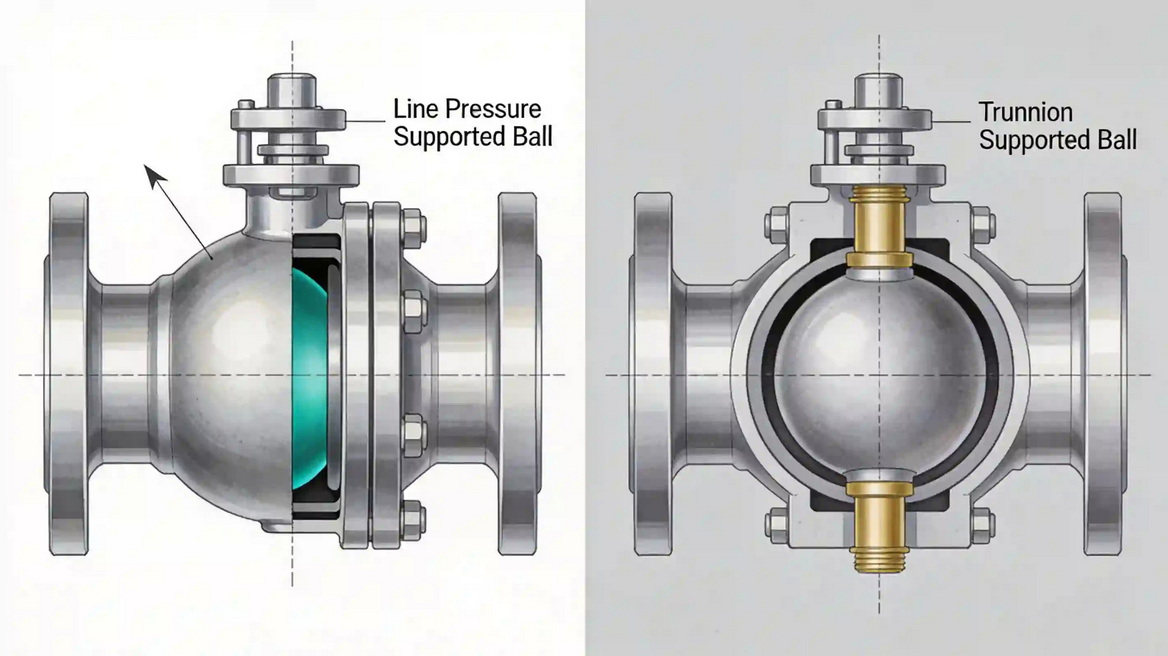
In industrial service, floating ball valves rely on line pressure to push the ball against the downstream seat, while trunnion ball valves support the ball on trunnions to reduce operating torque at higher pressures and larger sizes. Because of their tight shut‑off, wide pressure range, and easy automation, ball valves are widely used in upstream, midstream, and downstream oil and gas, as well as in desalination and offshore platforms.
What Is A Check Valve?
A check valve is a one‑way, self‑acting valve designed to prevent backflow and protect equipment. It opens automatically when upstream pressure exceeds downstream pressure and closes when flow reverses, without any manual or actuator input.
Common designs include swing, lift, and ball check valves, the last of which uses a spring‑loaded ball that lifts off its seat under forward flow and reseats to block reverse flow. In oil and gas separation systems, sea water injection lines, and pump discharge lines, check valves are essential to avoid reverse rotation, water hammer, and contamination of upstream equipment.
Ball Valve vs Check Valve: Core Functional Difference
The most important distinction is control vs protection.
- A ball valve provides intentional, positive control of flow—open, closed, or modulating with proper trim and actuation.
- A check valve provides passive, automatic protection against reverse flow and associated damage.
In other words, when an operator or control system must decide when and how flow happens, you specify a ball valve; when you need the system to protect itself against backflow, you specify a check valve.
Six Practical Differences You Need To Know
1. Flow Direction and Control
- Ball valves are typically bi‑directional and allow full shut‑off in either direction, especially in floating ball designs.
- Check valves are fundamentally uni‑directional; they are designed for one correct flow direction and close against reverse flow.
Implication: Use ball valves where you may need to isolate piping from either side; use check valves where protecting downstream or upstream equipment from reverse flow is critical.
2. Operation: Manual / Automated vs Self‑Acting
- Ball valves can be manually operated (lever, gear) or automated (pneumatic, electric, hydraulic actuators) and integrated into sophisticated control systems.
- Check valves require no external power or actuation; they respond purely to differential pressure and flow direction.
Implication: For SCADA‑integrated oil and gas pipelines, ball valves often serve as main isolation and emergency shut‑down valves, while check valves quietly protect pumps and compressors in the background.
3. Shut‑off Performance and Leakage
- Ball valves are known for bubble‑tight shut‑off when correctly selected and maintained, particularly in trunnion designs for high pressure.
- Check valves are optimized to close reliably under reverse flow, but in many designs small leakage rates are acceptable depending on the standard and application.
For hazardous hydrocarbons or high‑salinity media in desalination plants, a high‑integrity ball valve is typically specified as the primary isolation point, even when check valves are present in the same line.
4. Pressure, Size, and Cost Considerations
- Floating ball valves offer a relatively simple structure and cost‑effective solution for small to medium sizes and moderate pressures.
- Trunnion ball valves, while more complex, maintain low operating torque and better seat performance at higher pressures and large diameters, such as in transmission pipelines or offshore risers.
- Check valves are generally simpler and less expensive per unit than large, actuated ball valves, especially when only backflow prevention—not tight isolation—is required.
Project teams often use a combination: trunnion ball valves as main line block valves, with check valves positioned strategically around pumps, compressors, and vertical runs.
5. Installation, Orientation, and Piping Layout
Ball valves are relatively forgiving in orientation and proximity to fittings, provided basic manufacturer guidelines are followed. Check valves, by contrast, are far more sensitive to placement and flow profile.
Industry guidance recommends maintaining sufficient straight pipe runs upstream and downstream of check valves (for example, 5–10 times the pipe diameter from elbows, pumps, or tees) to minimize turbulence, disc flutter, and premature wear. Certain check valve types, such as swing checks, are not recommended for vertical pipelines due to poor closing behavior and water hammer risk.
6. Maintenance, Reliability, and Lifecycle Cost
Ball valves, especially in demanding oil and gas service, require periodic inspection of seats, seals, and actuators to maintain their tight shut‑off performance. Check valves may appear "fit and forget," but poor sizing or installation can lead to chattering, seat damage, and unplanned downtime.
A lifecycle‑cost perspective that considers valve cost, maintenance man‑hours, accessibility on offshore platforms, and the consequences of failure is essential when comparing ball vs check valve strategies at FEED stage.
Side‑By‑Side Comparison: Ball Valve vs Check Valve
Floating vs Trunnion Ball Valves: Why It Matters When Comparing To Check Valves
From a manufacturer's perspective, many selection mistakes occur because "ball valve" is treated as a single category.
- Floating ball valves use line pressure to push the ball against the downstream seat, making them ideal for smaller sizes, general service, and applications where cost‑effectiveness and compactness matter.
- Trunnion ball valves support the ball on trunnions, reducing seat wear and operating torque at high pressures and large diameters, and are commonly specified in transmission pipelines, subsea, and offshore topside service.
When comparing ball valves with check valves in a pipeline design, engineers should consider whether a floating or trunnion configuration provides the right balance of sealing performance, torque, and cost in combination with check valves placed at critical protection points.
Application‑Level Comparison In Oil & Gas, Desalination, And Offshore
Oil & Gas (Upstream, Midstream, Downstream)
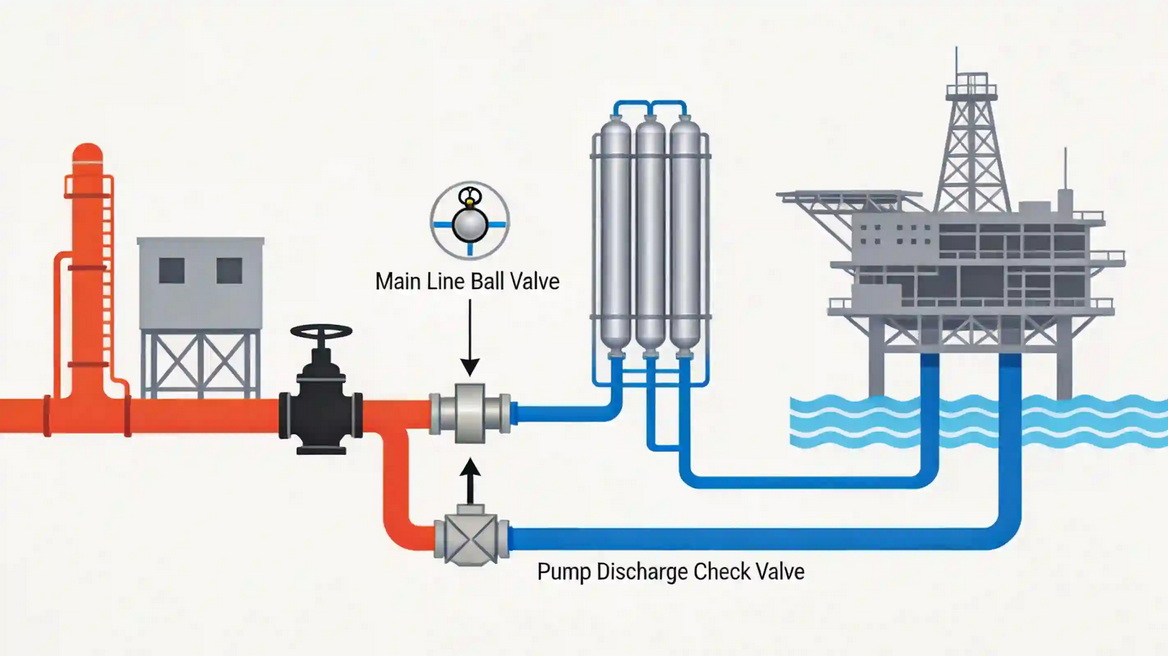
- Use trunnion ball valves as main line block valves and section isolation in high‑pressure gas transmission and crude oil pipelines.
- Use check valves at pump and compressor discharge, gas lift lines, and critical elevation changes to prevent reverse flow and water hammer.
In gas processing plants and refineries, ball valves often interface with emergency shutdown systems, while check valves help maintain directional flow through separation trains and heat‑exchanger networks.
Desalination And Water Treatment
In desalination plants, ball valves are frequently used on high‑pressure RO feed lines, chemical dosing, and CIP loops because of their robust shut‑off and compatibility with various alloys and coatings. Check valves protect high‑pressure pumps and membrane trains from reverse pressure spikes and cross‑contamination between parallel trains.
Offshore Platforms
Offshore platforms face additional constraints of limited space, difficult access, and harsh environments. Here, compact, corrosion‑resistant ball valves with actuator packages are combined with carefully selected check valves positioned according to best‑practice straight‑run and orientation guidelines to minimize maintenance interventions.
Expert Checklist: How To Choose Between Ball Valve And Check Valve
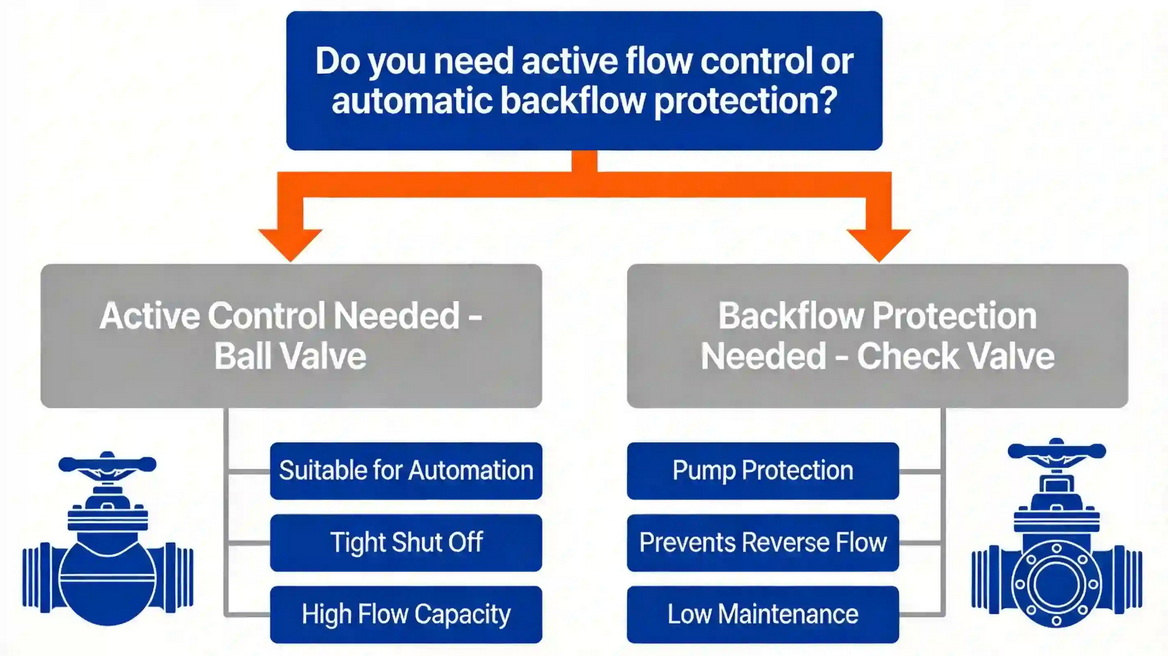
When specifying valves for a new line or retrofit, project engineers can use this simplified checklist.
1. Define the primary purpose
- Need on/off control or automation? → Ball valve.
- Need automatic backflow protection? → Check valve.
2. Clarify operating conditions
- Medium (oil, gas, produced water, seawater, chemicals)
- Pressure and temperature envelope
- Required shut‑off class and leakage tolerance
3. Consider system dynamics
- Risk of water hammer or pressure surges
- Vertical vs horizontal runs
- Proximity to pumps, compressors, elbows, and tees
4. Plan for lifecycle and maintenance
- Accessibility (onshore vs offshore)
- Availability of actuation, spare parts, and trained technicians
- Total cost of ownership, not just initial valve price
5. Integrate with control and safety philosophy
- Which valves are tied into ESD or SIS?
- Where must flow stop even if power or controls fail?
- Where is "silent" protection against backflow required?
Working with an experienced valve manufacturer that understands floating and trunnion ball valve design, as well as how these interact with check valves in complex systems, significantly reduces project risk.
Where To Add Visuals For Better UX
To improve user understanding and engagement, consider embedding visuals at these points:
- Section "What Is A Ball Valve?"
Add a cutaway 3D illustration showing a floating ball valve and a trunnion ball valve, with flow paths highlighted.
- Section "What Is A Check Valve?"
Insert a simple flow diagram comparing forward and reverse flow through a ball check valve.
- Table "Side‑By‑Side Comparison"
Include an infographic summarizing ball vs check valve differences for quick reference.
- Section "Application‑Level Comparison"
Use a process flow schematic of an oil & gas or desalination system with ball valves and check valves clearly marked at typical locations.
- Expert Checklist Section
Add a flowchart or decision tree graphic that guides engineers from application requirements to valve selection.
When generating visuals with AI, keep a consistent industrial style—clean technical drawings, neutral background, clear labels—and ensure each image aligns with the surrounding copy.
Strategic CTA For OEMs, Wholesalers, And EPCs
If you are planning a new oil and gas pipeline, upgrading a desalination plant, or designing an offshore process module, selecting the right combination of floating ball valves, trunnion ball valves, and check valves is critical to safety and lifecycle cost. For project‑level technical support, customized materials, and OEM/ODM services tailored to your brand, contact our engineering team to review your P&IDs, line list, and valve specifications before you finalize your next RFQ.
FAQs: Ball Valve vs Check Valve
1. Can a ball valve replace a check valve?
No. A ball valve can be closed to stop reverse flow, but it does not close automatically when flow reverses. A check valve is specifically designed to react to differential pressure and protect equipment from backflow.
2. Do I need both a ball valve and a check valve on the same line?
Often yes. In pump discharge lines and critical process connections, ball valves provide positive isolation for maintenance, while check valves prevent reverse rotation and water hammer when equipment trips.
3. Which valve is better for high‑pressure gas pipelines?
For primary line isolation in high‑pressure gas service, trunnion‑mounted ball valves are typically preferred because they maintain tight shut‑off with manageable operating torque at large diameters. Check valves are added at strategic points for backflow protection.
4. Are ball check valves the same as ball valves?
No. A ball check valve uses a ball as the closing element in a one‑way, self‑acting valve, while a standard ball valve is a quarter‑turn, bi‑directional isolation valve operated manually or by an actuator.
5. How does installation affect check valve performance?
Improper installation—such as placing a check valve too close to elbows or pumps or using swing checks in vertical lines—can cause chattering, premature wear, and water hammer. Following guidelines on straight pipe runs and orientation is essential.
Hot Tags: Ball Valve, Manufacturers, Customized, Custom, Suppliers, Buy, Cheap, Quality, Advanced, Durable, in Stock, Free Sample, Made in China, Price, Quotation