API 607 vs API 6FA Fire Safe Ball Valves A Practical Guide For Floating And Trunnion Designs
Content Menu
● What Is a Fire‑Safe Valve and Why It Matters
● API 607: Fire Test for Soft‑Seated Quarter‑Turn Valves
● API 6FA: Fire Test for Valves to API 6A and 6D
● API 607 vs API 6FA: Core Differences That Matter
>> Practical comparison of API 607 and API 6FA
● How These Standards Apply to Floating and Trunnion Ball Valves
● Integrating Fire‑Safe Standards with Broader Valve Testing (API 598 Insight)
● Expert Insight: How Engineers and Buyers Should Decide Between API 607 and API 6FA
● Case‑Oriented Scenario: Selecting Fire‑Safe Ball Valves for an Offshore Platform
● Practical Checklist for OEM, ODM, and Brand Owners
● Call to Action: Work With a Fire‑Safe Valve Partner
● FAQs About API 607 vs API 6FA for Ball Valves
>> 1. Is API 607 enough for all fire‑safe ball valve applications?
>> 2. Do trunnion ball valves always need API 6FA fire testing?
>> 3. How do API 598 tests relate to API 607 and API 6FA?
>> 4. Can a single ball valve design be tested to both API 607 and API 6FA?
>> 5. What documents should I request from a valve supplier to verify fire‑safe compliance?
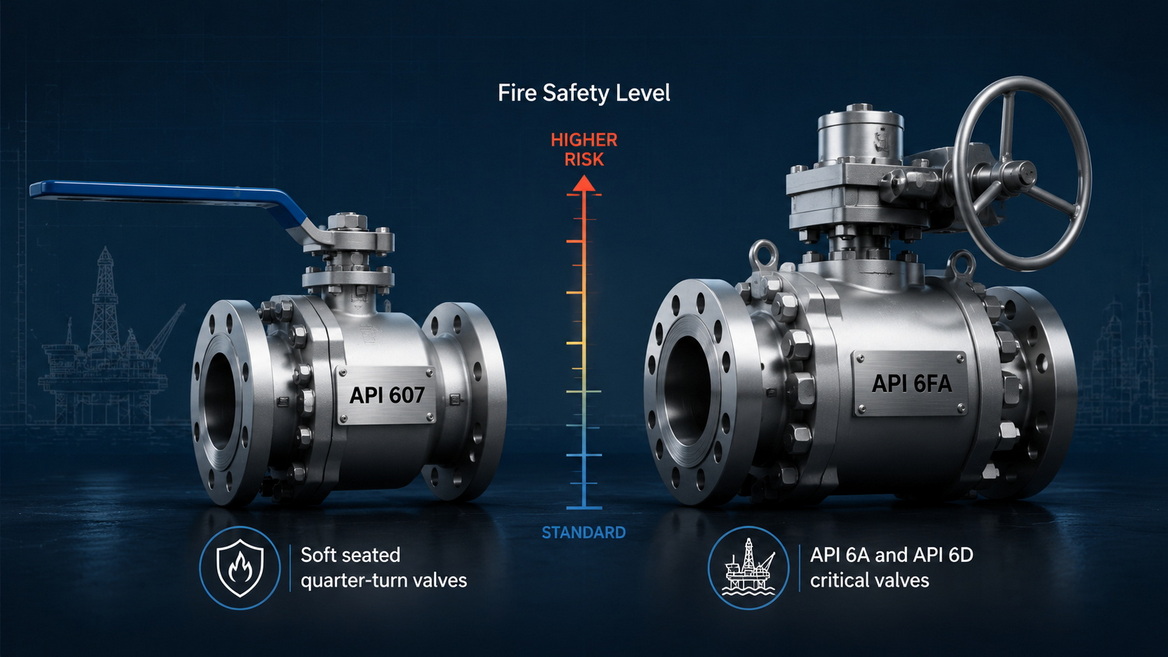
API 607 and API 6FA are both critical fire-testing standards for industrial ball valves, but they target different valve types, system risks, and compliance scenarios in oil and gas, petrochemical, and offshore applications. Understanding these differences is essential if you specify, purchase, or manufacture floating or trunnion ball valves for high‑risk environments where a fire‑safe design is non‑negotiable.
What This Guide Will Cover
As a content strategist working closely with valve engineers and overseas buyers, I often find that API 607 vs API 6FA is one of the most misunderstood topics in ball valve selection. In this guide, I will walk through the standards from a practical, engineer–buyer perspective, using real project scenarios and manufacturing experience from Wenzhou Leader Flow Control Equipment Co., Ltd. as context.
We will cover:
- What "fire‑safe" actually means in real operations
- Core differences between API 607 and API 6FA
- How these standards apply to floating vs trunnion ball valves
- How EPCs, OEM brands, and valve factories should choose between them
- Typical documentation, testing, and audit expectations
What Is a Fire‑Safe Valve and Why It Matters
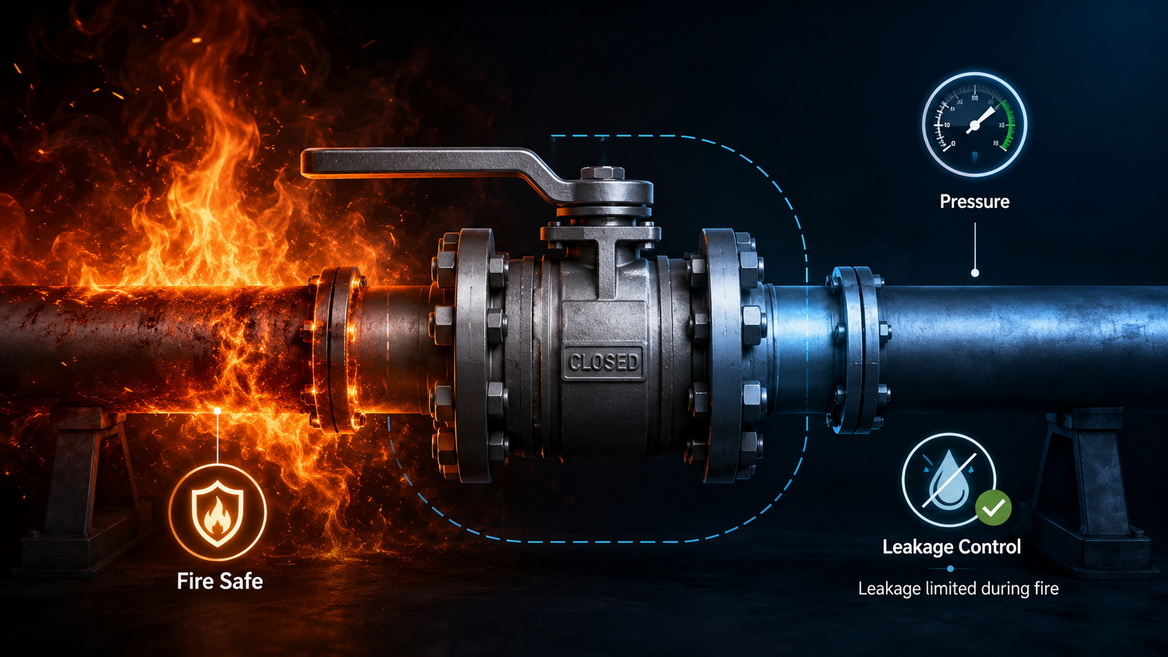
In oil and gas, petrochemical, and offshore platforms, a "fire‑safe" valve is designed to maintain sealing and structural integrity during and after a fire, limiting flammable media leakage, even when soft seals are damaged. In other words, a fire‑safe ball valve buys time: it helps isolate the fire zone, protects personnel, and reduces escalation risk until operators can shut down or emergency systems take over.
From a practical project standpoint, fire‑safe performance is not a "nice‑to‑have," it is a contract clause that affects:
- HSE (Health, Safety & Environment) acceptance
- Regulatory approvals and insurance conditions
- Operator confidence in upstream, midstream, and downstream facilities
For floating and trunnion ball valves used in crude oil lines, gas gathering systems, LNG terminals, offshore platforms, and desalination plants, fire safety is now a baseline expectation rather than a premium feature.
API 607: Fire Test for Soft‑Seated Quarter‑Turn Valves
Scope and Purpose
API 607 is the American Petroleum Institute fire test standard for soft‑seated quarter‑turn valves, including ball valves, with non‑metallic seat materials under pressure. Its core objective is to verify that, after exposure to a defined fire, the valve still provides an acceptable level of tight shut‑off and external leakage control.
In practice, API 607 is typically applied to:
- Soft‑seated floating ball valves used in general pipeline and process duties
- Quarter‑turn trunnion ball valves with non‑metallic seats in midstream/downstream systems
- Valves manufactured under API 6D that rotate 90° and use soft seating.
Key Test Characteristics
While the exact test sequence is more detailed, the essential elements include:
- Valve is pressurized with a test medium before and during fire exposure
- Valve is exposed to a defined flame profile and temperature–time curve
- Leakage is measured both through the seat and to atmosphere
- Acceptance criteria limit internal and external leakage to specified values.
The emphasis of API 607 is on demonstrating that even if soft seats are damaged by fire, the valve's metal‑to‑metal contact areas can still provide a backup sealing function to limit leakage.
API 6FA: Fire Test for Valves to API 6A and 6D
Scope and Purpose
API 6FA is a broader and more stringent fire test standard that covers both soft‑seated and metal‑seated valves, primarily those designed according to API 6A (wellhead and tree equipment) and API 6D (pipeline valves). It sets fire testing requirements for a wider range of valve constructions, including high‑pressure and critical service units.
API 6FA is commonly specified for:
- High‑pressure trunnion ball valves on transmission pipelines
- Valves in wellhead, gathering, and export lines with severe risk profiles
- Systems where metal‑seated designs or special trims are used.
Testing Focus
Compared with API 607, API 6FA places a stronger emphasis on:
- Overall structural integrity of the valve body and connections during fire
- Operability (ability to open/close) after fire exposure
- Performance of both metal‑seated and soft‑seated designs under extreme conditions.
From an engineering standpoint, API 6FA gives operators and EPCs more confidence for high‑pressure, high‑consequence segments of the pipeline or process where any leakage could be catastrophic.
API 607 vs API 6FA: Core Differences That Matter
The table below summarizes the most important distinctions decision‑makers care about when specifying fire‑safe ball valves.
Practical comparison of API 607 and API 6FA
When engineers ask, "Do we need API 607 or API 6FA?", they are really asking how conservative they must be for a given line class and risk profile. In many projects, specifiers will assign API 607 fire testing for standard soft‑seated pipeline ball valves and API 6FA for high‑criticality segments such as trunk pipelines, risers, or wellhead‑related services.
How These Standards Apply to Floating and Trunnion Ball Valves
From a manufacturer's perspective, it is crucial to match valve construction to the right fire test standard. For a ball valve factory like Wenzhou Leader Flow Control Equipment Co., Ltd., which specializes in floating ball valves and trunnion ball valves, this alignment starts in the design phase and runs through prototype testing, production, and third‑party inspection.
Floating ball valves
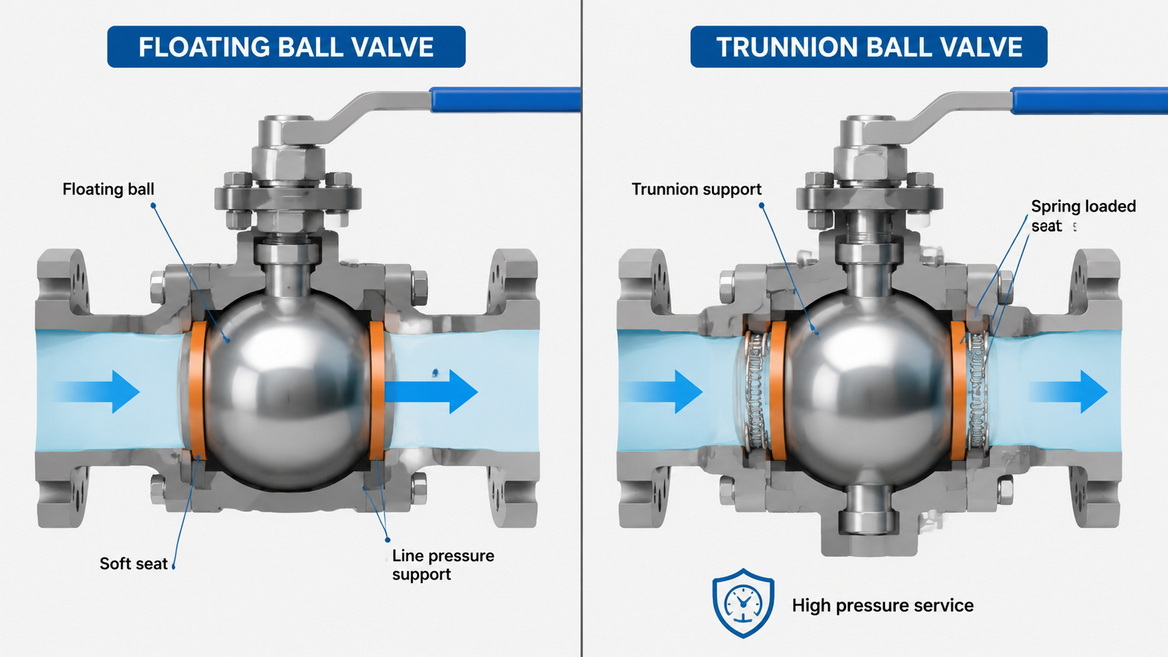
Floating ball valves rely on the line pressure to push the ball against the downstream seat, creating tight shut‑off. In fire‑safe designs with soft seats, API 607 testing confirms that after soft seats are damaged, secondary metal‑to‑metal contact still limits leakage.
Typical floating ball valve applications:
- Low‑to‑medium pressure oil and gas lines
- Utility and general process service
- Desalination and offshore platform auxiliary systems where soft seating is preferred for tight shut‑off.
Trunnion ball valves
Trunnion ball valves use a supported ball with upper and lower trunnions, making them suitable for larger sizes and higher pressures. In high‑risk pipelines, trunnion designs are often required to comply with API 6FA due to their role in mainline isolation and emergency shutdown.
Key trunnion applications include:
- Long‑distance gas and oil transmission pipelines
- Offshore production manifolds and export lines
- Critical isolation valves in upstream and midstream systems.
In practice, OEM and ODM customers often specify both API 607 and API 6FA coverage in their vendor qualification documents, and factories must demonstrate compliance for the exact valve series and sizes they supply.
Integrating Fire‑Safe Standards with Broader Valve Testing (API 598 Insight)
Fire testing is only one piece of a comprehensive valve qualification program. API 598, another widely referenced standard, defines inspection and pressure testing requirements for gate, globe, check, ball, and butterfly valves used in oil, gas, petrochemical, and high‑pressure services.
In a typical project, an end user expects:
- API 598: shell, seat, and backseat pressure tests for leakage and structural integrity.
- API 607 or API 6FA: fire testing for specific ball valve series and sizes.
- Additional project‑specific requirements: materials traceability, NDE, coating, and documentation packages.
For manufacturers and importers, aligning these standards means designing valves that not only pass fire tests, but also demonstrate repeatable quality over large production batches. This is particularly important for OEM and ODM programs serving overseas brands that rely on a stable valve factory for long‑term supply.
Expert Insight: How Engineers and Buyers Should Decide Between API 607 and API 6FA
Based on discussions with project engineers, EPC specifiers, and overseas distributors, the decision usually follows this logic:
1. Define the risk level of the system
- High‑pressure transmission line, riser, or wellhead system: default to API 6FA for ball valves.
- General process or distribution line with soft‑seated ball valves: API 607 is often accepted.
2. Check governing standards and contracts
- If the project requires API 6A/6D compliance, API 6FA is normally referenced directly for fire testing.
- For facility‑specific standards, the owner's engineering specification may explicitly list API 607 for quarter‑turn valves.
3. Consider valve design and seat configuration
- Soft‑seated quarter‑turn valves: align naturally with API 607.
- Metal‑seated or mixed‑trim designs in critical lines: API 6FA offers better alignment with risk and function.
4. Balance cost, lead time, and safety margin
- API 6FA testing and documentation can be more involved, but the additional safety margin is often justified for high‑consequence lines.
- For less critical duty, API 607 may provide sufficient fire‑safe assurance without excessive testing cost.
In real projects, many end users build a tiered standard: API 6FA for main isolation and ESD valves, API 607 for secondary isolation and non‑critical lines, supported by API 598 for routine testing across all valves.
Case‑Oriented Scenario: Selecting Fire‑Safe Ball Valves for an Offshore Platform
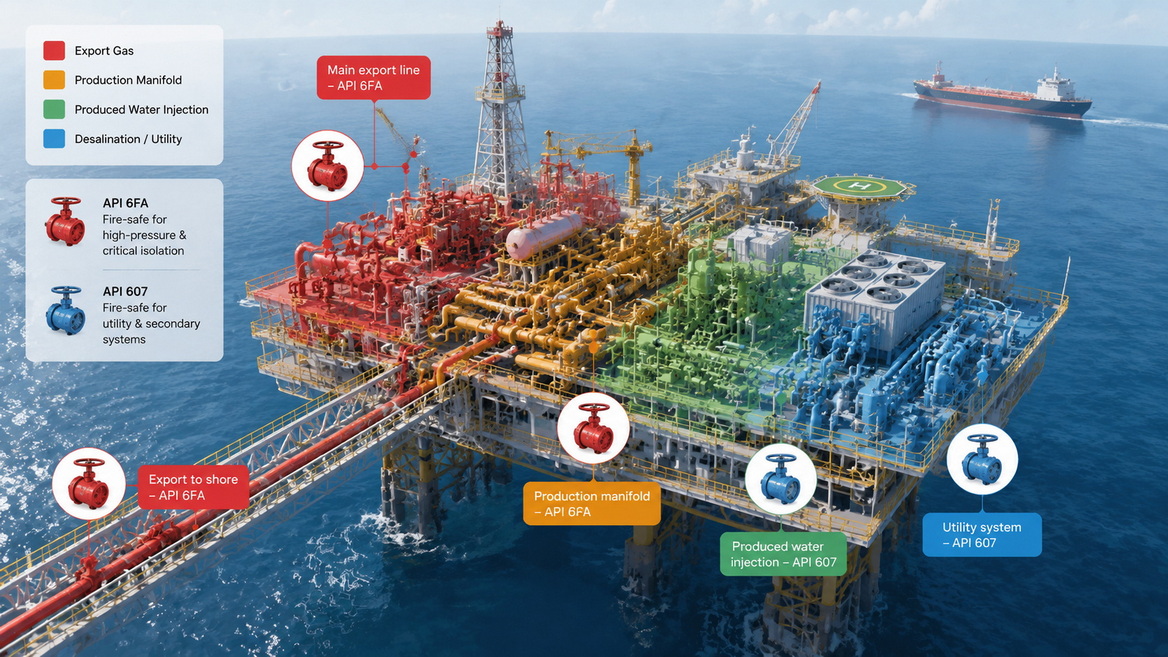
To illustrate how these decisions play out, consider a typical offshore oil and gas platform with:
- High‑pressure export gas line
- Produced water injection system
- Utility and desalination units for platform operations
In such a project, a common valve strategy is:
- Export gas line (trunnion ball valves)
- API 6D design, API 6FA fire test, API 598 pressure test
- Full documentation, including third‑party witness for key tests.
- Produced water injection and high‑pressure process lines
- Mix of trunnion and floating ball valves
- API 6FA for main isolation, API 607 for secondary or lower‑criticality valves.
- Desalination and utility systems
- Floating soft‑seated ball valves
- API 607 fire‑safe testing where required by platform standards, API 598 pressure tests for all units.
For a ball valve factory providing OEM/ODM products to an offshore EPC, being able to supply both API 607‑tested floating ball valves and API 6FA‑tested trunnion ball valves under one roof simplifies vendor management and reduces project risk.
Practical Checklist for OEM, ODM, and Brand Owners
If you are an overseas brand, wholesaler, or system integrator sourcing ball valves from a Chinese factory, use the following short checklist when discussing API 607 and API 6FA requirements:
1. Confirm which lines and systems in your project require API 6FA vs API 607.
2. Ask for the exact valve series, size range, and pressure class already certified to these standards.
3. Request fire test reports and witness certificates from recognized labs for both floating and trunnion ball valves.
4. Verify that routine production follows API 598 inspection and testing requirements.
5. Check that the factory can support OEM/ODM customization (branding, special trims, coating, documentation templates) based on your project and market needs.
By aligning your specifications early with your valve partner, you avoid rework at the RFQ or FAT stage and ensure that your own brand is protected when your customers audit fire‑safe performance.
Call to Action: Work With a Fire‑Safe Valve Partner
If your next project requires compliant floating ball valves or trunnion ball valves designed and tested to API 607 or API 6FA, it is essential to partner with a manufacturer who understands both the standard and the real‑world operating conditions. A dedicated ball valve factory can support OEM and ODM programs for international brands, wholesalers, and system builders, providing consistent quality, full documentation, and engineering support from design through final inspection.
When you plan your next RFQ or technical specification, involve your valve supplier early. Share your line classes, fire‑safe requirements, and documentation needs so your partner can recommend the best‑fit fire test standard and valve design for each system.
FAQs About API 607 vs API 6FA for Ball Valves
1. Is API 607 enough for all fire‑safe ball valve applications?
API 607 is widely accepted for soft‑seated quarter‑turn valves in many midstream and downstream applications, but for high‑pressure or high‑consequence systems, project standards may specifically require API 6FA.
2. Do trunnion ball valves always need API 6FA fire testing?
Not always. Many trunnion ball valves in general service are qualified to API 607, but for API 6D pipelines or API 6A‑related duties, API 6FA is often preferred or mandated due to higher risk and pressure levels.
3. How do API 598 tests relate to API 607 and API 6FA?
API 598 covers routine inspection and pressure testing (shell, seat, backseat) for valves, while API 607 and API 6FA specifically address performance under fire conditions. They are complementary, not interchangeable.
4. Can a single ball valve design be tested to both API 607 and API 6FA?
Yes, if the valve construction and intended service justify it, a manufacturer may test the same series according to both standards, especially for OEM/ODM customers who serve different industry segments and risk levels.
5. What documents should I request from a valve supplier to verify fire‑safe compliance?
You should request fire test reports to API 607 and/or API 6FA for the exact valve series, API 598 test records or procedures, material certificates, and any third‑party inspection or witness documentation relevant to your project scope.
References
1. Onero Valve. "API 607 vs API 6FA: Industrial Ball Valves Fire‑Safety Standards." https://www.onerovalve.com/blog/comparison/api-607-vs-api-6fa/
2. Everlasting Valve. "Valve Testing Methods and Standards: A Guide." https://www.everlastingvalveusa.com/valve-testing-methods/
3. STV Valve. "API 598: Valve Inspection & Testing Standard (Complete Guide)." https://www.stvvalves.com/api-598-valve-inspection-testing-standard-complete-guide/
4. NSW Valve. "Difference between API 607 and 6FA: Fire Test of Valves." https://www.nswvalve.com/news/difference-between-api-607-%E2%80%8B%E2%80%8Band-6fa-fire-test-of-valves/
5. Jonloo Valves. "What is a fire-safe valve? The differences between API 607 and API 6FA." https://www.jonloovalves.com/news/what-is-a-fire-safe-valve-the-differences-between-api-607-and-api-6fa.html
Hot Tags: Ball Valves, Manufacturers, Customized, Custom, Suppliers, Buy, Cheap, Quality, Advanced, Durable, in Stock, Free Sample, Made in China, Price, Quotation