Ball Valves Explained by An OEM Manufacturer
Content Menu
● What Is a Ball Valve and How Does It Work?
● Core Components of an Industrial Ball Valve
● Floating vs Trunnion Ball Valves – Expert Overview
>> Floating Ball Valve – How It Works and When to Use It
>> Trunnion Ball Valve – How It Works and When to Use It
● Manual vs Electric vs Pneumatic Ball Valves
● Materials and Connection Types for Harsh Industrial Service
● Full Port vs Standard Port – Why It Matters
● One‑, Two‑, and Three‑Piece Ball Valve Designs
● Can Ball Valves Be Used for Flow Control?
● Special Ball Valve Types for Demanding Applications
● OEM / ODM Perspective – How We Support Global Projects
● Practical Selection Checklist for Engineers and Buyers
● Call to Action – Discuss Your Ball Valve Project
● FAQs
>> Q1: What is the main difference between a floating and a trunnion ball valve?
>> Q2: When should I choose a trunnion ball valve instead of a floating ball valve?
>> Q3: Can I use a standard ball valve for flow control?
>> Q4: Which materials are best for ball valves in seawater or desalination applications?
>> Q5: What are the advantages of a 3‑piece ball valve in industrial plants?
From my experience working with international EPCs and valve distributors, a ball valve is more than just a quarter‑turn shut‑off device – it is a critical safety and reliability component in upstream, midstream, and downstream systems. When you choose between a floating ball valve and a trunnion ball valve, you are really deciding how much downtime, leakage risk, and lifecycle cost your project can tolerate.
This guide combines industry references with our daily manufacturing practice at Wenzhou Leader Flow Control Equipment Co., Ltd., an OEM/ODM ball valve factory serving oil & gas, seawater desalination, and offshore platforms. It is written for engineers, buyers, and technical sales teams who need both high‑level clarity and practical selection criteria.
What Is a Ball Valve and How Does It Work?
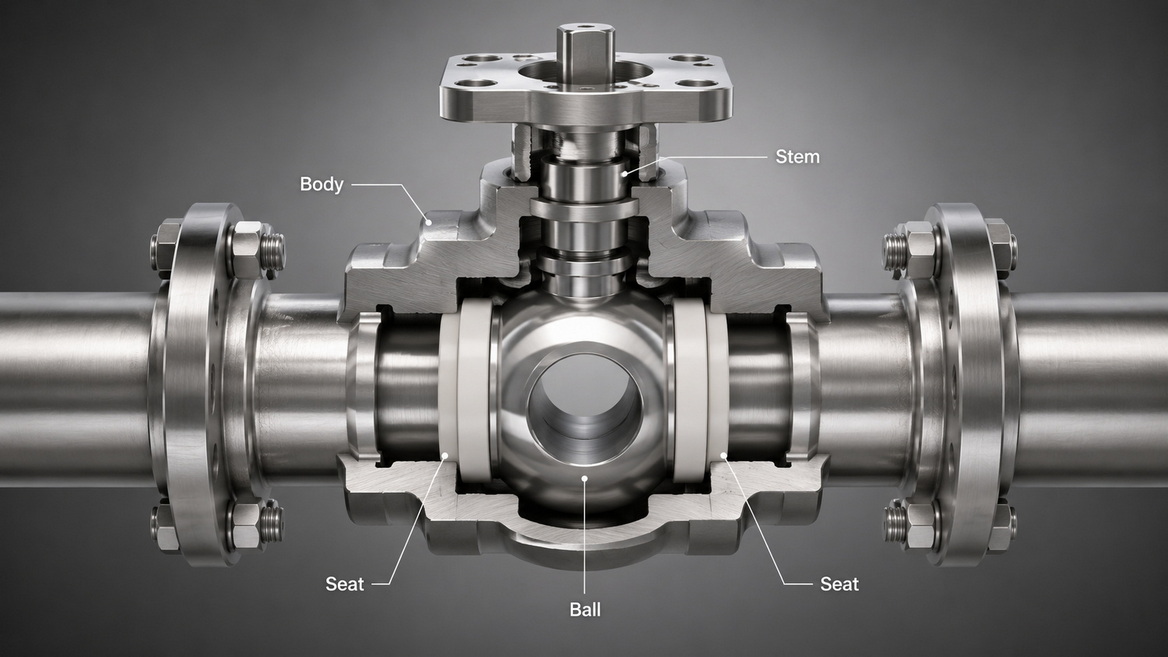
A ball valve is a shut‑off valve that uses a rotating ball with a bore (hole) to open or close the flow of liquids or gases. When the handle or actuator turns the ball 90 degrees, the bore aligns with the pipeline and allows full flow; turning it back 90 degrees blocks the passage. This simple quarter‑turn motion is the reason ball valves are fast‑acting and easy to automate.
Key characteristics from an engineering perspective:
- Primary function: On/off isolation rather than precise throttling.
- Operating mode: Quarter‑turn rotary motion with manual, electric, or pneumatic actuators.
- Typical benefits: Tight sealing, low pressure drop, compact size, and long service life with minimal maintenance.
Core Components of an Industrial Ball Valve
In industrial service, a ball valve is built around a few critical components that determine performance, safety, and lifetime.
- Body / housing:
The valve body contains the pressure boundary, end connections, and all internal parts. For aggressive media in oil & gas and desalination, stainless steel or duplex stainless steel bodies are common for corrosion resistance.
- Ball:
The ball has a precisely machined bore; when aligned with the pipeline, it allows full flow, and when turned perpendicular, it shuts off flow. High‑quality surface finishing and coating reduce torque and wear.
- Seats:
Seats support and seal around the ball to provide tight shut‑off. Soft seats (PTFE, reinforced PTFE, etc.) are common for general service; metal seats are used for high temperature, high pressure, or erosive media.
- Stem and stem sealing:
The stem connects the ball to the handle or actuator. O‑rings and packing around the stem prevent external leakage and must be carefully selected for temperature and chemical compatibility.
- Actuator interface:
Many industrial ball valves use an ISO 5211 mounting pad so they can be easily fitted with electric or pneumatic actuators. This is critical for remote operation on offshore platforms and pipelines.
From a reliability standpoint, seat material and stem sealing design are often where "hidden" quality differences appear between commodity products and engineered valves.
Floating vs Trunnion Ball Valves – Expert Overview
In daily engineering practice, the most important design choice is often between a floating ball valve and a trunnion ball valve.
Floating Ball Valve – How It Works and When to Use It
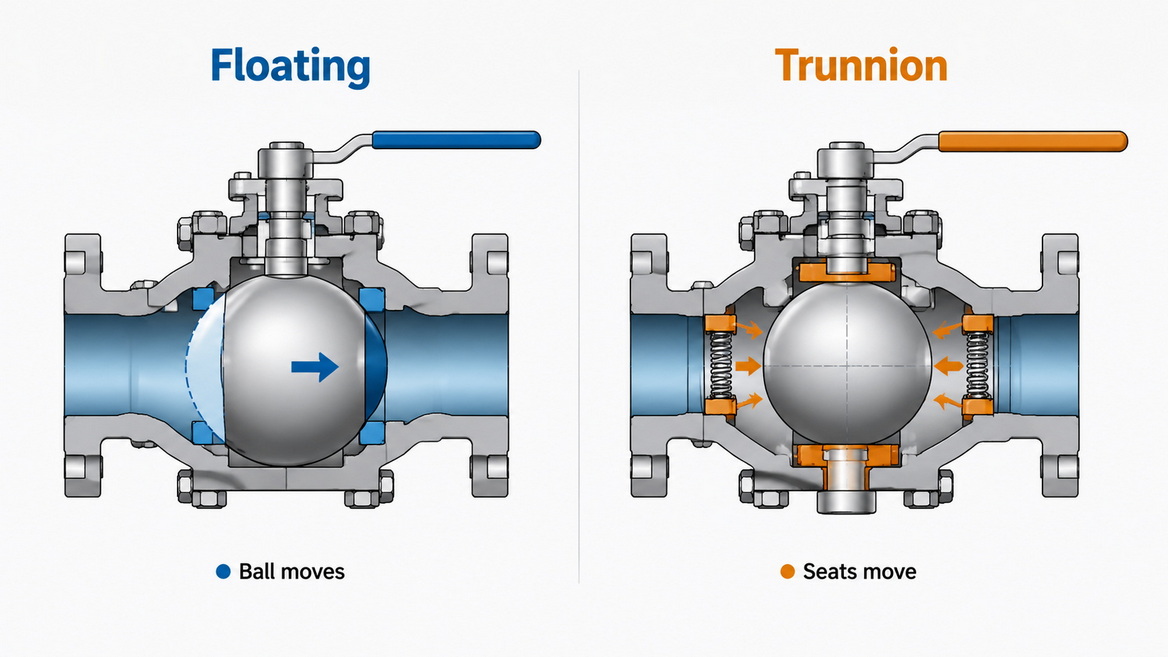
In a floating ball valve, the ball is held in place by the seats and can move slightly in the direction of flow. When the valve is closed, upstream pressure pushes the ball against the downstream seat, creating a tight seal.
Key points:
- Construction: Ball supported by the downstream seat; no mechanical support at the bottom of the ball.
- Typical sizes and pressures: Common for small to medium sizes and low to medium pressure services.
- Torque: Requires higher operating torque because the ball loads the seat directly.
- Leak tightness: Excellent shut‑off; widely used where bubble‑tight sealing is required.
Typical applications:
- Utility and process lines in refineries and chemical plants.
- General service oil & gas piping with moderate size and pressure.
- OEM skids and packages where compactness and cost matter more than very high pressure capability.
Trunnion Ball Valve – How It Works and When to Use It
A trunnion ball valve uses mechanical supports ("trunnions") at the top and bottom of the ball, so the ball is fixed in position and does not float downstream. Instead, the seats are spring‑loaded or pressure‑activated to move towards the ball and create a seal.
Key points:
- Construction: Ball supported by upper and lower trunnions; seats move to seal, not the ball.
- Pressure capability: Better suited for high pressure applications and large diameter pipelines.
- Torque: Lower operating torque compared to floating design, enabling smaller actuators on large valves.
- Operational safety: More stable under high differential pressure and less risk of seat damage in large‑bore lines.
Typical applications:
- High‑pressure transmission pipelines for oil and gas.
- Offshore platforms where high design pressures, large sizes, and tight automation envelopes are common.
- Desalination plants and critical water transfer lines where tight shut‑off and low operating torque support reliable automation.
Manual vs Electric vs Pneumatic Ball Valves
From a project execution standpoint, actuator choice is as important as valve design.
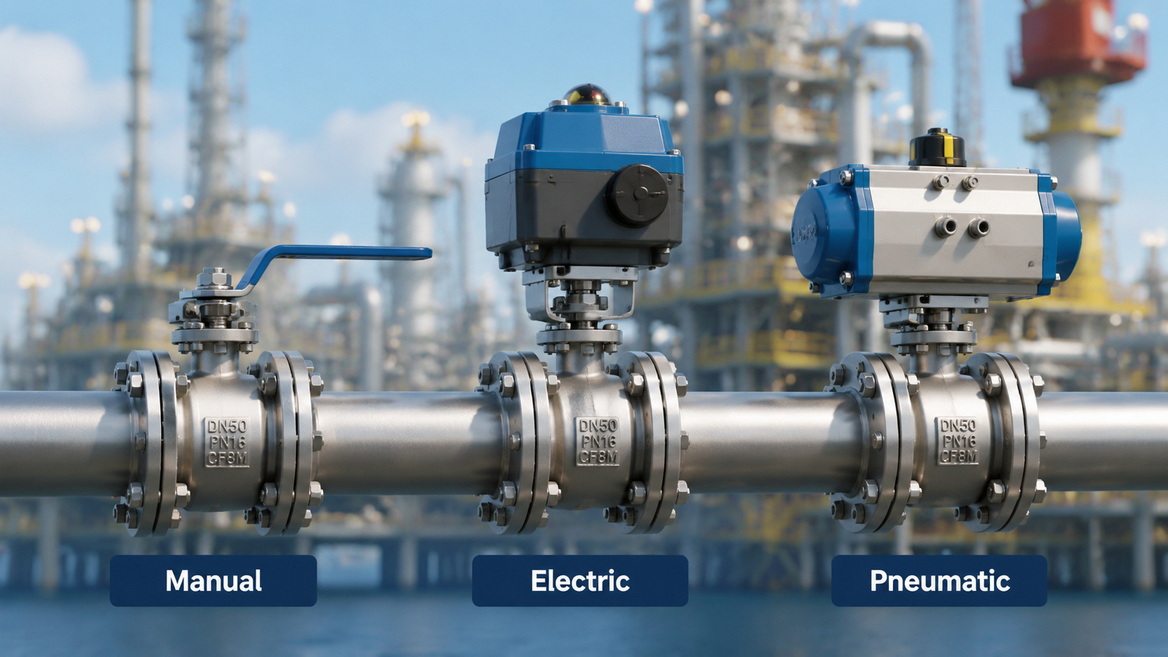
- Manual ball valves:
Best for simple, local isolation points. They are cost‑effective and easy to maintain but require human access and are not suitable for hazardous or remote locations.
- Electric actuated ball valves:
Electric actuators offer precise positioning and integrate easily with digital control systems. They are widely used in building services, zone control, and process environments where electrical infrastructure is already available. Key parameters include torque, fail‑safe position, and response time.
- Pneumatic actuated ball valves:
Pneumatic actuators provide high torque and fast response, making them ideal for high‑cycle service in oil & gas and other hazardous areas. They do not introduce ignition sources, which is a major advantage in explosive atmospheres.
Materials and Connection Types for Harsh Industrial Service
Housing and Seat Materials
Choosing the right valve body and seat materials is fundamental for safety and lifecycle cost.
Common housing materials:
- Brass: Durable and cost‑effective, suitable for many low‑pressure general applications but sensitive to dezincification in certain media.
- Stainless steel: Highly corrosion‑resistant and abrasion‑resistant, widely used in chemical, petrochemical, and marine environments.
- Plastic (PVC, PVDF): Lightweight and corrosion‑resistant; suitable for lower pressures and many chemical applications.
- Cast iron / carbon steel: Strong and economical for larger sizes and high pressures but need proper coating and corrosion protection.
Seat and seal materials:
- PTFE (Teflon): Excellent chemical resistance and low friction, widely used as the default seat material.
- Elastomers (EPDM, FKM, PA): Selected based on temperature range and chemical resistance.
- Metal seats: Used for high temperature, erosive, or high‑cycle services where soft seats would wear prematurely.
In offshore and desalination projects, we frequently combine stainless or duplex bodies with specialized seats to handle chloride‑rich environments and high design pressures.
End Connection Types
Different connection types provide flexibility in installation and maintenance.
In our OEM projects, we see flanged trunnion ball valves dominate high‑pressure lines, while threaded and welded floating ball valves remain cost‑efficient choices for smaller bore process, utility, and instrument lines.
Full Port vs Standard Port – Why It Matters
Ball valves are typically offered in full port and standard (reduced) port options.
- Full port ball valves:
The bore is the same size as the pipeline, resulting in minimal pressure drop and enabling pigging operations in pipelines. These are preferred for transmission lines and processes where pressure loss must be minimized.
- Standard port ball valves:
The bore is smaller than the pipeline diameter, leading to higher flow velocity and some pressure drop. They are more compact and cost‑effective, suitable where minor energy loss is acceptable.
In practice, high‑pressure trunnion ball valves for oil & gas pipelines are usually designed as full port, while many utility and secondary lines rely on standard port floating ball valves to balance performance and cost.
One‑, Two‑, and Three‑Piece Ball Valve Designs
From a maintenance and lifecycle perspective, the body construction makes a real difference.
- 1‑piece ball valve:
Compact and economical, common in residential and light commercial applications. Limited maintainability, typically replaced rather than repaired.
- 2‑piece ball valve:
Body split into two sections, allowing the valve to be removed for service without cutting the pipe. A good balance between cost and maintainability for industrial applications.
- 3‑piece ball valve:
Three body sections with bolted connections so the center part can be removed while the end connections remain in the line. This design allows easy cleaning, seat replacement, or customization and is widely used in chemical processing, oil & gas, and water treatment where downtime is costly.
Can Ball Valves Be Used for Flow Control?
Standard ball valves are designed primarily as shut‑off valves. While they can be partially opened to restrict flow, this is not recommended for precise control because it can cause uneven seat wear, vibration, and noise.
For applications requiring accurate modulation, engineers specify characterized ball valves with special V‑port or parabolic bores. These designs provide a more linear flow characteristic and better stability under varying differential pressures. In HVAC and process control, such characterized ball valves are often paired with modulating electric actuators for precise control of temperature or flow.
Special Ball Valve Types for Demanding Applications
Certain applications require specialized ball valve designs.
- Vented ball valves:
Include a vent port to safely relieve trapped pressure when the valve is closed, reducing the risk of accidental discharge when disconnecting downstream equipment.
- Modulating ball valves:
Designed to hold intermediate positions between fully open and fully closed, usually with a feedback signal for closed‑loop control. Common in process control and HVAC.
- 90‑degree (angle) ball valves:
Used where the pipeline changes direction by 90 degrees, combining a valve and elbow in one component.
- High‑pressure ball valves:
Engineered for hydraulic and high‑pressure oil applications up to roughly 500 bar, using robust bodies and full‑bore designs.
For OEM and ODM projects, we often integrate these special designs into skid‑mounted systems, ensuring that the actuation and connection standards align with the client's broader plant design.
OEM / ODM Perspective – How We Support Global Projects
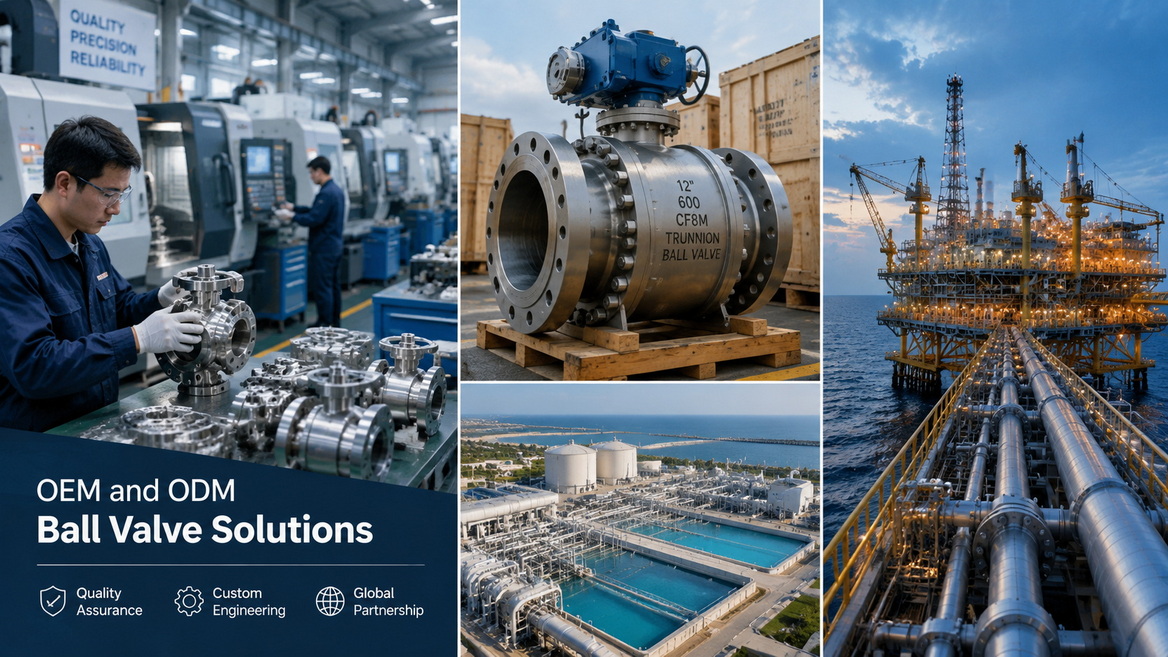
As an OEM and ODM manufacturer in Wenzhou, China, our team works closely with foreign brands, wholesalers, and system manufacturers who private‑label our floating and trunnion ball valves. From a practical standpoint, what they value most is not just product cost, but engineering support and documentation.
Typical support we provide:
- Application engineering to choose between floating vs trunnion, full vs standard port, and suitable materials for each project.
- Customization of end connections, coatings, and actuation packages based on local standards and site conditions.
- Complete inspection and test documentation (EN, API, or customer‑specific standards) to support their brand promise in local markets.
If you are specifying ball valves for oil & gas, desalination, or offshore projects, partnering with an OEM that understands both design standards and real‑world operating conditions can significantly reduce project risk.
Practical Selection Checklist for Engineers and Buyers
When selecting a ball valve for a project, consider the following practical checklist:
1. Define the service conditions
- Medium (oil, gas, seawater, chemicals)
- Pressure and temperature range
- Required shut‑off class and leakage rate
2. Choose the valve design
- Floating ball valve for small/medium sizes at low to medium pressure.
- Trunnion ball valve for high‑pressure or large‑diameter lines.
3. Select body, seat, and seal materials
- Stainless or duplex for corrosive media or seawater.
- PTFE or reinforced seats for general duties, metal seats for severe conditions.
4. Specify end connections and port type
- Flanged ends for large or high‑pressure piping.
- Threaded or welded ends for small‑bore or skid‑mounted systems.
- Full port where low pressure drop or pigging is required.
5. Decide on actuation and control
- Manual for local isolation.
- Electric for precise and integrated control.
- Pneumatic for hazardous areas and high‑cycle service.
6. Confirm standards, testing, and documentation
- Applicable international standards.
- Required test certificates and documentation packages.
A structured approach like this turns ball valve selection from a price‑driven decision into a risk‑controlled engineering choice.
Call to Action – Discuss Your Ball Valve Project
If you are planning a new pipeline, desalination plant, or offshore project and need reliable floating or trunnion ball valves, you do not have to navigate the specifications alone. Our engineering team at Wenzhou Leader Flow Control Equipment Co., Ltd. can review your process data and standards to recommend a cost‑effective, compliant valve package tailored to your application.
Contact us today to discuss your project requirements, request technical support, or explore OEM/ODM cooperation for your own branded ball valve line.
FAQs
Q1: What is the main difference between a floating and a trunnion ball valve?
A floating ball valve relies on line pressure pushing the ball against the downstream seat, while a trunnion ball valve supports the ball with trunnions and moves the seats to achieve sealing.
Q2: When should I choose a trunnion ball valve instead of a floating ball valve?
Choose a trunnion ball valve for high‑pressure, large‑diameter pipelines or where reduced operating torque and reliable automation are critical, such as transmission lines and offshore platforms.
Q3: Can I use a standard ball valve for flow control?
Standard ball valves are primarily shut‑off devices and are not ideal for precise flow control; for accurate modulation, specify a characterized or V‑port ball valve with a suitable actuator.
Q4: Which materials are best for ball valves in seawater or desalination applications?
For seawater and desalination, stainless or duplex stainless steel bodies combined with corrosion‑resistant seats and seals are commonly recommended to handle chloride‑rich environments and high pressures.
Q5: What are the advantages of a 3‑piece ball valve in industrial plants?
A 3‑piece ball valve allows the center section to be removed for cleaning or seat replacement without disturbing the end connections, minimizing downtime and simplifying maintenance in high‑value process lines.
References
1. Tameson. "A Guide To Ball Valves."
https://tameson.com/pages/ball-valve-introduction
2. MSEC. "Introduction to Ball Valves."
https://msecinc.com/blog/introduction-to-ball-valves/
3. Savree. "What is a Ball Valve? (Ball Valves Explained)."
https://savree.com/en/product/ball-valve
4. Dombor. "Floating Ball Valve Vs. Trunnion: What's Their Difference."
https://www.dombor.com/floating-ball-valve-vs-trunnion-ball-valve/
5. USCortec. "Trunnion Vs Floating Ball Valve."
https://uscortec.com/trunnion-vs-floating/
6. Tsuunny Group. "all Valve: A Comprehensive Guide for Industrial Applications."
https://www.tsunnyvalve.com/zh/ball-valve-a-comprehensive-guide-for-industrial-applications/
7. Copeland Valve. "Metal Seated Ball Valve: Floating vs. Trunnion."
https://copelandvalve.com/news/metal-seated-ball-valve-floating-vs-trunnion/
8. Wenzhou Leader Valve Co., Ltd. (Factory information and profile).
https://www.made-in-china.com/showroom/leadervalve888/
Hot Tags: Ball Valve, Manufacturers, Customized, Custom, Suppliers, Buy, Cheap, Quality, Advanced, Durable, in Stock, Free Sample, Made in China, Price, Quotation