Floating Vs Trunnion Ball Valve – Expert Guide for Oil & Gas, Desalination And OEM Projects
Content Menu
● Floating vs Trunnion Ball Valve – Expert Guide for Oil & Gas, Desalination and OEM Projects
● What Is a Floating Ball Valve?
● What Is a Trunnion Ball Valve?
● Key Design and Sealing Differences
>> Ball Support and Internal Mechanics
>> Sealing Principle – Downstream vs Upstream Seats
● Performance Comparison – Pressure, Size, Torque and Cost
● Application Scenarios – Where Each Valve Type Excels
>> Typical Use Cases for Floating Ball Valves
>> Typical Use Cases for Trunnion Ball Valves
● Industry-Focused Expert Insights (Oil & Gas, Desalination, Offshore)
● Practical Selection Checklist for Engineers and Buyers
● OEM & ODM Considerations for Global B2B Projects
● FAQs – Floating vs Trunnion Ball Valve
>> Q1: Are floating ball valves suitable for high-pressure gas pipelines?
>> Q2: Why do trunnion ball valves have lower operating torque?
>> Q3: Do floating ball valves provide double block and bleed functionality?
>> Q4: How should I choose between floating and trunnion valves for desalination plants?
>> Q5: What factors affect the total cost of ownership (TCO) of ball valves?
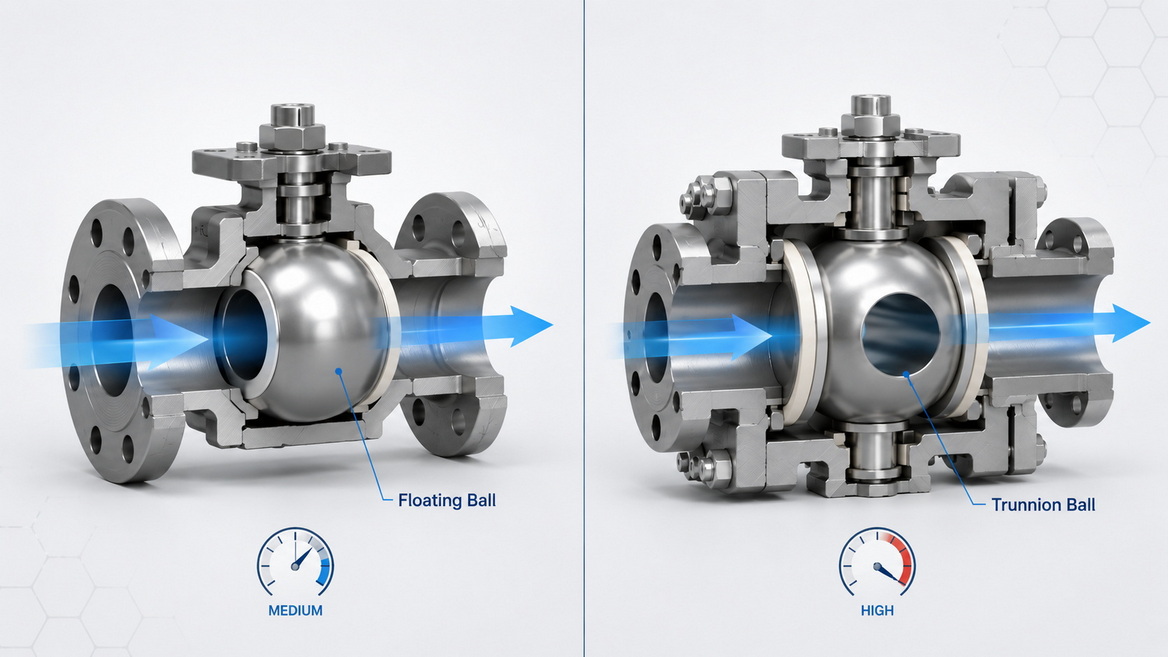
Floating ball valves are ideal for medium-pressure, cost-sensitive industrial lines, while trunnion ball valves are engineered for high-pressure, large-bore, safety-critical applications such as oil and gas pipelines and offshore platforms. For manufacturers, EPC contractors and B2B buyers, the real question is not which design is "better", but which design is mechanically and economically correct for your specific project.
Floating vs Trunnion Ball Valve – Expert Guide for Oil & Gas, Desalination and OEM Projects
Selecting between a floating ball valve and a trunnion ball valve is a high-impact engineering decision that shapes safety, lifecycle cost and automation reliability across your entire process line. As a valve specialist working with global OEM and ODM customers in oil & gas, seawater desalination and offshore platforms, I see the same pattern: projects succeed or fail based on how well the valve design matches pressure, size, media and maintenance realities—not on price alone. This guide breaks down both designs from a practical, field-tested perspective, so that engineers, purchasing managers and project owners can justify their choice with confidence.
What Is a Floating Ball Valve?
A floating ball valve uses a ball that is not rigidly fixed to the valve body; instead, it "floats" between two seats with a small axial clearance. When the valve closes, upstream line pressure pushes the ball against the downstream seat, creating a tight seal.
Typical characteristics include:
- Simple structure with fewer internal components
- Lower manufacturing cost and compact footprint
- Best suited to low-to-medium pressure systems and small-to-medium line sizes
From a buyer's perspective, a floating ball valve is often the "default" choice for utility services, general process isolation and medium-pressure transfer lines where budget and ease of maintenance are primary drivers.
What Is a Trunnion Ball Valve?
A trunnion ball valve features a ball that is anchored by an upper stem and a lower trunnion shaft, supported by bearings. The ball cannot move laterally; instead, spring-loaded floating seats move toward the ball to achieve sealing when pressure is applied.
Key characteristics:
- Fixed-axis ball supported by stem and trunnion
- Floating, spring-loaded seats that maintain seal integrity
- Designed for high-pressure, large-bore and safety-critical service
In practice, trunnion ball valves dominate pipeline isolation (API 6D), high-pressure gas transmission, refinery units and offshore topside systems, where predictable torque, double block and bleed (DBB) capability and cavity pressure relief are non-negotiable safety requirements.
Key Design and Sealing Differences
Ball Support and Internal Mechanics
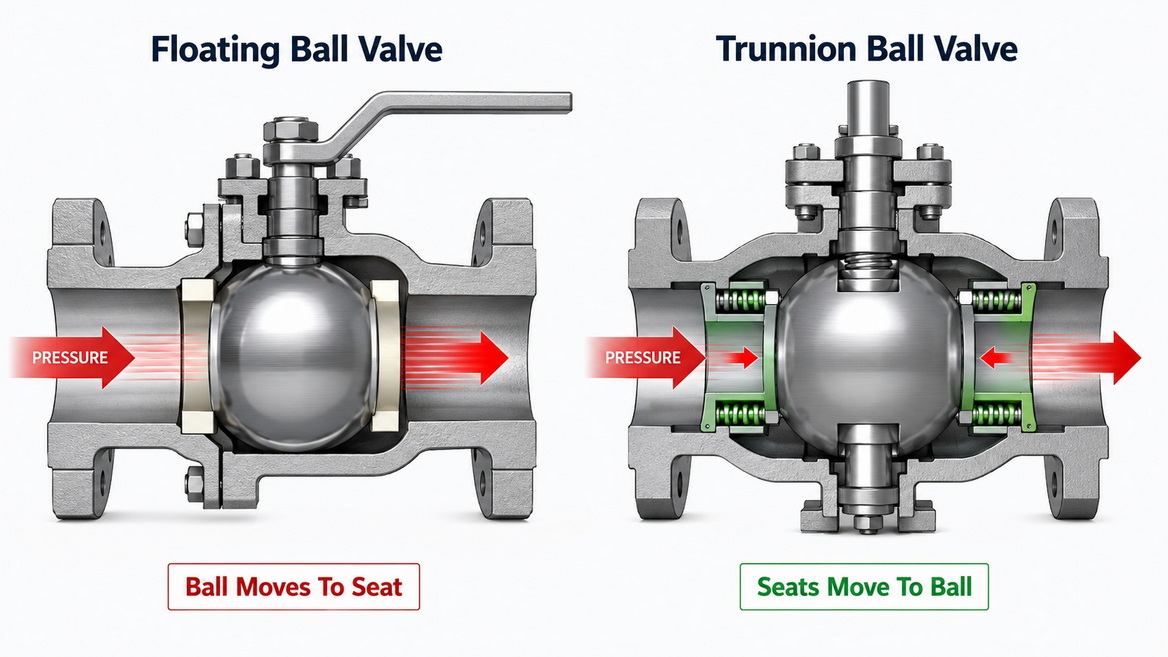
The core design difference lies in how the ball is supported:
- Floating ball valve:
- Ball is driven by the stem and allowed a small axial movement.
- Line pressure pushes the ball downstream; the downstream seat carries the full pressure load.
- Trunnion ball valve:
- Ball is fixed on upper and lower trunnion bearings; it only rotates.
- Seats are floating and spring-loaded, moving toward the ball under pressure.
This structural contrast decides operating torque, size limits and seat wear patterns over the valve's lifecycle.
Sealing Principle – Downstream vs Upstream Seats
- In a floating ball valve, sealing is predominantly downstream: media pressure forces the ball against the outlet seat. - In a trunnion valve, sealing comes from spring-loaded seats plus media pressure, pressing seats against a fixed ball.
Because the trunnion design decouples line pressure from sealing force, it maintains more stable sealing performance at high pressures and large diameters, where floating seat loads become mechanically excessive.
Performance Comparison – Pressure, Size, Torque and Cost
Below is a concise engineering-focused comparison table you can use in technical proposals and internal specs.
| Parameter | Floating Ball Valve | Trunnion Ball Valve |
|---|---|---|
| Ball Support | Free-floating ball (no bottom shaft)fitok+1 | Fixed by stem and lower trunnion on bearingsfitok+1youtube |
| Sealing Principle | Ball pressed against downstream seat by line pressurefitok+1 | Spring-loaded seats pressed against fixed ballfitok+1youtube |
| Typical Pressure Range | Low to medium (e.g. Class 150–300)fitok+1 | Medium to very high (up to Class 2500)blog.projectmaterialsyoutube |
| Typical Size Range | Small to medium, commonly up to 8–10 inchblog.projectmaterialsyoutube | Large-bore pipelines up to 60 inch or moreblog.projectmaterialsyoutube |
| Operating Torque | Increases significantly with pressure and sizefitok+1 | Lower, more stable torque curve vs pressurefitok+1youtube |
| Manufacturing Cost | Lower, fewer internal partsfitok+1 | Higher initial cost, more complex internalsfitok+1youtube |
| DBB Capability | Usually single downstream seal; no true DBBblog.projectmaterials | Supports double block and bleed designsblog.projectmaterialsyoutube |
| Maintenance | Simple seats and fewer components; faster routine workfitok+1 | More complex but longer service intervals and better TCOfitok+1youtube |
From a project ROI standpoint, floating ball valves win on CapEx, while trunnion designs often win on OpEx and risk reduction in critical services.
Application Scenarios – Where Each Valve Type Excels
Typical Use Cases for Floating Ball Valves
You'll usually select a floating ball valve when:
- Line sizes are small to medium and pressures are low or moderate.
- The system is utility-focused: water treatment, general process isolation, instrument root valves.
- Budget constraints favor lower initial cost and basic automation or manual operation.
In OEM and ODM projects, floating ball valves are often specified for secondary process lines, skid-mounted packages and non-critical isolation points where simplicity and standardization matter more than DBB capability.
Typical Use Cases for Trunnion Ball Valves
You should lean toward a trunnion ball valve when:
- Pipe diameter exceeds 8 inch or design pressures exceed Class 300.
- The application involves high-pressure gas, crude pipelines, subsea tie-ins or critical refinery units.
- The system requires double block and bleed, cavity pressure relief, and tight shut-off under both upstream and downstream pressures.
For offshore platforms and desalination plants, trunnion ball valves provide stable torque for large actuators, verified isolation via DBB and integration with emergency shutdown systems, which collectively reduce shutdown risk and insurance exposure.
Industry-Focused Expert Insights (Oil & Gas, Desalination, Offshore)
From an industry practitioner's perspective, the floating vs trunnion choice should be anchored in real operating conditions, not just catalogue data.
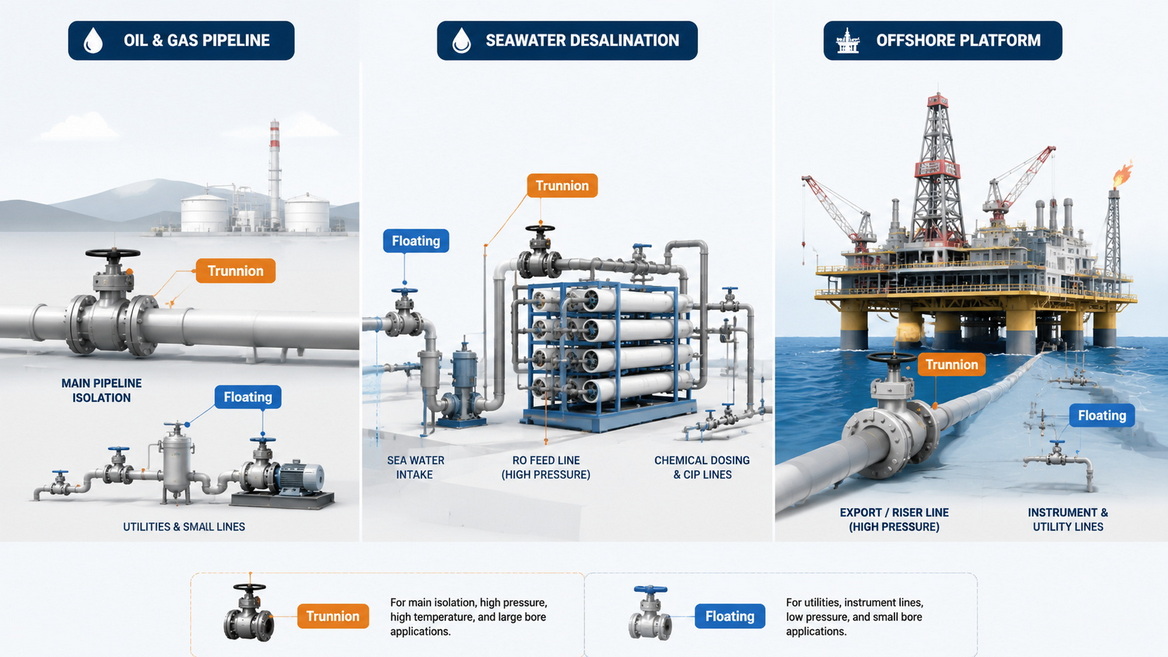
Oil & Gas Pipelines and Terminals
- Long-distance pipelines, export terminals and high-pressure gas lines almost universally standardize trunnion ball valves to API 6D, due to DBB, cavity relief and large-bore capability.
- Floating ball valves remain useful in utility lines, flare systems and instrument isolation, where pressures are modest and safety requirements differ.
Seawater Desalination and Water Treatment
- For SWRO high-pressure pump discharge, trunnion valves withstand continuous high differential pressure and cyclic loading.
- For pre-treatment and low-pressure distribution, floating ball valves offer a cost-effective solution that is easy to maintain and replace.
Offshore Platforms and FPSOs
- Space and weight limitations favor compact floating valves on some skids, but critical ESD, export and high-pressure injection lines are usually equipped with trunnion designs.
- In corrosive seawater and mixed media services, seat and body material choices become as important as the ball support design; this is where OEM customization and material traceability add significant value.
Practical Selection Checklist for Engineers and Buyers
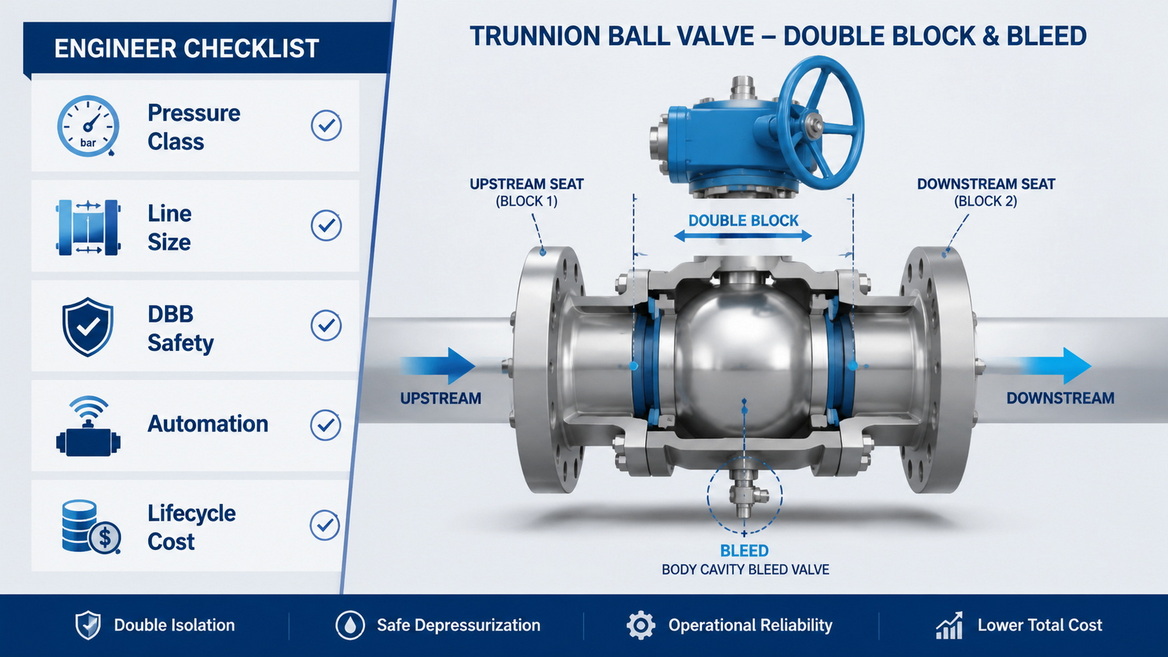
When deciding between floating vs trunnion ball valve for a new project or retrofit, I recommend running a quick six-point checklist:
1. Design Pressure and Class
- If your maximum operating pressure and ASME class stay in the low-to-medium range, a floating ball valve is typically sufficient.
- For high classes (e. g., 600–2500) or pressure surges, trunnion is the safer, standards-aligned choice.
2. Line Size and Flow Capacity
- Up to about 8–10 inch, floating designs are practical and cost-effective.
- Beyond that, actuator torque and seat load make trunnion designs far more reliable.
3. Safety and DBB Requirements
- If your specification calls for double block and bleed or formal cavity pressure relief, you're almost certainly in trunnion territory.
4. Automation Strategy
- Unpredictable, high torque of floating valves at high pressure requires larger actuators and margin, raising package cost. - Trunnion valves enable more accurate actuator sizing and integration with digital positioners and predictive maintenance tools.
5. Lifecycle Cost vs CapEx
- Floating valves minimize initial investment, ideal for non-critical duty. - Trunnion valves often lower total cost of ownership through reduced downtime and longer intervals between seat replacement.
6. Media, Temperature and Regulatory Compliance
- Aggressive media, high temperature and stringent compliance frameworks (API 6D, fire-safe, SIL) usually push you to trunnion with proven certification.
OEM & ODM Considerations for Global B2B Projects
For international brands, wholesalers and system manufacturers, the floating vs trunnion choice must also align with OEM/ODM strategy:
- Standardization of core trims: Defining common seat materials, stem designs and fire-safe options across both floating and trunnion families simplifies global inventory and after-sales service.
- Documentation and traceability: OEM valve programs benefit from robust test reports, MTCs and compliance documentation (API, ISO, CE) to satisfy regional regulatory requirements.
- Customization windows: Allowing customers to configure actuation packages, end connections, coatings and cavity relief options on top of a stable base design helps them fine-tune valves to project risk profiles without reinventing the core engineering.
FAQs – Floating vs Trunnion Ball Valve
Q1: Are floating ball valves suitable for high-pressure gas pipelines?
In most cases, no. Floating ball valves are generally recommended for low-to-medium pressure services, while high-pressure gas pipelines require trunnion-mounted ball valves conforming to API 6D standards.
Q2: Why do trunnion ball valves have lower operating torque?
Because the ball is supported on bearings and held stationary, the friction is mainly between spring-loaded seats and the ball, resulting in a lower and more stable torque profile compared to floating designs where pressure forces the ball into the seat.
Q3: Do floating ball valves provide double block and bleed functionality?
Typically no. Floating ball valves rely on a single downstream seat under pressure and cannot offer true double block and bleed (DBB); trunnion valves are engineered specifically to provide DBB with independent upstream and downstream seats.
Q4: How should I choose between floating and trunnion valves for desalination plants?
Use trunnion ball valves on high-pressure RO feed and critical isolation points, and floating ball valves on low-pressure pretreatment and utility lines where cost and simplicity are more important.
Q5: What factors affect the total cost of ownership (TCO) of ball valves?
Key factors include pressure class, seat wear rate, maintenance frequency, downtime costs, automation complexity and safety requirements; trunnion valves often justify higher initial cost through lower lifecycle risk and better availability in critical systems.
References
1. FITOK – *Floating Ball Valves vs. Trunnion Ball Valves*
https://www.fitok.com/blog/detail-17-049c4adbdc9d0b72.html
2. Projectmaterials – *Floating vs Trunnion Ball Valve*
https://blog.projectmaterials.com/quick-answers/valves/floating-vs-trunnion-ball-valve/
3. Onero Valve – *Floating vs. Trunnion Mounted Ball Valves: Key Differences*
https://www.onerovalve.com/blog/floating-vs-trunnion-ball-valve/
4. Dombor – *Floating Ball Valve Vs. Trunnion: What's Their Difference*
https://www.dombor.com/floating-ball-valve-vs-trunnion-ball-valve/
5. SpecForge – *Ball Valve Guide — Types, Specs, Selection*
https://www.sourcebyspec.com/encyclopedia/ball-valve.html
6. Neway – *Ball Valve Selection Guide: Trunnion vs Floating & Soft vs Metal Seat*
https://www.newayvalve.com/159/ball_valve_selection_trunnion_vs_floating_soft_vs_metal_seat
7. CORTEC – *Trunnion Vs Floating Ball Valve*
https://uscortec.com/trunnion-vs-floating/
8. Gemini Valve – *Floating Ball Valves vs. Trunnion Ball Valves*
https://www.geminivalve.com/floating-ball-valves-vs-trunnion-ball-valves/
9. Vincer Valve – *Trunnion vs Floating Ball Valve: Key Comparison Insights*
https://www.vincervalve.com/trunnion-vs-floating-ball-valve
10. CTGV – *Floating vs Trunnion Ball Valve: A Complete Guide*
https://www.tgvalve.com/blog/ball-valve/comparison-ball-valve/floating-vs-trunnion-ball-valve/
Hot Tags: Floating Vs Trunnion Ball Valve, Manufacturers, Customized, Custom, Suppliers, Buy, Cheap, Quality, Advanced, Durable, in Stock, Free Sample, Made in China, Price, Quotation