Butterfly Valve Vs Ball Valve: An Expert Guide for Oil & Gas And Industrial Operators
Content Menu
● 6 Key Similarities Between Butterfly and Ball Valves
● 8 Core Differences: Butterfly Valve vs Ball Valve
>> Design and Performance Overview
● Floating vs Trunnion Ball Valves: Why It Matters
● How They Compare in Cost, Space, and Weight
>> Space and Weight Constraints
● Sealing Performance, Pressure Handling, and Flow Control
>> Pressure and Temperature Ranges
>> Flow Characteristics and Cavitation Risk
● Application Scenarios: When to Choose Which Valve
>> When a Ball Valve Is the Better Choice
>> When a Butterfly Valve Makes More Sense
● Industry Case Example: Offshore Platform Produced Water Line
● OEM/ODM Perspective: Selecting the Right Ball Valve for Your System
● Practical Selection Checklist for Engineers
● Call to Action: Talk to a Ball Valve Specialist
● Frequently Asked Questions (FAQ)
>> 1. Can I use a ball valve for throttling?
>> 2. Are triple‑offset butterfly valves a complete replacement for ball valves?
>> 3. What is the main advantage of trunnion ball valves over floating ball valves?
>> 4. How do I choose between a wafer and lug butterfly valve?
>> 5. Why are ball valves so common in oil and gas compared with butterfly valves?
When you are responsible for keeping a pipeline, offshore platform, or desalination plant running safely, choosing between a butterfly valve and a ball valve is not a theoretical exercise—it is a decision that affects uptime, safety, and lifecycle cost. As a ball valve manufacturer working closely with international OEM and ODM partners, I have seen projects succeed or struggle based on how well this choice matched the actual operating conditions.
In this guide, we will walk through how butterfly and ball valves compare in real industrial environments, what recent developments mean for your selection, and when a floating ball valve or trunnion ball valve is clearly the better option.
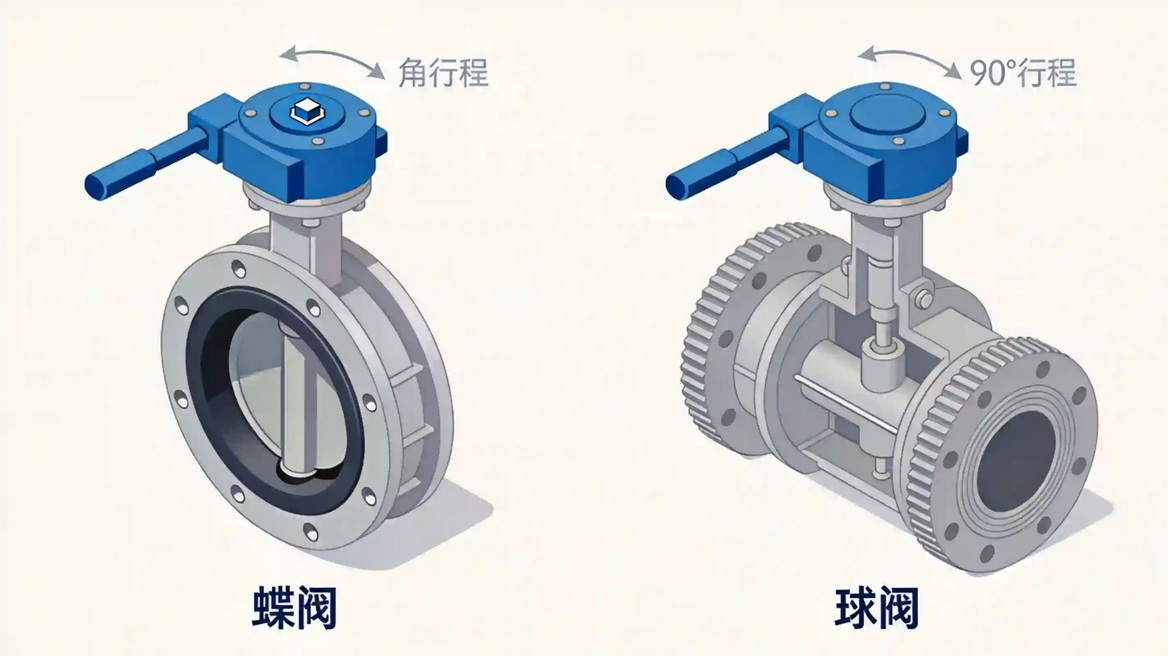
What Is a Ball Valve?
A ball valve is a quarter‑turn shut‑off valve that uses a spherical ball with a through‑bore to start or stop flow. When the bore aligns with the pipeline, the valve is fully open; when it is perpendicular, flow is fully blocked.
Key characteristics of ball valves:
- Tight shut‑off: Soft‑seated ball valves can achieve near zero‑leakage performance and are widely used where bubble‑tight isolation is required.
- High pressure capability: Properly designed ball valves handle high pressures and are common in oil and gas, chemical processing, and high‑duty water services.
- Simple quarter‑turn operation: Ball valves are easy to automate and integrate with actuators in modern process control systems.
In our own manufacturing, we focus on floating ball valves for small to medium sizes and trunnion‑mounted ball valves for larger diameters and higher pressures, especially in upstream and midstream oil and gas applications.
What Is a Butterfly Valve?
A butterfly valve is also a quarter‑turn valve, but it uses a circular disc mounted on a shaft as the closure element. When the disc is parallel to the flow, the valve is open; rotated to 90 degrees, the disc blocks the flow path.
Typical features of butterfly valves:
- Compact and lightweight: Short face‑to‑face dimensions and a slim disc make butterfly valves ideal where space and weight are constrained.
- Cost‑effective in large diameters: For DN 300 (12‑inch) and above, butterfly valves often cost significantly less than ball valves of equivalent pressure class.
- Good for throttling: Butterfly valves can be used for flow regulation when specified and sized correctly.
Butterfly valves are very common in water treatment, HVAC, and large diameter low‑ to medium‑pressure pipelines where tight shut‑off under extreme conditions is less critical.
6 Key Similarities Between Butterfly and Ball Valves
Both valve types share several fundamental traits that often make them candidates for the same projects.
- Quarter‑turn operation: Both open and close with a 90‑degree turn, enabling fast isolation and easy actuation.
- Manual or automated: Both can be fitted with levers, gearboxes, or electric/pneumatic actuators.
- Wide media compatibility: With proper trim and seat selection, both handle liquids, gases, and some slurries.
- Broad industrial use: Oil and gas, water treatment, power, and marine applications all use both types in different parts of the system.
- Durability: When built to standards like API and ISO and maintained correctly, both can deliver long service life.
- Standardized design codes: Ball valves commonly follow API 6D and API 608, while butterfly valves follow API 609 and related standards.
8 Core Differences: Butterfly Valve vs Ball Valve
The real decision is not whether one valve is "better" in general, but which is more appropriate for a specific duty. The table below summarizes the main differences.
Design and Performance Overview
| Factor | Ball Valve | Butterfly Valve |
|---|---|---|
| Closure element | Spherical ball with bore | Rotating disc on shaft |
| Flow path | Full‑bore options with minimal restriction | Disc remains in flow, causing some obstruction |
| Sealing performance | Excellent, bubble‑tight with soft seat | Good; triple‑offset types can reach Class VI |
| Pressure capability | Very high, especially trunnion design | Moderate to high (depends on design) |
| Size sweet spot | Small to medium, up to large | Medium to very large diameters |
| Weight | Heavier, more material | Lighter, especially wafer designs |
| Cost in large diameters | Generally higher | Typically lower, often 30–40% of ball valve cost for large sizesonerovalve |
| Best use cases | Critical isolation, high pressure, piggable lines | Large, low‑ to medium‑pressure systems, throttling |
Design note: For piggable pipelines and critical isolation, a full‑bore ball valve that matches the pipe ID is often a requirement.
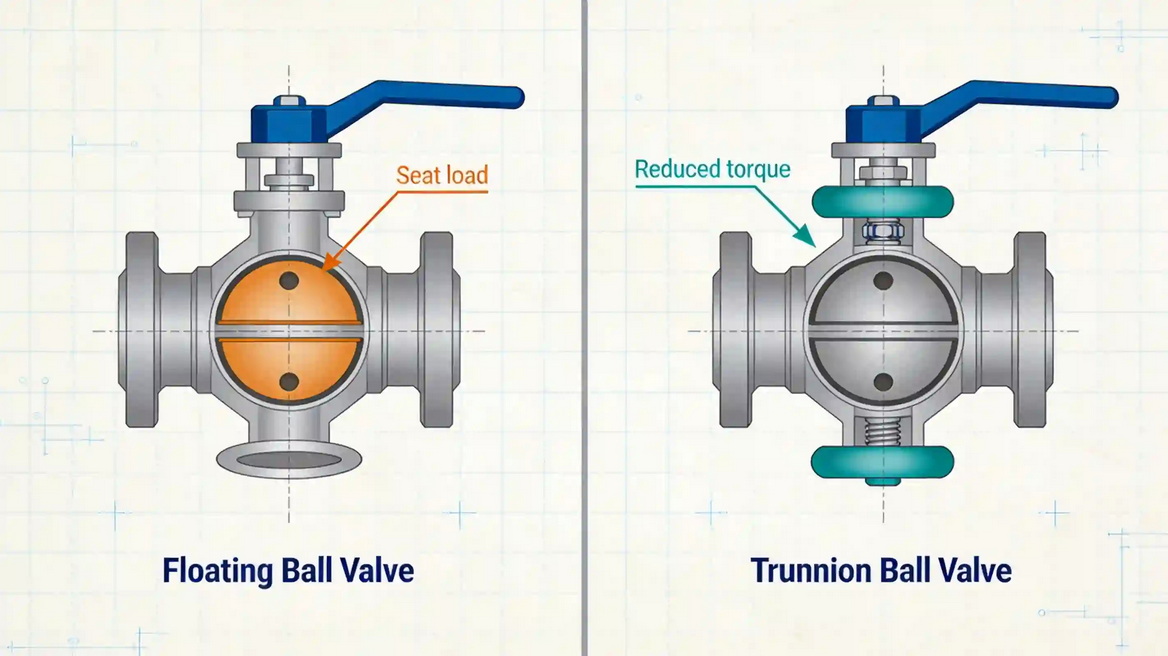
Floating vs Trunnion Ball Valves: Why It Matters
For buyers who view "ball valve" as a single category, an important nuance is the difference between floating ball and trunnion‑mounted ball designs.
Floating Ball Valve
In a floating ball valve, the ball is held in place by the seats and can move slightly downstream under pressure.
- Best for small and medium diameters.
- Provides reliable tight shut‑off for medium pressure applications.
- Simple construction and easier maintenance.
Trunnion Ball Valve
In a trunnion ball valve, the ball is supported by bearings (trunnions) at the top and bottom, reducing the load on the seats.
- Ideal for large diameters and high pressures.
- Lower operating torque, which reduces actuator size and cost.
- Preferred in long‑distance pipelines, offshore platforms, and critical shutdown services.
As a manufacturer, we typically recommend trunnion ball valves for oil and gas transmission lines, offshore platforms, and high‑pressure petrochemical units, especially where OEM and ODM clients need reliable, long‑life isolation.
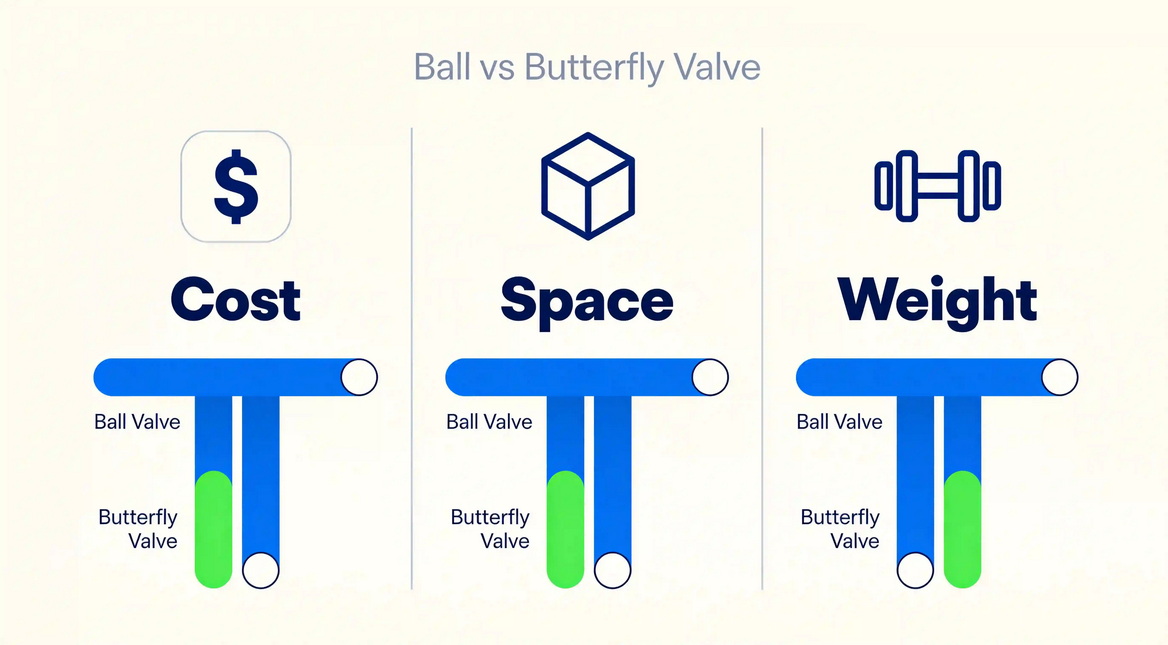
How They Compare in Cost, Space, and Weight
Initial Purchase Cost
Industry data indicates that in large diameters, butterfly valves can be as little as 30–40% of the cost of equivalent ball valves, particularly around 24‑inch size and Class 150 pressure ratings. This cost advantage comes from simpler machining and lower material usage.
However, for small diameters (≤4 inches), the cost difference narrows, and in some cases a small ball valve can be priced competitively with or even below a comparable butterfly valve.
Space and Weight Constraints
Butterfly valves—especially wafer and lug types—have very short face‑to‑face dimensions and much lower weight compared to trunnion ball valves.
- In crowded pipe racks and skid packages, a butterfly valve's compact footprint often makes installation easier.
- For large‑bore lines, a trunnion ball valve may weigh several times more than a butterfly valve of the same size and class, increasing structural and handling requirements.
Practical tip: In offshore and topside applications where deck loading and space are critical, the space and weight advantages of butterfly valves are hard to ignore—unless you need the sealing and pigging capability of a ball valve.
Sealing Performance, Pressure Handling, and Flow Control
Sealing and Shut‑Off
- Ball valves remain the standard choice for bubble‑tight shut‑off, particularly with soft seats and full‑bore design.
- Triple‑offset butterfly valves with metal seats have closed much of the gap and can also achieve Class VI shut‑off at very high pressures and temperatures.
In high‑hazard services (flammable gases, volatile hydrocarbons), most pipeline operators still specify ball valves for safety and leakage control.
Pressure and Temperature Ranges
- Ball valves are widely used from low to very high pressures, with Class 150–2500 ratings depending on design and seat materials.
- Butterfly valves can also reach high pressure classes, especially in triple‑offset configurations, and can outperform soft‑seated ball valves at very high temperatures where elastomer or PTFE seats would fail.
Flow Characteristics and Cavitation Risk
A full‑port ball valve has a flow coefficient close to a straight pipe section, offering minimal pressure drop and turbulence. By contrast, a butterfly valve's disc remains in the flow path even when fully open, adding resistance and potential turbulence.
On pump suction lines, this turbulence can promote cavitation and impeller damage, which is why many pump manufacturers still recommend ball valves on intakes where space and budget allow.
Application Scenarios: When to Choose Which Valve
When a Ball Valve Is the Better Choice
You should strongly consider a ball valve when:
- You need zero or near‑zero leakage on hazardous or high‑value media. - The system operates under high pressure or involves long‑distance transmission lines.
- Pigging operations are required; full‑bore ball valves allow pigs to pass without obstruction.
- The line is part of an emergency shutdown system in oil and gas, petrochemical, or power generation plants.
This is why we see floating and trunnion ball valves widely specified on upstream and midstream oil and gas, offshore platforms, petrochemical units, and critical shutdown lines.
When a Butterfly Valve Makes More Sense
A butterfly valve is often the more practical choice when:
- You are dealing with large diameters and need to control project CAPEX.
- The system operates at low to medium pressures where slight leakage is acceptable.
- The line requires modulating control rather than simple on/off isolation.
- Space and weight restrictions make heavy trunnion ball valves impractical.
Examples include cooling water systems, HVAC networks, municipal water distribution, and non‑hazardous process lines in industrial plants.
Industry Case Example: Offshore Platform Produced Water Line
On a recent offshore project, an EPC contractor faced a choice between DN 16‑inch trunnion ball valves and high‑performance butterfly valves for a produced water line.
- The original specification called for ball valves due to concerns about leak‑tight isolation.
- Structural engineers later raised concerns about weight and deck loading, since each trunnion ball valve exceeded 1,000 kg including actuator.
- After a detailed risk assessment, the team opted for triple‑offset butterfly valves on the produced water line while retaining trunnion ball valves on hydrocarbon lines.
This hybrid approach balanced safety, structural constraints, and project cost, illustrating how butterfly and ball valves can coexist within a single facility when selected carefully.
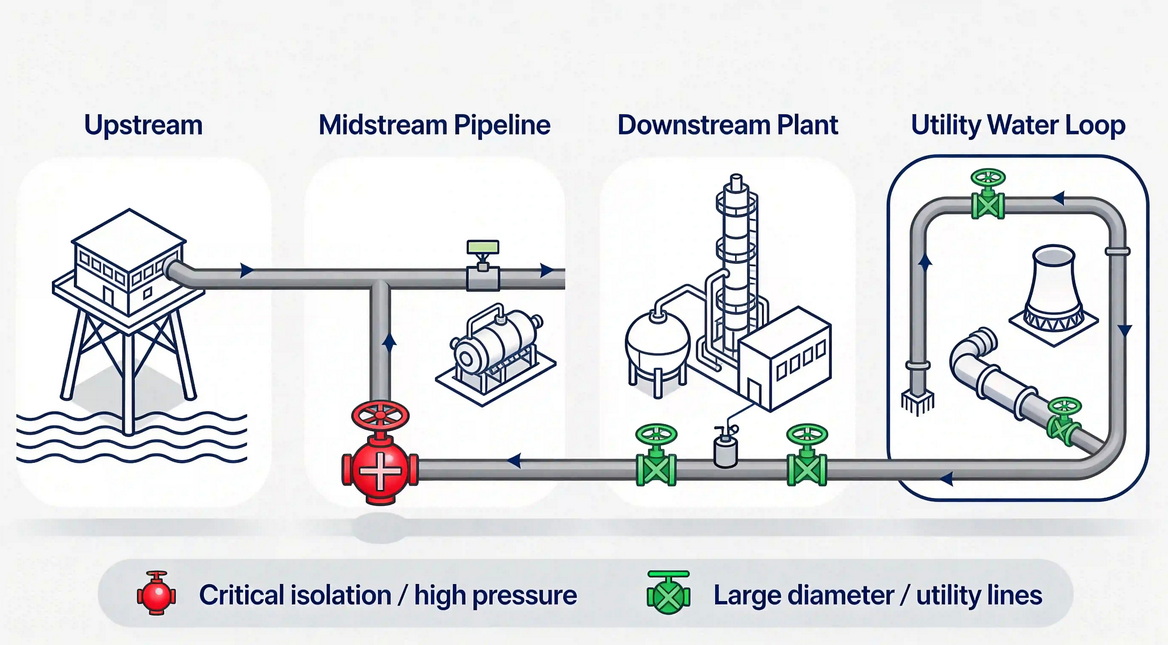
OEM/ODM Perspective: Selecting the Right Ball Valve for Your System
As an OEM/ODM partner supplying floating and trunnion ball valves to overseas brands and industrial systems integrators, we see recurring selection patterns for demanding applications.
For upstream and midstream oil & gas:
- Trunnion ball valves with API 6D compliance are the default for mainline isolation.
- Materials often include carbon steel, stainless steel, or alloys, with fire‑safe design and anti‑static features.
For desalination and offshore platforms:
- Corrosion‑resistant materials (such as duplex steel) and robust sealing are critical to handle saline environments.
- Ball valves are typically used in high‑pressure sections and critical shut‑off points, while butterfly valves may handle non‑critical or low‑pressure branches.
For OEM brands and system builders:
- OEM partners often require customized face‑to‑face dimensions, special actuation packages, or unique coatings.
- An experienced ball valve manufacturer can adapt floating or trunnion designs to align with your branding, local codes, and end‑user expectations.
Practical Selection Checklist for Engineers
To simplify your selection, use this step‑by‑step checklist:
1. Define the function: Is the valve primarily for isolation, throttling, or both?
2. Confirm pressure and temperature: Align with appropriate pressure class and seat materials.
3. Check diameter and layout: Evaluate space, weight, and structural constraints.
4. Clarify leakage tolerance: Decide whether Class VI or bubble‑tight shut‑off is mandatory.
5. Assess lifecycle cost: Consider not just purchase price, but actuation, maintenance, and downtime implications.
6. Confirm standards and approvals: Ensure compliance with relevant API, ISO, or industry standards.
In many cases, the selection will lead you to ball valves for hazardous, high‑pressure, or piggable lines, and butterfly valves for large, non‑critical, or budget‑sensitive services.
Call to Action: Talk to a Ball Valve Specialist
If you are planning or upgrading a system in oil and gas, desalination, offshore, or other demanding industries, selecting the right combination of ball and butterfly valves can significantly improve safety and lifecycle performance. As a manufacturer focused on floating and trunnion ball valves, we help OEM, ODM, and engineering partners evaluate real operating conditions and specify valves that match their application, standards, and budget.
Get in touch with our engineering team to:
- Review your P&ID and operating data
- Compare ball vs butterfly options for key lines
- Customize floating or trunnion ball valves to your project requirements
A short consultation can prevent long‑term issues with leakage, maintenance, and unplanned downtime.
Frequently Asked Questions (FAQ)
1. Can I use a ball valve for throttling?
In general, ball valves are designed for on/off isolation rather than throttling; extended throttling can damage seats and reduce sealing performance. For precise flow control, a control valve or properly selected butterfly valve is usually a better option.
2. Are triple‑offset butterfly valves a complete replacement for ball valves?
Triple‑offset butterfly valves can match or exceed ball valves in some high‑temperature and high‑pressure services, but they may not be suitable for piggable pipelines or situations where a full‑bore port is mandatory. Many operators use both technologies in different parts of the same system.
3. What is the main advantage of trunnion ball valves over floating ball valves?
Trunnion ball valves support the ball with bearings, reduce seat loading, and lower operating torque, making them ideal for large diameter and high‑pressure pipelines. Floating ball valves remain the cost‑effective choice for smaller, lower‑pressure lines.
4. How do I choose between a wafer and lug butterfly valve?
Wafer butterfly valves are clamped between flanges and are more compact and economical, while lug types allow one‑side piping removal and are often used where pipeline sections need to be isolated and removed. The choice depends on maintenance strategy and pipeline configuration.
5. Why are ball valves so common in oil and gas compared with butterfly valves?
Oil and gas systems often demand bubble‑tight shut‑off, high pressure capability, and pigging compatibility, all areas where ball valves traditionally excel. Butterfly valves are more frequently used in utility and non‑critical lines within the same facilities.
References
1. ONERO Valve. "Butterfly vs Ball Valve: 6 Similarities and 8 Differences." (2024). Available at:
https://www.onerovalve.com/blog/comparison/butterfly-vs-ball-valve-6-similarities-and-8-differences/
2. Ballvalve Technology. "Ball Valve vs. Butterfly Valve: Which Offers Better Cost, Space, and Performance?" (2026). Available at:
https://ballvalve.tech/ball-valve-vs-butterfly-valve/
3. Wenzhou Leader Flow Control Equipment Co., Ltd. Company Profile. Available at:
4. Wenzhou Leader Flow Control Equipment Co., Ltd. "Top 10 Shutdown Valve Manufacturers in China." (2025). Available at:
https://www.wzldballvalve.com/44-top-10-shutdown-valve-manufacturers-in-china.html
5. NSW Valve. "Understanding Butterfly Valve vs Ball Valve Comparison Guide." Available at:
https://www.nswvalve.com/news/butterfly-valve-vs-ball-valve-comparison-guide/
6. ESG International. "Butterfly Valve vs Ball Valve: Complete Comparison Guide." (2026). Available at:
https://www.esg-intl.com/feeds/blog/butterfly-valve-vs-ball-valve
7. MNC Valves. "Why Ball Valves Are Widely Used in Oil & Gas, Water Treatment." (2025). Available at:
https://mncvalves.com/why-ball-valves-are-widely-used-in-oil-gas-water-treatment/
8. Rapid Controls Pvt. Ltd. "Best Ball Valves for Oil & Gas Industry." (2025). Available at:
https://rapidcontrols.in/blogs/best-ball-valves-for-oil-gas-industry/
Hot Tags: Butterfly Valve , Ball Valve, Manufacturers, Customized, Custom, Suppliers, Buy, Cheap, Quality, Advanced, Durable, in Stock, Free Sample, Made in China, Price, Quotation