How To Read Ball Valve Markings: An Engineer’s Guide For Floating And Trunnion Ball Valves
Content Menu
● Why Ball Valve Markings Matter In Real Projects
● Core Elements Of Ball Valve Markings
>> Valve size (DN and inch markings)
>> Mounting interface markings (ISO 5211)
>> Pressure class and pressure rating
>> WOG, CWP, WSP and gas ratings
● Floating vs. Trunnion Ball Valve Markings: What Changes?
● How OEM/ODM Manufacturers Design Identification Plates
● Practical Step‑By‑Step: How To Read A Ball Valve Marking In The Field
● Table: Typical Markings You Will See On Ball Valves
● Expert Perspective: Common Pitfalls With Ball Valve Markings
● Call To Action: OEM/ODM Ball Valves With Standards‑Compliant Markings
>> Q1: What do the numbers on a ball valve mean?
>> Q2: How can I tell if a ball valve is suitable for gas service?
>> Q3: What is the difference between WOG and CWP?
>> Q4: Why are serial numbers important on ball valves?
>> Q5: How do floating and trunnion ball valve markings differ?
When you work on offshore platforms, gas pipelines, or desalination plants, you quickly learn that ball valve markings are not just "labels" – they are safety‑critical information that tell you where a valve can be used, how it was built, and whether it meets the standards your project requires. As a manufacturer of floating ball valves and trunnion ball valves for oil & gas and marine applications, we see every day how clear, consistent markings reduce installation errors, speed up commissioning, and protect contractors from costly failures.
Why Ball Valve Markings Matter In Real Projects
In theory, every valve arrives with a nameplate and body markings that match the datasheet. In practice, engineers and technicians are often working in harsh environments, under time pressure, with mixed inventories from different suppliers. If the markings are confusing, incomplete, or not aligned with API/ASME standards, the risk of mis‑application increases immediately.
From our experience supplying OEM/ODM ball valves to international brands, three practical outcomes depend directly on good markings:
- Correct valve selection for pressure, temperature, and media.
- Traceability to manufacturing batch and testing records. - Faster troubleshooting and replacement in the field.
That is why modern specifications and directives (API 6D, ASME B16.34, PED 2014/68/EU, EN 19, etc.) explicitly define what must appear on the identification plate and body of a ball valve.
Core Elements Of Ball Valve Markings
Valve size (DN and inch markings)
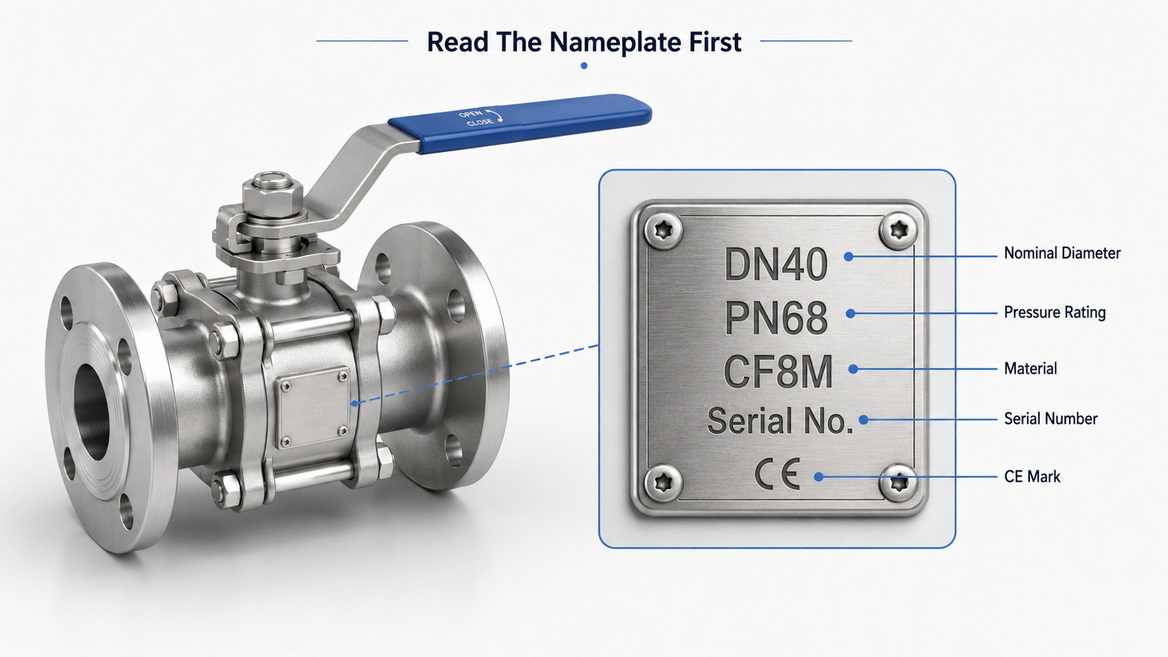
The first thing most technicians look for on a ball valve is its size. Typical markings include:
- Inches: Simple fractional sizes such as 1/2", 3/4", 2", etc.
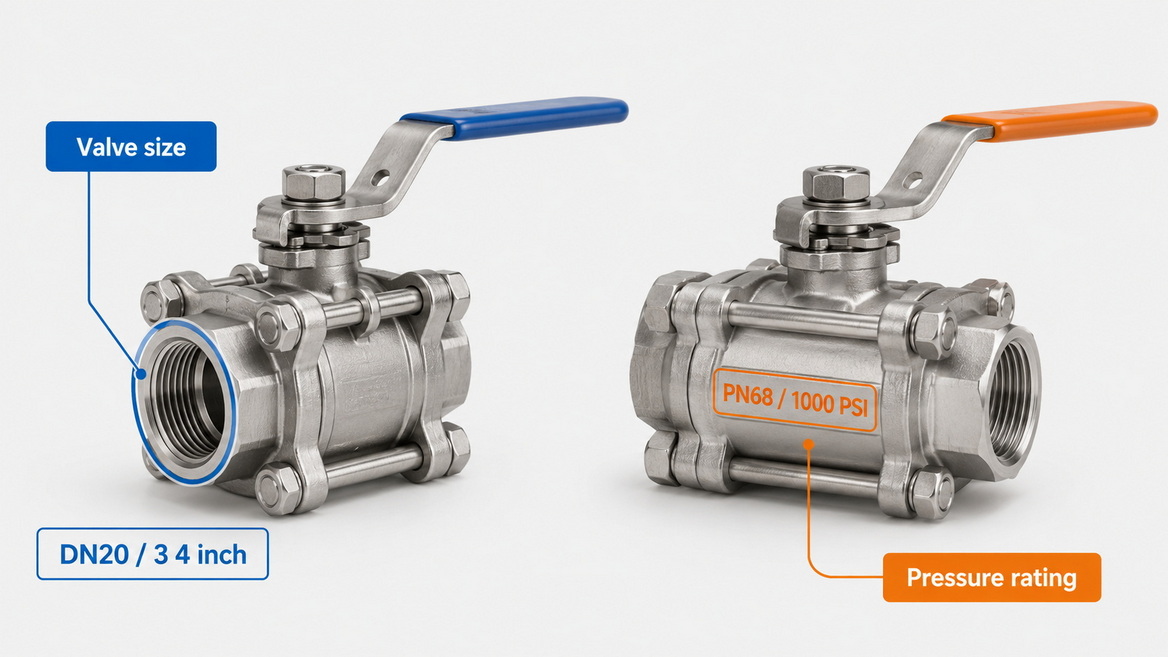
- Millimeters (DN): The letters DN ("diameter nominal") followed by a number, such as DN20 or DN40, indicating the port size in millimeters.
On compact manifolds or skid packages, we often see mixed systems where project drawings are in DN but installers use inch terminology every day. Consistent DN and inch markings on the nameplate and body help avoid mismatches between design and reality.
Body material markings
For process safety and corrosion control, the body material marking is one of the most critical details on the valve. Common markings include:
- Austenitic stainless steels:
- Numeric grades: 304, 316. - Casting codes: CF8 (304 equivalent) and CF8M (316 equivalent). - Combined markings: SS304, SS316.
- Carbon steel:
- WCB – a widely used designation for cast carbon steel valve bodies.
- Brass and bronze:
- Brass: BS, BRS, CW617N. - Bronze: BZ, BRZ, C84400.
- Plastics (for utility and low‑pressure service):
- PVC, CPVC, ABS, PP, PTFE, PE, HDPE.
In an offshore or upstream gas environment, you will typically see stainless steel or high‑alloy carbon steel bodies marked in line with API 6D and ASME B16.34 requirements, because material traceability is essential for H₂S service, low temperature service, and fire‑safe design.
Mounting interface markings (ISO 5211)
With the growth of automated valves on platforms and pipeline stations, mounting interface markings are another key detail. A valve marked with F04 or F05 indicates that its mounting pad follows the ISO 5211 standard for actuator interface dimensions.
From an OEM perspective, clear mounting codes make it much easier for actuator integrators to:
- Select compatible electric or pneumatic actuators. - Standardize hardware kits across multiple valve sizes.
- Reduce installation time and mis‑alignment risks.
Pressure class and pressure rating
Ball valves are always selected against the design pressure of the line or equipment, so pressure markings must be immediately understandable.
Typical formats include:
- Nominal pressure in bar (PN):
- Marked as PN followed by a number, e. g., PN16, PN68, PN100.
- Pressure in PSI:
- Marked directly, e. g., 1000 PSI.
In high‑pressure trunnion ball valves, you will also see ASME pressure classes, such as Class 150, Class 600, Class 1500, or Class 2500, which are often referenced on datasheets and nameplates together with PN values.
WOG, CWP, WSP and gas ratings
Many installers are familiar with older markings like WOG, but may not fully understand newer terms such as CWP or WSP. Clarifying these codes is essential for safe valve selection.
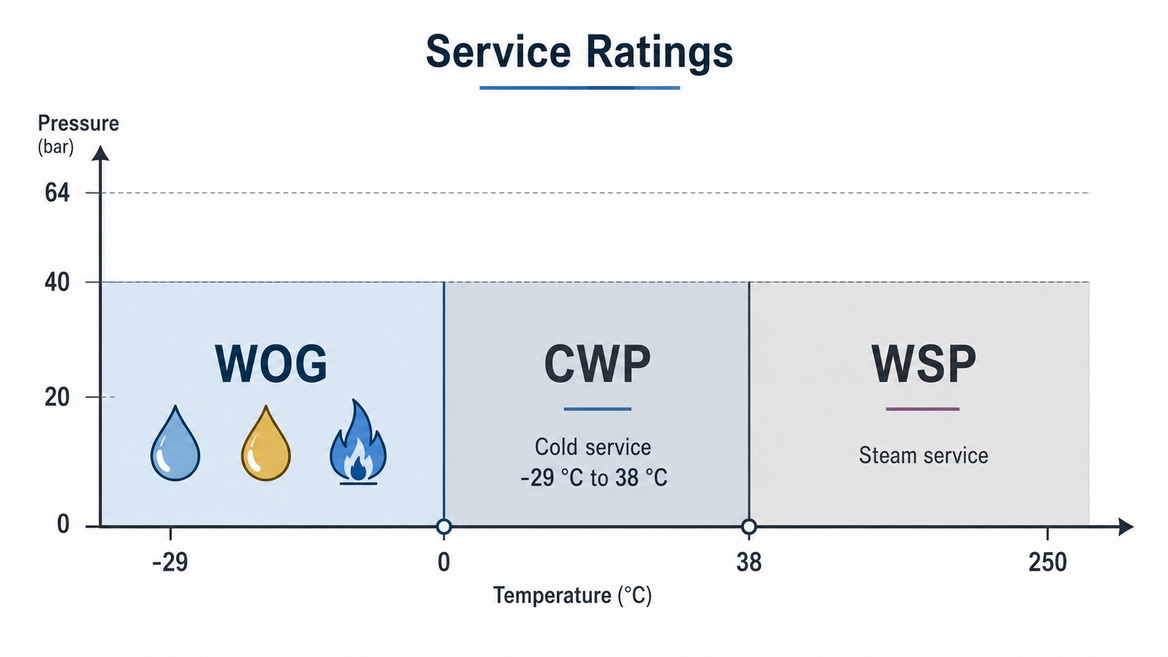
- WOG (Water, Oil, Gas):
An older marking that indicates suitability for water, oil, and gas media at the stated pressure rating. Although considered outdated, it still appears on some new and existing valves.
- CWP (Cold Working Pressure):
Indicates the maximum working pressure between approximately ‑29 °C and 38 °C (‑20 °F to 100 °F), for example: 1000 CWP = 1000 PSI maximum within that temperature range.
- WSP / SWP (Working Steam Pressure):
Indicates the maximum working pressure for steam service. In steam lines, this value is more relevant than WOG or CWP.
For gas service, markings often distinguish indoor and outdoor ratings:
- Indoor gas: Codes such as 1/2 PSIG for low‑pressure systems, 5G for higher‑pressure gas piping.
- Outdoor gas: Standards like CAN/CGA‑3.16 (Canada), BRS125G (U. S.), and BS EN 331 (Europe) commonly appear on gas valves for outdoor use.
In our own oil & gas projects, we treat gas‑specific markings as a non‑negotiable requirement, especially where regional gas standards are enforced by local authorities or pipeline operators.
Lead‑free markings
With increasingly strict regulations on heavy metals in potable water systems, LF (lead free) has become a routine marking on valves used in drinking water and some industrial water systems.
If a valve is marked LF, it indicates that no lead was used in its construction, making it suitable for lead‑restricted applications. For OEM customers serving building services, HVAC, and municipal water markets, this small marking can be the difference between passing or failing compliance checks.
Floating vs. Trunnion Ball Valve Markings: What Changes?
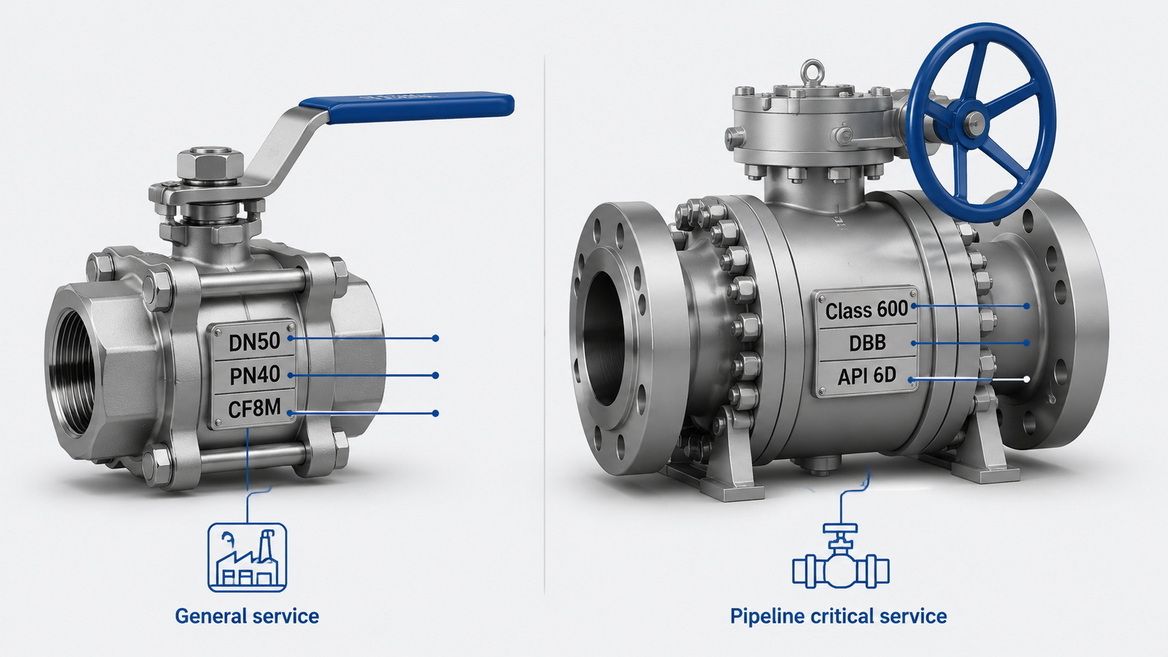
From a marking perspective, floating ball valves and trunnion ball valves share many common elements (size, material, pressure, standards), but there are notable differences driven by application and design.
Floating ball valves
Floating ball valves, typically DN 15–DN 300 and ASME Class up to 600, are widely used for general industrial and utility services. Typical marking specifics include:
- DN size and pressure rating (e. g., DN50, PN40).
- Body and seat materials, often PTFE‑based seats and stainless or carbon steel bodies.
- Standard references: EN 19 for marking, DIN and API standards for design and testing. Floating valves tend to have more compact nameplates, so careful abbreviation and consistent coding are essential. As a manufacturer, we make sure all critical information (size, pressure, materials, date code, serial number) remains legible even on smaller DN sizes.
Trunnion ball valves
Trunnion ball valves are usually specified for high‑pressure, large‑bore, and critical isolation duties in oil & gas pipelines and process plants.
Typical marking features include:
- ASME pressure class (e. g., Class 600, Class 1500) and corresponding PN references. - Body, ball, stem, and seat material codes, often with fire‑safe and low‑emission certifications.
- Style or configuration: Markings such as Double Block & Bleed (DBB) or Double Isolation & Bleed (DIB) to define sealing functionality.
- Standards and certificates: API 6D, ISO 14313, PED, ATEX, fire‑safe standards (API 607, API 6FA), fugitive emission standards (TA‑Luft, EN ISO 15848).
Because each trunnion valve can be customized (special materials, underground service, SIL 3 certification, emergency seat injection, etc.), the identification tag becomes a critical link to the full technical file and test records.
How OEM/ODM Manufacturers Design Identification Plates
From the manufacturing side, we treat the identification nameplate as part of the safety system, not just an accessory. Modern directives like PED 2014/68/EU and API 6D specify that the valve must be supplied with documentation and markings that clearly cover its operating limits.
A typical nameplate on a trunnion ball valve will include:
- Manufacturer name and logo.
- Valve series and model code.
- Size (DN and inch).
- Pressure class (PN and/or ASME class).
- Body, ball, stem, and seat materials.
- Bore type (full bore or reduced bore).
- Style (e. g., DBB or DIB).
- Serial number and year/month of manufacture.
- Relevant certifications and standards.
For OEM/ODM customers, we can also integrate private‑label branding and customer‑specific codes while still maintaining compliance with international standards and traceability requirements.
Practical Step‑By‑Step: How To Read A Ball Valve Marking In The Field
To make this more actionable for engineers and technicians, here is a simple checklist we recommend when you pick up any ball valve, floating or trunnion, in the field.
1. Locate the identification plate and body markings.
Check the valve body, handle, or tag for plates stamped or engraved according to API 6D and EN 19.
2. Confirm size and bore type.
Read the DN and inch values, and note if the valve is full bore or reduced bore, especially for trunnion valves used in pipelines. 3. Verify pressure rating and service category.
Check PN, PSI, ASME class, and any WOG/CWP/WSP markings to ensure compatibility with line design pressure and medium (gas, steam, liquids).
4. Check materials against the specification.
Confirm body, ball, stem, and seat materials as marked (e. g., CF8M, WCB, PTFE, graphite), and cross‑check with your project datasheet.
5. Look for standards and certifications.
Identify API 6D, fire‑safe standards (API 607, API 6FA), PED, ATEX, or regional gas standards that apply to your installation.
6. Record the serial number.
Note the serial number and manufacturing date for traceability, warranty tracking, and future maintenance.
By following these steps, site teams can systematically check that each valve is fit for purpose before installation, significantly reducing the chance of late rework or non‑compliance findings.
Table: Typical Markings You Will See On Ball Valves
| Marking code | Meaning on the valve | Typical use case |
|---|---|---|
| DN20 / 3/4" valvedistributors.com | Nominal port size in mm / inches valvedistributors.com | Confirms line size before installation valvedistributors.com |
| CF8 / CF8M valvedistributors.com | Stainless steel casting grades (304 / 316) valvedistributors.com | Corrosion‑resistant bodies in oil & gas and marine service valvedistributors.com |
| WCB valvedistributors.com | Cast carbon steel body valvedistributors.com | High‑strength bodies for high‑pressure lines demesne |
| PN68 / 1000 PSI valvedistributors.com | Maximum working pressure rating valvedistributors.com | Verifies compatibility with design pressure valvedistributors.com |
| WOG / CWP / WSP valvedistributors.com | Medium and temperature‑specific pressure ratings valvedistributors.com | Distinguishes cold service, steam service, and general media bray+1 |
| CAN/CGA‑3.16 / BS EN 331 valvedistributors.com | Gas application standards (indoor/outdoor) valvedistributors.com | Compliance with regional gas regulations hgs.com+1 |
| LF valvedistributors.com | Lead‑free construction valvedistributors.com | Potable and low‑lead water systems valvedistributors.com |
| F04 / F05 valvedistributors.com | ISO 5211 actuator mounting interface valvedistributors.com | Automated on/off or control valves bray+1 |
| API 6D / API 607 / API 6FA valvedistributors.com+2 | Pipeline and fire‑safe design/testing standards valvedistributors.com+2 | Critical isolation in oil & gas pipelines hgs.com |
Expert Perspective: Common Pitfalls With Ball Valve Markings
From years of supplying valves to international OEM customers, we see a few recurring issues that engineers should avoid:
- Assuming all "3/4\" ball valves" are equivalent.
Without checking PN/PSI, WOG/CWP/WSP, and material markings, two valves of the same nominal size can have completely different operating limits.
- Ignoring gas‑specific certifications.
In gas distribution, the difference between a generic industrial valve and a gas‑rated valve marked to CAN/CGA‑3.16 or BS EN 331 is crucial for regulatory compliance.
- Overlooking fire‑safe and fugitive emission markings.
For upstream and offshore projects, fire‑safe standards (API 607, API 6FA) and low‑emission certificates (TA‑Luft, EN ISO 15848) are often contractual requirements and must be clearly marked on the valve.
By treating the markings as a compact summary of the entire design and testing philosophy, engineers can make faster, more reliable decisions in the field.
Call To Action: OEM/ODM Ball Valves With Standards‑Compliant Markings
If your projects demand floating and trunnion ball valves with clear, standards‑compliant markings for oil & gas, desalination, and offshore platforms, partnering with a manufacturer that treats markings as part of the safety system is essential.
As an OEM/ODM supplier, we can:
- Design and produce ball valves to API, ASME, EN, and regional gas standards.
- Customize nameplates and marking schemes for your brand while preserving full traceability.
- Support your engineering team with datasheets, installation manuals, and marking guides for global projects.
Contact our engineering team to discuss your next ball valve project and how optimized markings can simplify specification, installation, and long‑term maintenance.
FAQs: Ball Valve Markings
Q1: What do the numbers on a ball valve mean?
Most numbers indicate size and pressure rating, such as DN40 for a 40 mm port, or PN68 / 1000 PSI for maximum working pressure.
Q2: How can I tell if a ball valve is suitable for gas service?
Look for gas‑specific standards or codes such as CAN/CGA‑3.16, BRS125G, or BS EN 331, and check WOG/CWP markings and pressure ratings.
Q3: What is the difference between WOG and CWP?
WOG is an older code indicating suitability for water, oil, and gas at the stated pressure, while CWP defines maximum working pressure within a specified cold temperature range (around ‑29 °C to 38 °C).
Q4: Why are serial numbers important on ball valves?
Serial numbers link each valve to its manufacturing batch, test certificates, and material records, enabling traceability, audits, and targeted maintenance or replacement.
Q5: How do floating and trunnion ball valve markings differ?
Floating valves usually emphasize DN size, PN rating, and basic materials for general service, while trunnion valves add ASME class, DBB/DIB style, fire‑safe and low‑emission standards, and more detailed material codes for critical pipeline duties.
References
1. Meridian – Floating Ball Valve Catalogue (Figure numbering and material/pressure coding in floating ball valves). https://www.meridianvalve.ca/wp-content/uploads/2015/12/Meridian-API-6D-Floating-Ball-Catalogue.pdf
Hot Tags: Read Ball Valve, Manufacturers, Customized, Custom, Suppliers, Buy, Cheap, Quality, Advanced, Durable, in Stock, Free Sample, Made in China, Price, Quotation