Floating Ball Valve vs Trunnion Ball Valve: 8 Key Differences Engineers Need to Know
Content Menu
● Floating Ball Valve vs Trunnion Ball Valve: 8 Key Differences Engineers Need to Know
● What Is a Floating Ball Valve?
● What Is a Trunnion Ball Valve?
● 8 Critical Differences Between Floating and Trunnion Ball Valves
>> 2. Ball Support and Movement
>> 3. Pressure Range and Size Limit
>> 4. Operating Torque and Actuation
>> 5. Double Block and Bleed (DBB) Capability
>> 6. Cavity Pressure Relief and Safety
>> 7. Cost and Maintenance Complexity
>> 8. Typical Standards and Applications
● Floating vs Trunnion Ball Valve: Side‑by‑Side Comparison
● How Industry Engineers Actually Choose Between Floating and Trunnion Designs
● Expert Tips to Avoid Common Selection Mistakes
● Frequently Asked Questions (FAQ)
>> Q1. When should I choose a floating ball valve instead of a trunnion ball valve?
>> Q2. Why do trunnion ball valves require cavity pressure relief?
>> Q3. Are trunnion ball valves always more reliable than floating ball valves?
>> Q4. How does valve type affect actuator sizing?
>> Q5. Can a single plant use both floating and trunnion ball valves?
Floating Ball Valve vs Trunnion Ball Valve: 8 Key Differences Engineers Need to Know
Choosing between a floating ball valve and a trunnion ball valve is not just a design preference—it directly affects safety, torque requirements, lifecycle cost, and compliance in oil, gas, and process piping systems. As an engineer working with Chinese valve manufacturers and international EPCs, I've seen selection mistakes lead to costly downtime, actuator oversizing, and even leakage incidents in high‑pressure lines. This guide explains, in practical terms, the 8 most important differences you must understand before specifying a ball valve.
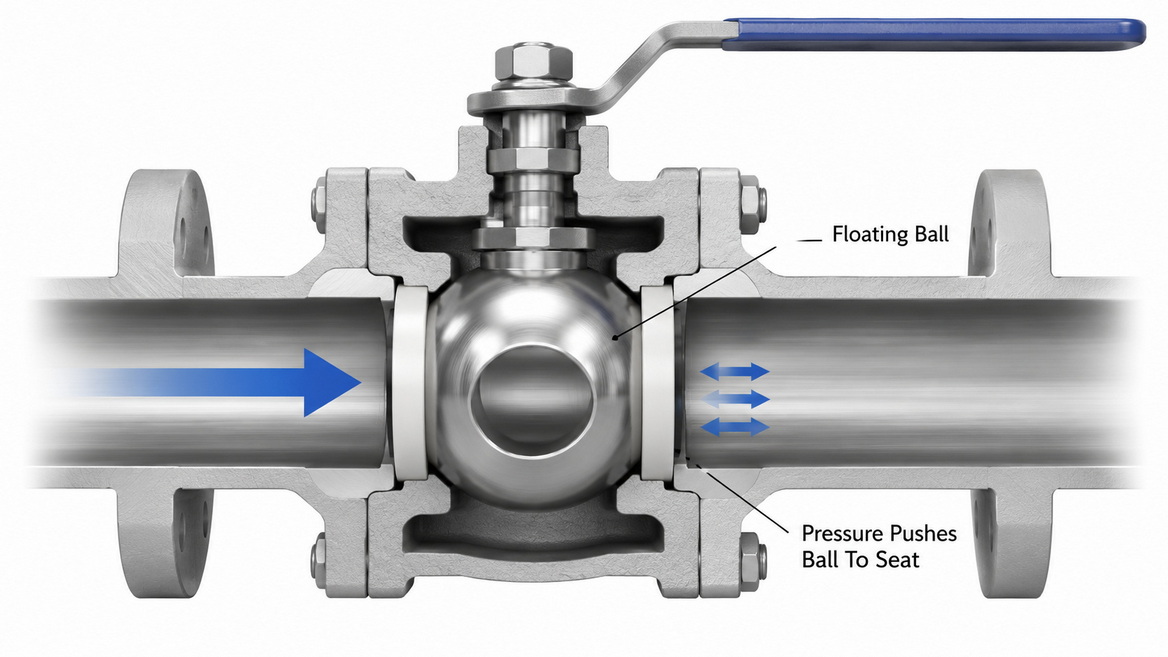
What Is a Floating Ball Valve?
A floating ball valve uses a ball that is not mechanically fixed to the body; instead, line pressure pushes the ball against the downstream seat to create sealing. The ball "floats" slightly inside the valve cavity, held in place by cup‑shaped seats that form a tight seal with the ball and body.
- The sealing force increases with line pressure, which works well at low‑to‑medium pressures.
- The structure is simple, with fewer components, so manufacturing cost and maintenance effort are generally lower.
- In many designs, only the downstream seat is fully loaded, so the valve is effectively uni‑directional.
In practice, floating ball valves are commonly used in small‑bore process piping (roughly ½″–8″), in pressure classes up to Class 300–600, and where cost and simplicity are the main drivers.
What Is a Trunnion Ball Valve?
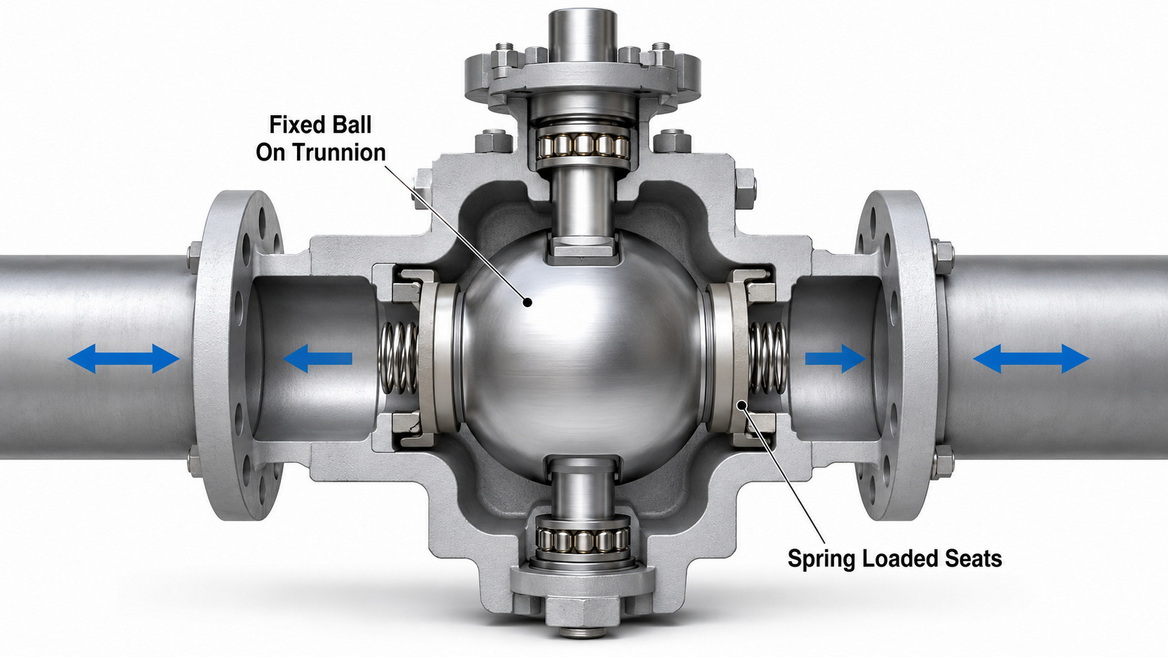
A trunnion ball valve supports the ball on upper and lower trunnion bearings (a second stem opposite the operating stem), so the ball cannot move laterally. Sealing is achieved by spring‑loaded seats that press inward toward the fixed ball, rather than pushing the ball toward the seat.
- The ball only rotates on its axis; it does not "float" toward the outlet.
- Seat springs provide a sealing force that is largely independent of line pressure, making the design suitable for very high pressures and large sizes.
- Because the ball is fixed, operating torque is lower and more predictable, especially at high pressure.
Trunnion ball valves are widely used for pipeline isolation, high‑pressure gas, subsea service, and any application requiring double block and bleed (DBB) capability. They are typically designed per API 6D and API 608 for sizes up to 60″ and pressure classes up to Class 2500.
8 Critical Differences Between Floating and Trunnion Ball Valves
1. Sealing Principle
The core difference lies in how sealing force is generated.
- Floating ball valve: Upstream pressure pushes the ball into the downstream seat, creating the seal.
- Trunnion ball valve: Spring‑loaded seats press against a fixed ball, so sealing depends mainly on seat springs plus media pressure.
In low‑pressure systems, a floating design can be very efficient because higher pressure naturally increases sealing force. In very high‑pressure pipelines, however, that same mechanism can overload seats and raise torque beyond practical limits.
2. Ball Support and Movement
In a floating ball valve, the ball is supported only by the cupped seats and floats slightly in the cavity. In a trunnion valve, the ball is anchored by upper and lower trunnion stems and bearings, eliminating axial movement.
- Floating design: Ball moves slightly toward the outlet during closure, contacting the downstream seat.
- Trunnion design: Ball stays fixed; floating seats move to maintain the seal.
This difference is why trunnion valves handle large diameters and high pressure more reliably: the ball does not need to "bend" the seat to seal.
3. Pressure Range and Size Limit
A simple rule of thumb used across the industry is:
- Floating ball valves are best for low‑ to medium‑pressure scenarios and smaller sizes.
- Trunnion ball valves are best for high‑pressure projects and larger diameters.
Industry data shows:
- Floating ball valves are commonly used in sizes up to about 8″–10″, above which torque and seat stress become impractical.
- Trunnion ball valves are used from 4″ up to 60″+, with pressure classes from Class 150 to 2500.
For engineers designing crude oil, natural gas, or high‑pressure steam pipelines, the trunnion design is often the only viable option.
4. Operating Torque and Actuation
Because the floating ball presses directly into the downstream seat, friction rises sharply with pressure and size.
- Floating valve: Requires more torque as pressure increases, often demanding larger manual levers or actuators.
- Trunnion valve: With the ball fixed and seats moving, rotational friction is lower, leading to more manageable actuator sizing.
From an OEM/ODM perspective, this directly affects actuator cost and the feasibility of automation on large‑diameter lines.
5. Double Block and Bleed (DBB) Capability
Trunnion ball valves can provide true double block and bleed capability: both upstream and downstream seats seal independently, and a body cavity bleed valve confirms isolation.
- Floating ball valves generally cannot provide DBB, because only the downstream seat is pressure‑loaded.
- Trunnion valves with DBB are standard in pipeline isolation, custody transfer, and high‑integrity applications.
If your specification or standard requires DBB (for example, API 6D pipeline valves), a trunnion‑mounted design is typically mandatory.
6. Cavity Pressure Relief and Safety
Cavity overpressure is a unique hazard with trunnion designs: when the valve is closed, fluid trapped in the body cavity can expand with temperature, increasing cavity pressure.
- Trunnion valves often use self‑relieving upstream seats or external relief valves to manage cavity pressure.
- Floating ball valves generally do not require dedicated cavity relief because the sealing mechanism loads only the downstream seat.
For safety‑critical systems, specifying the correct cavity relief design is as important as selecting the valve type itself.
7. Cost and Maintenance Complexity
In most product lines:
- Floating ball valves are less expensive, thanks to simpler construction and fewer components.
- Trunnion ball valves are more expensive, often costing 2–4× more than comparable floating designs in the same size and pressure class.
However, trunnion valves can offer a lower total cost of ownership (TCO) in high‑pressure or large‑diameter applications because they reduce actuator size, torque, and long‑term seat wear. Maintenance follows similar logic:
- Floating valves: Easier to disassemble and maintain; widely used in utility and general isolation service.
- Trunnion valves: More complex internals and seats, requiring specialized knowledge and sometimes OEM support.
8. Typical Standards and Applications
Key standards and application patterns include:
- Floating ball valves: Often designed to API 608, used in process lines, utility services, instrument root valves, and general isolation.
- Trunnion ball valves: Designed per API 6D and API 608, used for pipelines, high‑pressure gas, subsea service, and DBB isolation.
Engineers frequently use floating designs when cost and compactness matter more than advanced sealing features, and trunnion designs when reliability, pressure capability, and DBB are non‑negotiable.
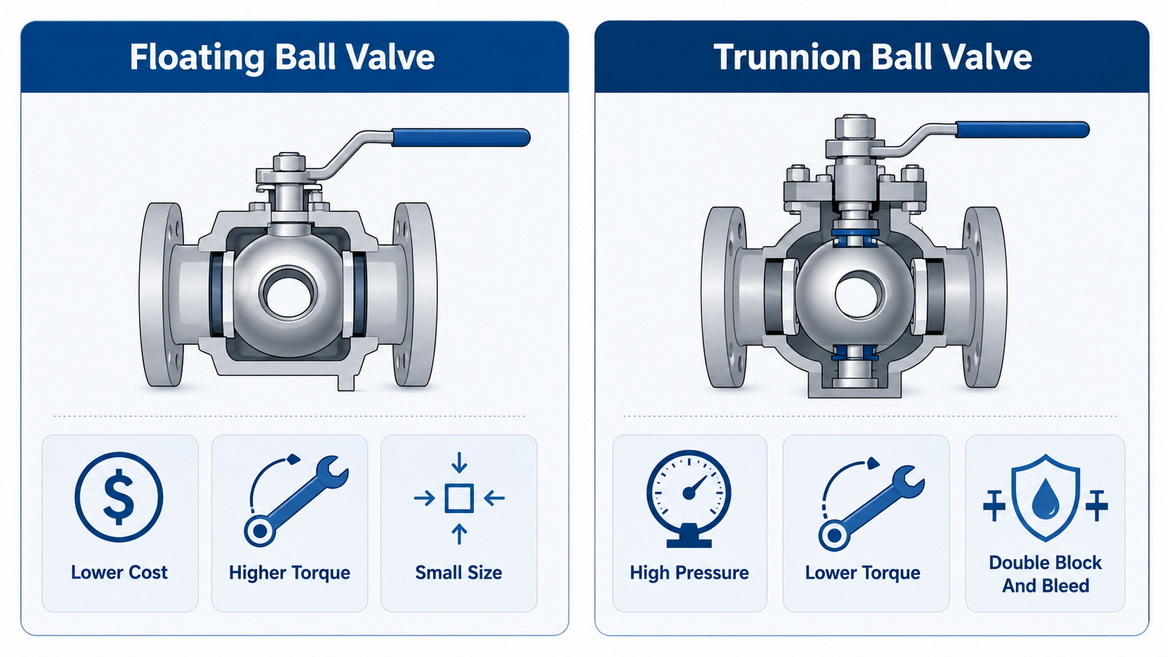
Floating vs Trunnion Ball Valve: Side‑by‑Side Comparison
To make real‑world specification easier, the table below consolidates the most important selection criteria.
| Parameter | Floating Ball Valvefitok+1 | Trunnion Ball Valvefitok+1 |
|---|---|---|
| Ball support | Free‑floating, held by seats | Fixed on upper and lower trunnion bearings |
| Sealing principle | Ball presses against downstream seat with line pressure | Spring‑loaded seats press inward against fixed ball |
| Pressure range | Low to medium pressure | Low to very high pressure, including pipeline service |
| Typical size range | ~½″ to 8″–10″ | 4″ to 60″+ |
| Operating torque | Increases sharply with pressure and size | Lower, more stable across pressure range |
| Double block and bleed | Generally not available | Common, especially to API 6D |
| Cavity pressure relief | Rarely required | Required (self‑relieving seat or external relief) |
| Structure complexity | Simple, fewer components | More complex, floating seats and bearings |
| Typical standards | API 608 | API 6D, API 608 |
| Relative cost | Lower purchase price | Higher purchase price, lower TCO in high‑pressure service |
| Typical applications | Utility, process isolation, small‑bore piping | Pipelines, high‑pressure gas, subsea, DBB isolation |
How Industry Engineers Actually Choose Between Floating and Trunnion Designs
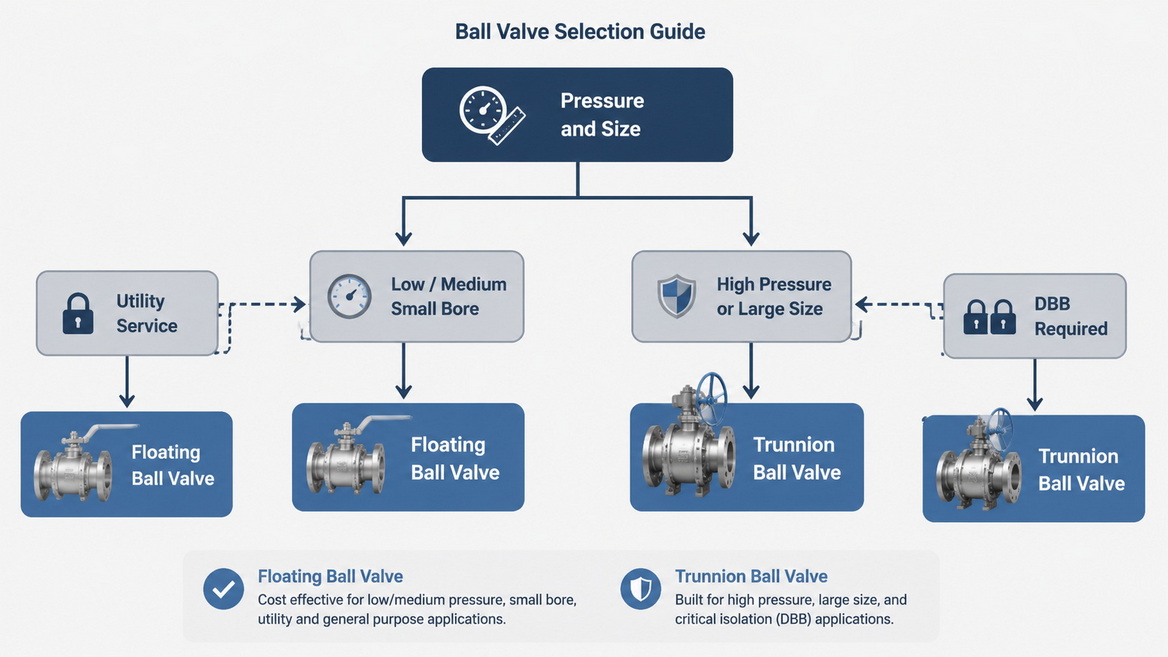
From my experience supporting OEM and ODM valve projects, the decision framework engineers use is straightforward but powerful:
1. Define pressure and size
- If your line is small‑bore and ≤Class 300, a floating valve is usually sufficient. - Above roughly 8″ at Class 300, trunnion becomes the safer and more practical choice.
2. Check DBB and isolation requirements
- If specifications mention double block and bleed, trunnion is almost always required.
3. Consider actuator sizing and automation
- For automated high‑pressure lines, a trunnion design helps control torque and actuator cost.
4. Balance capital cost vs lifecycle cost
- Floating valves save money upfront; trunnion valves can reduce unplanned downtime, maintenance, and actuator oversizing. This step‑by‑step approach is exactly what many EPC and pipeline engineers use in specification reviews and HAZOP workshops.
Expert Tips to Avoid Common Selection Mistakes
Based on industry case studies and manufacturer guidance, here are practical tips you can apply immediately:
- Do not oversize floating ball valves in high‑pressure service; excessive torque and seat wear will shorten valve life.
- Always verify standards (API 6D vs API 608) in pipeline projects to confirm whether a floating design is even allowable.
- When specifying trunnion valves, include cavity pressure relief requirements explicitly in the datasheet.
- For general plant utility and non‑critical isolation, choose floating ball valves to optimize cost and maintenance simplicity.
Following these guidelines helps prevent the "right valve in the wrong service" problem that often shows up only after commissioning.
Clear Call to Action (CTA)
If you are planning a new pipeline, upgrading existing process lines, or standardizing specifications across multiple plants, choosing the right ball valve design will directly impact safety, performance, and lifecycle cost.
Talk to our engineering team today to review your pressure class, size range, and isolation requirements. We can help you select and customize floating or trunnion ball valves to meet API standards, torque limits, and DBB needs—while optimizing total cost of ownership.
Frequently Asked Questions (FAQ)
Q1. When should I choose a floating ball valve instead of a trunnion ball valve?
A floating ball valve is ideal for low‑ to medium‑pressure, small‑bore lines where cost, simplicity, and ease of maintenance are the top priorities and DBB is not required.
Q2. Why do trunnion ball valves require cavity pressure relief?
Because the ball is fixed and both seats can seal, fluid trapped in the body cavity can expand with temperature, increasing pressure; dedicated cavity pressure relief prevents overpressure and potential damage.
Q3. Are trunnion ball valves always more reliable than floating ball valves?
Trunnion ball valves are more suitable for high‑pressure, large‑diameter, and DBB applications, but properly specified floating ball valves are highly reliable in low‑ to medium‑pressure service.
Q4. How does valve type affect actuator sizing?
Floating ball valves typically require higher torque as pressure and size increase, leading to larger actuators; trunnion valves keep torque lower and more predictable, which can reduce actuator size and cost.
Q5. Can a single plant use both floating and trunnion ball valves?
Yes. Many plants use floating ball valves for general process isolation and trunnion ball valves for critical pipelines, high‑pressure gas lines, and DBB points, optimizing performance and budget.
Hot Tags: Floating Ball Valve、Trunnion Ball Valve, Manufacturers, Customized, Custom, Suppliers, Buy, Cheap, Quality, Advanced, Durable, in Stock, Free Sample, Made in China, Price, Quotation